How to do a local competitor analysis of your whole market
One business audited alone cannot tell you why it loses. How to analyse the five to ten rivals that keep winning the searches and AI answers, and plan the quarter.
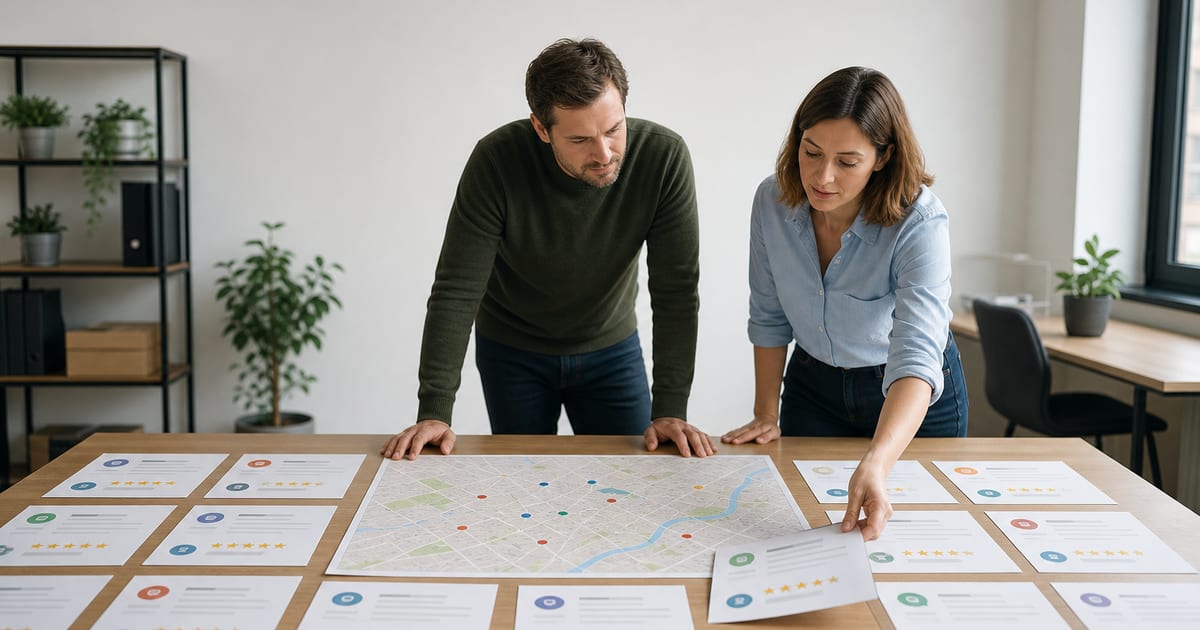
A local competitor analysis compares your business with the five to ten rivals that keep appearing when customers search, in the Google map pack and in AI answers, rather than auditing your own profile on its own. You list who shows up, compare their profiles, reviews, and presence beyond Google field by field, then turn the gaps into a plan for the next quarter. This guide sets out the method in six steps, says which checks you make yourself, and says which part our reports cover.
Why a local competitor analysis looks at the whole market
Local results rank businesses against each other, so an audit of one business cannot tell you why you lose. Google's help page on local ranking says local results rest on relevance, distance, and prominence, that more reviews and positive ratings can help, and that prominence also draws on how many websites link to your business. A complete profile can still lose to a rival whose reviews and links are stronger.
In the US, the space at the top is also getting smaller. Sterling Sky's 2026 analysis of 322 US markets found Google's AI local packs surfaced about 32% as many unique businesses as regular three-packs, with fewer businesses visible in 88% of markets. That is US vendor data: Sterling Sky says it had seen these packs only on mobile and only in the USA, on about 7% of the keywords it tracks, so check whether they appear for your searches at all. AI assistants answer with a short list too.
UK customers use both. Yext's 2026 survey of 600 UK consumers found 36.7% had used AI for local search in the past month. Its interactive report gives 38%, the lowest of its five markets. And 49% search Google or Bing to check an AI recommendation. It is a vendor survey with a small UK sample, but it points one way: you need to be on the assistant's list and on the list people check it against.
Step 1: list who actually shows up
Your competitors for getting found are the businesses that appear for your customers' searches, which are not always the ones you think of as rivals.
- Write down three to five searches in your customers' words, such as "emergency plumber" and "boiler service near me".
- Run each one from the nine points of a 3x3 grid across your catchment, signed out, and record the top three map results at each point and whether an AI local pack appears. The method is in how to rank in surrounding towns.
- Ask the same questions in ChatGPT, Gemini, Google's AI Mode, Microsoft Copilot, and Perplexity, three runs each in a new chat, using the sheet from how to check if ChatGPT recommends your business.
- Keep the five to ten businesses that keep appearing, and mark each one: in both, Maps only, or AI answers only.
The businesses in both lists are your benchmark. The ones named only by assistants show you what those assistants read beyond Google.
Step 2: compare their profiles, field by field
Open each rival's Google Business Profile beside yours and record the same fields for every business in one table. Gaps that several winners share matter more than any one rival's quirks.
| Field | Where to see it | What to note |
|---|---|---|
| Primary category | Under the business name on the listing | Same as yours, or more specific |
| Services | The profile's services section, where shown | Services they list that you offer but do not list |
| Hours | Opening hours, including evenings, weekends, and bank holidays | Open when you are closed |
| Attributes | Listed on the profile, such as wheelchair access | Any that apply to you too |
| Photos | The photos section | How many, how recent, and whether real or stock |
| Website link | The website button | Home page or a matching service page |
| Address | Shown, or hidden behind a service area | Whether customers can visit |
Additional categories are not shown on a listing, so leave that column out unless you trust a tool that reads them. For what each field does, see how to choose Google Business Profile categories. To read one rival in depth, see why a competitor with fewer reviews ranks higher.
Check, too, whether each business's name, address, and phone number (NAP) match between its website and its profile. In Whitespark's 2026 survey of local search experts, that website-to-profile match ranks 15th for local pack and Maps rankings, consistency across key directories 63rd, and the quantity of directory listings 110th. That is expert opinion, not Google's weighting, and it suggests directory listings are upkeep rather than a lever for the map pack. For AI search, the same report says three of the top five factors are citation factors, such as best-of lists and press mentions.
Step 3: compare their reviews, briefly
For each business on your list, note four figures: review count, average rating, reviews per month over the past year, and the share of reviews with an owner's reply. Google names count and score as ranking inputs, but pace and replies show which businesses are active now. Keep this step short: the full method for benchmarking a market by its reviews is on our blog.
Step 4: compare what searchers read about each
Customers choose from the words they see under each listing, so read every rival's listing as a customer would. The snippets under a map pack listing that quote review text, with the search words in bold, are a form of what practitioners call local justifications. These come from the business's Google reviews, so customers' own wording shapes them, and they are not always flattering, according to Search Engine Land's look at local justifications, which rests on one practitioner's informal checks.
Note each business's snippets for your main searches and any review summary Google shows on its profile, covered in what replaced Google Business Profile Q&A. Then list the themes customers praise and the complaints that recur. A complaint no business in your market has fixed, such as late arrivals or slow quotes, is an opening if you can genuinely do better.
Step 5: compare their presence beyond Google
Assistants and Google both read the wider web, so record what each business has outside its profile:
- Website: a real page for each main service and each area served, not copies with the town name changed.
- Crawler access: whether the site's robots.txt file blocks OAI-SearchBot, OpenAI's search crawler. How to get recommended by ChatGPT explains the check.
- Other maps: a claimed listing on Bing Places and on Apple Maps.
- Review sites: Trustpilot, Checkatrade, or your sector's own directory.
- Mentions: local press, community sites, sponsorships, and trade bodies. Search each name in quotes and exclude its own site to see them.
Mentions may matter more than they look. An analysis of 75,000 brands by Ahrefs, an SEO software vendor, found branded web mentions had the strongest correlation with visibility in Google's AI Overviews (0.664), with link metrics weaker. Ahrefs notes that is a correlation, not an experiment.
Step 6: turn the gaps into a quarterly plan
Rank each gap by two questions: do the businesses that keep appearing have it in common, and how cheap is it to close? Shared and cheap goes first. Then spread the work across three months:
- Month one: profile fields, categories, services, and hours, including bank holidays.
- Month two: website service and area pages, and crawler access.
- Month three: Bing and Apple listings, a repeat of the AI hand check, and a fresh read of review themes.
Give every task one owner and every change one date, so the monthly routine in is my Google Business Profile working? can show what moved. Then run the whole local competitor analysis again next quarter, from the same grid points and with the same searches. If you drop out of the pack mid-quarter, see what to check first.
Where reviews fit, and what our reports cover
Reviews run through steps 3 and 4: the words customers write become the snippets searchers read under each listing and part of what assistants can read when they name businesses. That review layer is what a Rate My Ratings market report covers for a category and town: ratings, review counts, and share of positive reviews side by side, with the themes customers raise across the market.
Steps 1, 2, and 5 are your own checks, as are the pace and reply figures in step 3. Our reports contain no ranking, search, or AI visibility data, and they do not diagnose why a business ranks where it does.
What to do this week
- Write down three to five searches in your customers' words.
- Run them from your nine grid points and in at least two assistants, and list every business that appears.
- Build the profile table for the five to ten that keep appearing.
- Note the four review figures for each, and read their snippets.
- Choose the three cheapest gaps the winners share, and give each an owner and a date.
A local competitor analysis done this way takes an afternoon the first time and less each quarter after, because the searches, grid points, and table stay the same.
Frequently asked questions
- What should a local competitor analysis include?
It should cover who appears for your customers' searches in the map pack and in AI answers, how their Google profiles compare with yours field by field, and their reviews. It should also look at what searchers read about each business and their presence beyond Google, such as their website, other listings, and local mentions. It ends with a ranked list of gaps to close.
- Which competitors should I include?
Include the five to ten businesses that keep appearing when customers search for your services from different parts of your area, and in AI assistants' answers. These may not be the businesses you think of as rivals. A business you never see on the high street can still win most of your searches.
- How often should I review my local market?
Once a quarter is a sensible rhythm for the full analysis, with a short monthly check of your own figures in between. A quarter gives changes to profiles and websites time to show. Run it sooner if you suddenly drop out of the map pack or a new rival appears.
- Can I do this without paid tools?
Yes. Searching from several postcodes while logged out, reading each rival's listing, asking the assistants your customers use, and keeping the results in a spreadsheet covers most of it. Paid rank tracking tools save time on the searches, but the comparison and the plan are judgement you make yourself.
- Which part of the analysis does a Rate My Ratings report cover?
A Rate My Ratings report covers the review layer for a category and town: ratings, review counts, share of positive reviews, and the themes customers praise or complain about. It contains no ranking, search, or AI visibility data. Who shows up, how profiles compare, review pace and reply rates, and presence beyond Google are checks you make yourself.

Rate My RatingsNewsletter
What reviews say about local markets, in your inbox.
New articles and findings from the blog, as they're published.
Check your inbox.
If this address isn't subscribed yet, we've sent it a link to confirm. Nothing is sent until you click it.
That didn't go through. Check the email address and try again.
Hold on a moment, then subscribe again.
Rate My RatingsNewsletter
What reviews say about local markets, in your inbox.
New articles and findings from the blog, as they're published.
Check your inbox.
If this address isn't subscribed yet, we've sent it a link to confirm. Nothing is sent until you click it.
That didn't go through. Check the email address and try again.
Hold on a moment, then subscribe again.