Why does a competitor with fewer reviews rank higher?
More reviews, lower in the map pack? Proximity, category, the rival's name, opening hours, or recent reviews may explain it. Here is how to tell which.
When you see a competitor with fewer reviews rank higher on Google Maps, the cause is often something other than reviews. Google's guide to local ranking says local results rest mainly on relevance, distance, and prominence, and review count feeds only the last of those. Often the rival is closer to the searcher, has a sharper primary category, carries a keyword in its business name, or is open when you are closed. Where reviews do play a part, the evidence points to a steady flow of recent text reviews rather than a large old total.
Why can a competitor with fewer reviews rank higher?
Because reviews are one input, not the scoreboard. Google says prominence is based partly on how many reviews you have, and that more reviews and positive ratings can help a business's local ranking, but it publishes no weights for any of its three factors.
- Relevance: how well the profile matches the search.
- Distance: how far the business is from the customer searching.
- Prominence: how well known it is, from information such as reviews and links to the business.
Relevance and distance can settle the order before prominence has much to separate. A rival that wins on the first two can sit above you with a fraction of your reviews.
Work through the checks below in order. The table is the short version.
| Check | How to see it | What it tells you |
|---|---|---|
| Where you searched from | Repeat the search from a customer's area | Whether distance explains it |
| Their primary category | The category under their name on Maps | Whether they match the search better |
| Their business name | Compare with their storefront and website | Whether a keyword is helping them |
| Opening hours | Search at the time customers do | Whether you are shown as closed |
| Recent reviews | Dates of the last few reviews on each listing | Whether they are collecting faster |
Check where you are searching from
Start here, because distance changes the whole order. Google describes distance as how far each business is from the customer searching, and Google Maps Help adds that a business farther away can still rank higher if Google judges it more likely to have what the searcher wants.
Take a plumber in Leeds who checks from their own yard and sees themselves first, while a customer a few miles across the city sees a rival at the top. Neither view is wrong. Search from a phone, signed out, in the areas your customers live before you compare anything else.
Typing a postcode or district into the search is a rough stand-in, not something Google's help page describes, and it may not match what someone standing there sees. Use both where you can. If you appear near your premises and nowhere else, our guide to a business not showing up on Google Maps works through distance in more detail.
Compare primary categories
The primary category is the first thing to compare once distance is ruled out. Whitespark's 2026 Local Search Ranking Factors report, published on 6 November 2025, surveyed 47 local search practitioners on 187 factors. Its local pack and Maps list puts primary category first, proximity to the search point second, and keywords in the business title third.
That is expert opinion, not a measurement of Google, but it matches what owners see. On a rival's Maps listing, the category shown under the name is normally the primary one. If theirs is narrower and closer to the search than yours, as "Nail salon" is to "Salon" in Google's own example, they are the more precise match. Our guide to Google Business Profile categories explains how to choose yours.
Look at the name on their profile
Suppose a rival's name on Maps reads like a list of services, "Smith Plumbing Leeds Emergency Boiler Repair", while their van says "Smith Plumbing". The extra words are probably helping them. Whitespark's study of more than 1.4 million listings across 17 industries found listings with keywords in the business title reached the local pack top three far more often. The finding is correlational.
It is also against the rules. Google's guidelines say the name must reflect the real-world name on your storefront, website, and stationery, and that adding unnecessary information could lead to suspension. Enforcement is uneven: Sterling Sky's December 2020 study of 50 listings, mostly in the legal sector, found Google let a business add keywords back as many as eight times after removal without taking action, while others were suspended after one report.
So do not copy it. Open their listing, choose "Suggest an edit", and change the name to the one on their storefront or website. Your own profile is not worth the risk.
Are they open when you are closed?
An evening or weekend search can go to whoever is open. Practitioners have reported since 2023 that a business closed at the time of the search can rank lower, though Google has not documented it. Whitespark's 2026 survey ranks "open at time of search" 5th among local pack factors, again as expert opinion.
If the rival only beats you after 6pm, or on bank holidays, compare your hours with theirs before anything else.
Do recent reviews matter more than the total?
The ranking evidence favours pace and recency over a large old total, though none of it comes from Google, and the larger studies are US data.
- In a small 2025 test, Sterling Sky saw a modest Maps gain when businesses went from 9 to 10 Google reviews, and no comparable gain from 10 to 11.
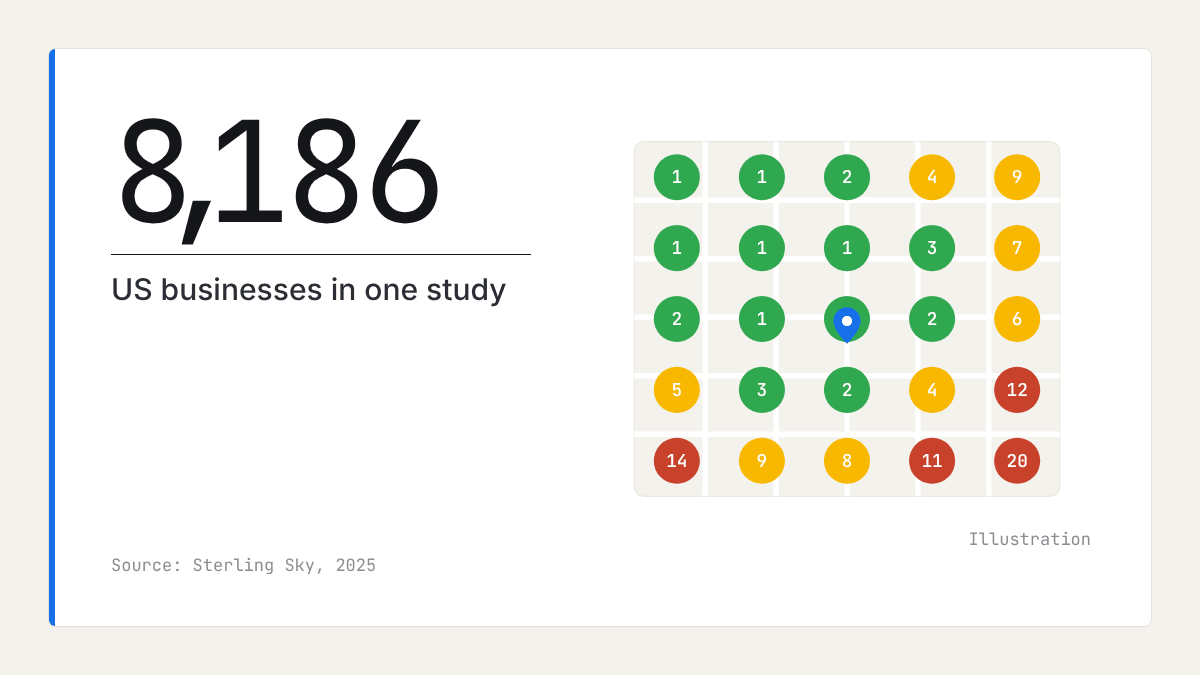
- In a study of 8,186 businesses across 200 US cities, covering "near me" searches in five home-service trades, Sterling Sky and Places Scout found reviews received in the current month mattered more than total review count, and text reviews more than star-only ones. Correlational.
- Whitespark's 2026 survey ranked review recency 11th. In May 2025, when its 2023 survey had it 20th, Whitespark's Darren Shaw put it in his own top five, citing a Sterling Sky case study in which rankings rose and fell with new reviews.
Customers look at dates too. BrightLocal's Local Consumer Review Survey 2026, of 1,002 US adults, found 74% look for reviews written in the last three months. That measures behaviour, not ranking. For how many reviews to aim for and how to ask, see the review guides on our blog.
Where reviews fit: compare the market, not one rival
Seeing a competitor with fewer reviews rank higher for one search, from one spot, is an anecdote. The useful question is how you compare with every business in your category and town, on the review side and on the listing side.
On reviews, compare totals, monthly pace, how recent the latest reviews are, whether they carry text, and how often owners reply. The words customers use matter as well: when reviews describe a same-evening call-out or a boiler fitting, those are the descriptions the next searcher reads. Our market reports set out review count, rating, and share of positive reviews for the businesses in a category and town, side by side, with the themes customers raise across the market. They hold no ranking data: category, distance, and hours are checks you make on the listings themselves.
For the full method, see our guide to a local competitor analysis of your whole market. To see how your position changes across town, try the manual grid in how to rank in surrounding towns. If the rival has pushed you out of the top three altogether, read dropped out of the Google map pack.
What to do this week
- Repeat the search from two or three customer areas on a phone, signed out, and note who appears where.
- Compare primary categories. Change yours if a more specific one describes your core service, knowing Google says you might be asked to verify again.
- Tick the suggested services that match what you do.
- Correct your hours, including special hours for bank holidays.
- Make sure your website shows the same name, address, phone number, and hours as the profile.
- If a rival's name breaks Google's guidelines, suggest an edit with the real-world name.
- Ask every customer you serve this month for a review, so reviews arrive steadily rather than in one push. Offer nothing in return: Google's policies forbid incentives.
Then repeat step 1 in a month, from the same places, and compare.
Frequently asked questions
- Why does a business with fewer Google reviews rank above mine?
Review count is only one part of prominence, which is one of the three factors Google names alongside relevance and distance. The rival is often closer to the person searching, has a more precise primary category, has a keyword in its business name, is open when you are closed, or is collecting reviews more steadily than you.
- Do more Google reviews always mean a higher ranking?
No. Google says more reviews and positive ratings can help local ranking, but it does not say they outweigh relevance or distance, and it publishes no weights. One small practitioner test found a modest gain at ten reviews and none from ten to eleven, and a larger US study of "near me" trade searches suggests a steady flow of recent reviews counts for more.
- Does review recency matter more than total reviews for ranking?
The evidence points that way, although none of it comes from Google. A large US study by Sterling Sky of "near me" trade searches found reviews received in the current month mattered more than the total count, and Whitespark's Darren Shaw points to a Sterling Sky case study in which rankings rose and fell with new reviews. Neither is proof of cause.
- Is it allowed to put keywords in my Google business name?
Not unless the keyword is part of your real-world name as used on your storefront, website, and stationery. Google's guidelines say adding unnecessary information to the name can lead to the profile being suspended. Some stuffed names survive for a long time, but that is inconsistent enforcement, not permission.
- What can I do about a competitor with a keyword-stuffed name?
Open their listing on Google Maps, choose Suggest an edit, and change the name to the one on their storefront or website. Keep a screenshot of the evidence in case you need to follow it up. Do not copy the tactic, because your own profile is then the one at risk of suspension.

Rate My RatingsNewsletter
What reviews say about local markets, in your inbox.
New articles and findings from the blog, as they're published.
Check your inbox.
If this address isn't subscribed yet, we've sent it a link to confirm. Nothing is sent until you click it.
That didn't go through. Check the email address and try again.
Hold on a moment, then subscribe again.