Dropped out of the Google map pack? What to check first
In the top three last week, gone today? Confirm the drop is real, then work through edits, hours, rivals, and changes to the results page, in that order.

If you have dropped out of the Google map pack, check five things in this order before you change anything: whether the drop is real, whether anyone has edited the profile, whether Google thinks you are closed when people search, whether a rival has gained ground, and whether the results page itself has changed. Confirming the drop comes first, because the map pack is different for every searcher's location, and an owner checking from the shop sees a different list from a customer two miles away.
This is a triage list, not a rebuild. If your business never appeared on Maps at all, start with why your business is not showing up on Google Maps instead.
First, confirm you really dropped out of the Google map pack
A real drop shows up from several places at once, not only from your own desk. Before you act, run the same searches from different points on the same day and write down what you see.
- Open a private browser window, or sign out of Google, so your own history does not shape the results.
- Search your main query, such as "dentist near me", and the service plus the town.
- Repeat from four or five postcodes around your catchment. Take a dental practice in Manchester: it would search from postcodes on each side of its catchment, not only from the surgery.
- Note where you appear in the pack and in the full Maps list for each point.
- Check whether your ordinary website listing has moved too. If only the pack has changed, the cause is more likely to be the profile.
If you appear from some points and not others, you may not have dropped at all; your reach may have narrowed. Our guide to ranking in surrounding towns covers that.
A fall in direction requests is not proof
Google filters repeated taps and cancelled requests out of the direction requests figure, so it can read lower than under the old count. Momentic dates the change to February 2023, so it only affects comparisons reaching back that far. On its own, a fall in that number is not proof of a drop, so check it against the searches above. Our guide to whether your Google Business Profile is working explains the change.
Did you, or someone else, edit the profile?
Recent edits are a cause you can fix yourself, so check them before anything else. Look at the business name, the primary category, and the address.
Google's guidelines for representing your business say the name must reflect the real-world name used on your storefront, website, and stationery, that adding unnecessary information could lead to suspension, and that categories should not be used solely as keywords. A name that has gained a town or a service, or a category swapped for a broader one, is the first thing to undo. Google warns that editing a category might mean verifying the business again, so allow for that.
Edits do not always come from you. Members of the public can suggest changes to a profile on Maps, and staff or a former agency may still have access. Check the profile's managers as well as its fields.
Other changes worth checking
A few quieter changes can have the same effect as an edit to the name:
- The map pin has moved, or the address now sits in a different town.
- A second profile exists for the same business, perhaps created by a former owner or agency.
- The website link points to a page that has moved or been removed.
- A rival has added a town or service to its own name. You can suggest an edit to its profile on Maps, as anyone can.
If the profile has vanished altogether rather than slipped, it may have been suspended. Google's page on fixing suspended or disabled profiles explains the appeals tool, which shows the reason for a decision, and the evidence to send. It also says you can appeal only once, so follow the guidelines first.
Are you closed when people search?
Your opening hours can decide whether you appear at all. Sterling Sky reported in December 2023 that Google appears to weigh whether a business is open at the time of the search, so a business that is closed when someone searches can rank lower. Google has not documented this, but Whitespark's 2026 expert survey separately ranks being open at the time of search fifth among local pack factors.
Check the hours themselves, any special hours left over from a bank holiday, and whether the profile was set to temporarily closed and never reopened.
Did a competitor gain ground?
Sometimes nothing changed on your side; a rival moved past you. One sign is a competitor with a recent run of new reviews.
Sterling Sky and Places Scout analysed 8,186 businesses in 200 US cities for "near me" searches in five home-service trades and found that reviews received this month mattered more than total review count, with text reviews stronger than star-only ones. They also found a negative correlation between hiding the address and ranking. That is US, correlational data, limited to those searches. In May 2025, when its 2023 survey ranked review recency 20th, Whitespark's Darren Shaw argued it was underrated, citing a Sterling Sky case study in which rankings rose and fell with new reviews, and put it in his own top five. Whitespark's 2026 survey ranks it 11th.
Open the businesses now above you and look at the dates of their latest reviews. Our article on why a competitor with fewer reviews can rank higher explains the mechanism.
Has the results page itself changed?
On some US searches the page no longer shows a classic three-business pack. Google's AI local packs show one or two businesses instead of three, with no call button, and ads now appear in more packs. Sterling Sky says AI packs appear only on mobile so far and that it has seen them only in the USA, so they may not explain a UK drop. All of the measurements below are US vendor data, and they disagree.
| Source | Finding | What it measures |
|---|---|---|
| Sterling Sky, 2026 | About 32% as many unique businesses; AI packs on about 7% of keywords | Distinct businesses across 322 markets |
| The Answer Engine, citing Sterling Sky | Pack ads in about 22% of reports by January 2026, from 1% at the start of 2025 | Tracked mobile reports |
| WordStream, citing Sterling Sky | About 22% of queries show an AI pack | Tracked local queries |
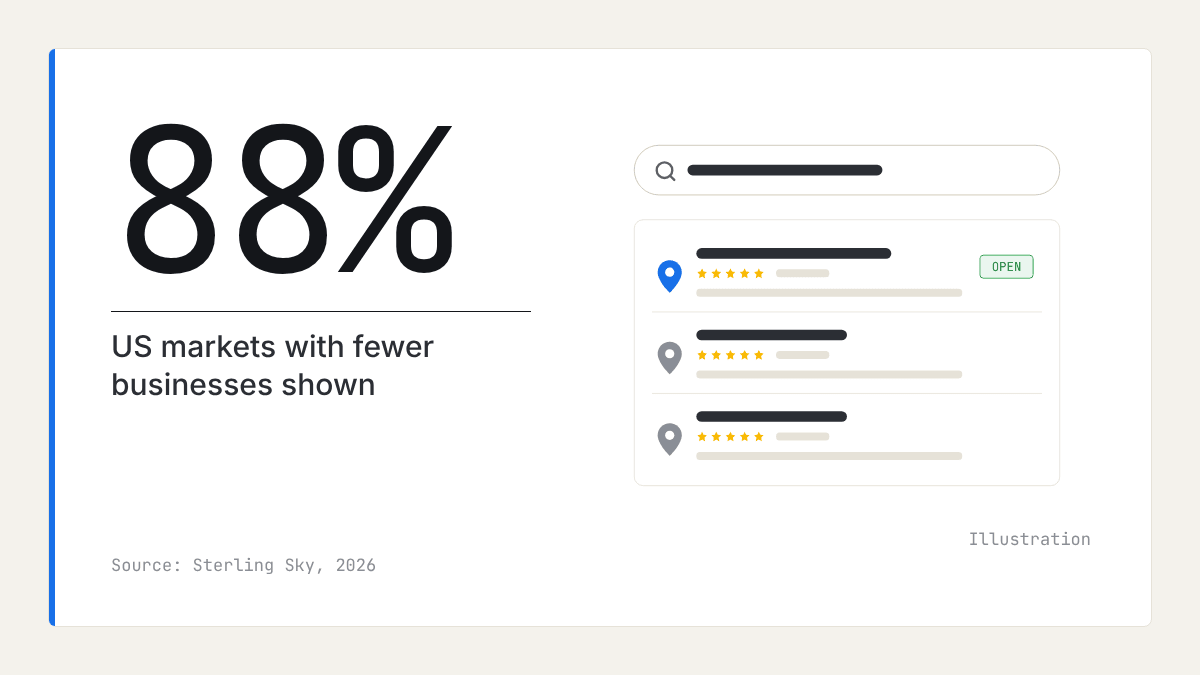
The 32% counts distinct businesses across all searches, and fewer businesses were visible in 88% of markets. The "68% fewer businesses" figure seen elsewhere restates the same ratio; it is not a count per pack. WordStream's 22% matches the ads figure in the same data, so treat it as a disagreement between published estimates, not a settled rate.
In the UK, Ofcom's Online Nation 2025 report cites YouGov research finding that 53% of UK people say they often see AI summaries. Our guide to showing up in Google AI Overviews covers those answers.
Where reviews fit
A rival's recent run of reviews is one of the causes you cannot see from your own profile, so open their listing, sort their reviews by newest, and count the past few months. Our market reports add the wider view of a category and town: each business's rating, review count, and share of positive reviews, and what customers praise and complain about across the market. The reports do not track map rankings or diagnose why a business ranks. More on collecting and replying to reviews is on our blog.
What to do this week
Work through the fixes in this order, one at a time, and record the date of each.
- Record your position for three searches from four or five postcodes, signed out.
- Undo any recent change to the name, primary category, or address.
- Check Google's appeals tool for a suspension and, if there is one, fix the cause and appeal once, with evidence.
- Correct the opening hours, special hours, and any temporary closure.
- Keep asking every customer for a review, so new ones keep arriving.
- Wait two to four weeks, then run the same searches from the same points before judging.
Notice sooner next time
The owners who recover fastest are the ones who notice first. Set a fixed weekly check: the same searches, from the same postcodes, on the same day. Add the monthly numbers in the performance report, which our guide to whether your Google Business Profile is working explains. If you dropped out of the Google map pack again, you would know within a week, with a record of what changed.
Frequently asked questions
- Why has my business disappeared from the Google map pack overnight?
Start by checking that it has. The map pack changes with where the searcher stands, so search from several postcodes, signed out, on the same day. If the drop is real, the usual causes are a recent edit to the profile, a guideline problem or suspension, hours that show you as closed, a rival's recent run of reviews, or a change to the results page itself.
- Why did my listing disappear after I changed the business name?
Google's guidelines say the name must match the one used on your storefront, website, and stationery, and that adding unnecessary information could lead to suspension. A name change that adds a town or a service is the first edit to undo. Put the real name back and check the profile for a notice from Google.
- How do I know if my Google Business Profile has been suspended?
Google's appeals tool shows any decision on your profile, with its date and reason. A suspended profile may vanish from Maps altogether rather than slip a few places. Google's help centre explains how to appeal and what evidence to send, and says an appeal can be submitted only once.
- Can a competitor's new reviews push me out of the map pack?
They can contribute. A large US study by Sterling Sky and Places Scout, of "near me" searches in five home-service trades, found that reviews received in the current month mattered more than a business's total review count. A rival who has collected a steady run of new reviews while yours have slowed can move past you even with fewer reviews overall.
- Are AI results replacing the Google map pack?
Not replacing it, but changing it on some searches. In US tracking, Google's AI local packs show one or two businesses instead of three and have no call button, and published estimates of how often they appear differ widely. Sterling Sky says it has seen them only in the USA and only on mobile, and we know of no equivalent UK measurements.
- How long does it take to get back into the map pack?
Nobody can promise a timescale, and Google does not publish one. After you have undone edits and fixed hours or guideline problems, give the change two to four weeks before judging it, and track the same searches from the same places each week.

Rate My RatingsNewsletter
What reviews say about local markets, in your inbox.
New articles and findings from the blog, as they're published.
Check your inbox.
If this address isn't subscribed yet, we've sent it a link to confirm. Nothing is sent until you click it.
That didn't go through. Check the email address and try again.
Hold on a moment, then subscribe again.