What Information Do Customers Actually Look for in Reviews?
The star average gets customers to your page; the words decide whether they book. What readers check in reviews, in the order they check it, and what that means for your business.
What customers look for in reviews is evidence about their own situation: how recent the reviews are, whether the problems people describe would affect them, how the business treats people, and specific detail that proves a reviewer really was a customer. The star average gets them to the page; the words decide whether they book.
That matters for businesses, because it means the content of your reviews does more work than the number on top. Below we set out what readers check, in roughly the order they check it, using consumer research and our own analysis of 524,000 recent Google reviews of local businesses in the UK and Australia.
The star rating is a filter, not a decision
Most people use the headline rating to decide which businesses to look at, not which one to choose. In BrightLocal's 2026 Local Consumer Review Survey, 68% of consumers said they need at least four stars before they will use a business, and 31% want 4.5 or more. Yet only 10% insist on five stars.
Once a business clears that bar, readers move on to the reviews themselves. Northwestern University's Spiegel Research Center found that purchase likelihood typically peaks between 4.0 and 4.7 stars and falls as ratings approach a perfect 5.0, because flawless scores can look too good to be true. People are not looking for perfection; they are looking for believability.
What customers look for in reviews, in the order they look
1. Recency
The first thing many readers check is the date. BrightLocal found that 74% of consumers only care about reviews written in the last three months, and 32% look for reviews from the last two weeks. A glowing review from 2021 says little about who answers the phone today.
For a business, this means a steady flow of new reviews matters more than a big total built up years ago. Our guide to getting more Google reviews without asking constantly covers how to keep that flow going.
2. The negative reviews
Readers go looking for the worst reviews on purpose. They want to know what goes wrong when things go wrong, and whether it would matter to them. Unhappy reviewers make that easy: in our data, the median one-star review with text runs to 74 words, against 27 for a five-star review.
The question the reader is asking is not "are there bad reviews?" but "are these bad reviews about something I care about?". A complaint about parking matters to some people and not others. A complaint about being misled on price matters to nearly everyone.
3. How the business replied
Owner replies are read almost as closely as the reviews. A reader sees a negative review, then reads the reply to judge how they would be treated if they were the unhappy customer. In our data, 53% of reviews get a reply from the business, but three-star reviews, which are often the most thoughtful, are answered least, at 42%.
4. Specific detail
Specifics are what make a review credible and useful. Readers look for named staff, the actual service or product, how long things took, what it cost and what happened when something went wrong. Detail is also what other readers reward: in our data, only 1.3% of reviews under 20 words received a single "helpful" vote, against 5.7% of reviews over 200 words.
5. People like them
Readers look for reviewers in their own situation: a first-time buyer, a nervous patient, a family with a dog that hates the car, a couple planning a small wedding. A review written by someone with the same worries is worth ten generic ones.
What reviews actually talk about
When we tag the themes in recent Google reviews, a clear pattern appears. Five-star reviews are mostly about people. Low ratings are mostly about process.
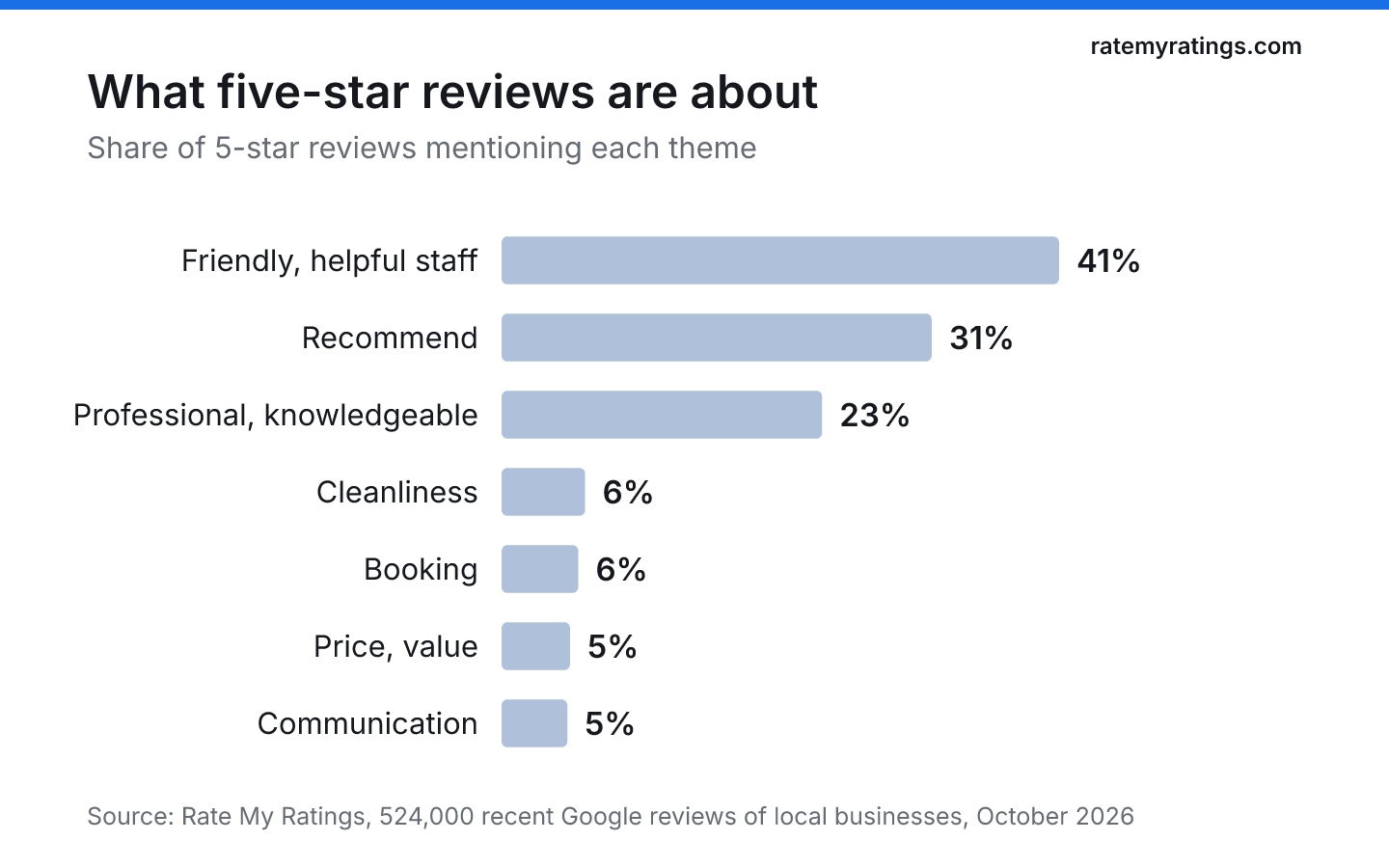
| Theme | Share of 1–2 star reviews | Share of 5 star reviews |
|---|---|---|
| Price, fees, quotes, value | 25% | 5% |
| Communication (calls, emails, no response) | 22% | 5% |
| Booking, appointments, cancellations | 22% | 6% |
| Waiting, lateness, delays | 18% | 4% |
| Rude or unprofessional staff | 17% | under 1% |
| Friendly, helpful, kind staff | 12% | 41% |
| Professional, knowledgeable, explained things | 9% | 23% |
These are keyword matches, so treat them as indicative rather than exact. But the shape is consistent across the categories we study. Customers praise kindness and competence, and they complain about surprises, silence and waiting. That tells a reader what to look for, and it tells a business what to protect.
What customers look for in reviews by type of business
What matters most shifts with the stakes.
- Healthcare (dentists, vets, physios): gentleness, explanation and trust. Nervous patients search for reviews from other nervous patients. Price transparency matters because treatment plans are hard to compare.
- Trades (electricians, roofers, plumbers): turning up on time, keeping to the quote and tidying up. A single review saying "the price went up halfway through" can outweigh many generic five-star ones.
- Events (wedding venues): how the team handled the day, flexibility and what was included. Readers look for reviews from couples with a similar size and budget.
- Hospitality: atmosphere, value and service speed, with photos weighing heavily.
How to find what matters on a Google profile quickly
Google's own tools make this faster than scrolling. On a Business Profile in Google Maps, open the reviews and:
- Sort by newest to check recency and see the business as it is now.
- Sort by lowest rating to read the critical reviews and the replies in one go.
- Use the search box or topic chips above the reviews to jump to mentions of the thing you care about, such as "parking", "price", "nervous" or "quote".
Two minutes of this tells most people more than the star average ever could, and it is exactly how your own prospective customers are reading your profile.
What readers ignore or distrust
- Vague superlatives. "Best ever, highly recommend!" is pleasant but weightless.
- Star-only ratings. 17% of the Google ratings we analysed have no text at all. They count towards the average but tell a reader nothing; see our explainer on Google reviews versus ratings.
- Suspicious clusters. A run of near-identical praise in one week makes careful readers more wary, not less. Our guide to spotting fake Google reviews covers the signs.
What this means if you run a business
You cannot write your customers' reviews, but you can shape what they are likely to mention.
- Ask at the right moment, when the good experience is fresh, so reviews are detailed and recent. See how to ask for Google reviews without being annoying.
- Make the thing you want to be known for memorable. If you explain every price before you start, customers mention it.
- Reply to the critical reviews well. For many readers, your reply is the most important review on the page.
- Read your reviews the way customers do, starting with the newest and the worst. Our guide to using customer reviews to improve your business turns that into a routine.
And read your competitors' reviews the same way. They show what your market values and where it is let down; our method for competitor analysis with Google reviews sets it out step by step, and our market reports do it across every business in a category and area.
The short version
- The star rating filters; the review text decides. Most people want four stars or more but distrust perfection.
- Readers check recency first, then the negative reviews, then the owner's replies, then specific detail and people like them.
- Five-star reviews are about people: friendliness and expertise. One- and two-star reviews are about process: price surprises, communication, booking and waiting.
- Longer, detailed reviews earn more trust and more helpful votes than short ones.
Frequently asked questions
- What do customers look for first in online reviews?
Usually the star rating, as a filter, then the date of the latest reviews. BrightLocal's 2026 survey found 68% of consumers want at least four stars and 74% only care about reviews from the last three months. After that, most readers go straight to the negative reviews and the business's replies to see what goes wrong and how it is handled.
- Do customers read negative reviews?
Yes, often deliberately. Negative reviews show what happens when things go wrong, and readers use them to judge whether the problems would affect them. They also tend to be the most detailed: in our data the median one-star review runs to 74 words, against 27 for a five-star review. A calm owner reply can neutralise much of the damage.
- Are longer reviews more helpful?
Readers seem to think so. In our analysis of 524,000 recent Google reviews, 5.7% of reviews longer than 200 words received at least one helpful vote, compared with 1.3% of reviews under 20 words and almost none of the star-only ratings. Detail makes a review credible and useful to someone in a similar situation.
- How recent do reviews need to be?
Recent enough to describe the business as it is now. In BrightLocal's 2026 survey, 74% of consumers said they only care about reviews from the past three months, and 32% look for reviews from the past two weeks. A steady flow of new reviews matters more than a large total collected years ago.

Rate My RatingsNewsletter
What reviews say about local markets, in your inbox.
New articles and findings from the blog, as they're published.
Check your inbox.
If this address isn't subscribed yet, we've sent it a link to confirm. Nothing is sent until you click it.
That didn't go through. Check the email address and try again.
Hold on a moment, then subscribe again.