How to Research Competitors Using Google Reviews
Your competitors' customers have already told you where they fall short. A step-by-step method for reading a whole local market's Google reviews, with a scorecard you can copy.
The fastest, cheapest way to understand your competitors is to read what their customers wrote about them. Every business near you has a public Google profile full of unprompted feedback: what people loved, what made them angry, what they paid and what they expected. It is the most honest form of competitor analysis. Google reviews show you where rivals are weak, what your market values and which promises you could own.
This guide sets out the method we use when we read whole local markets, scaled down so one person can do it in an afternoon with a spreadsheet. We have read more than half a million recent Google reviews across 130 local markets in the UK and Australia, and the same patterns turn up whether the market is vets, dentists, wedding venues or roofers.
Competitor analysis: Google reviews are the best free data you have
Most competitor research tells you what a business says about itself: its website, its prices, its adverts. Reviews tell you what customers experienced. That difference matters, because the gap between the promise and the experience is usually where the opportunity is.
Google reviews are also unusually complete for local businesses. In the 2026 edition of BrightLocal's Local Consumer Review Survey, Google was still the most used review source for local businesses, at 71% of consumers. In most UK and Australian service categories, Google holds far more reviews than any other platform, so it is where both your customers and your competitors' customers leave their verdicts.
Finally, reviews are written after people paid. Unlike a survey, nobody chose who to ask. That makes them a rough but honest census of what the market thinks.
What reviews can and cannot tell you
Before you start, be clear about the limits.
Reviews can tell you:
- What customers praise and complain about, in their own words
- Which competitors are growing (review volume over recent months)
- How each competitor handles criticism (owner replies)
- Which services, products or staff members get mentioned most
- Price perception: whether customers felt they got value
Reviews cannot tell you:
- Revenue, margins or customer numbers (review volume is only a rough proxy)
- What happened with customers who never wrote a review
- Whether a single review is true
So treat individual reviews as anecdotes and patterns as evidence. One furious review about a vet's out-of-hours fee is a story. Thirty of them across three practices is a market problem you can design around.
Step 1: Define your market the way customers do
Start by searching Google Maps for your category and area exactly as a customer would: "dentist near me", "wedding venue Cotswolds", "emergency electrician Leeds". The businesses that appear in the map results are your real competitors, whether or not you think of them that way.
Write down every business in the first two pages of results, plus any you know customers compare you with. For most local markets that is 10 to 30 businesses. Resist the urge to only study the two or three famous names; the most useful insight often comes from a small competitor with a surprisingly strong rating.
Step 2: Build a simple scorecard
For each competitor, record the basics from their Google profile in a spreadsheet:
| Column | What to record | Why it matters |
|---|---|---|
| Rating | The star average, to one decimal place | Headline reputation |
| Review count | Total number of reviews | Prominence and trust; Google says more reviews can help local ranking |
| Recent reviews | How many in the last three months | Momentum: who is busy now |
| Reply rate | Of the last 20 reviews, how many have an owner reply | How much they invest in reputation |
| Top praise | The two or three things happy customers mention most | What they are known for |
| Top complaint | The two or three recurring problems | Where they are weak |
| Price signal | Do customers call them expensive, fair or cheap? | Positioning |
Rating and review count together tell you more than either alone. In our data on 46,800 local businesses, 70% of businesses with fewer than 10 reviews have a perfect 5.0, while only 1% of businesses with 1,000 or more reviews do. A 4.6 from 600 reviews is a far stronger reputation than a 5.0 from eight. Our guide to what counts as a good Google rating explains how much this varies by category.
Context matters for counts too. The median vet practice we track has 154 Google reviews; the median electrician has seven. Compare competitors with each other, not with businesses in other trades.
Step 3: Read the reviews in the right order
You do not need to read every review. Read in this order and you will find the important patterns quickly:
- The most recent 20 to 30 reviews (sort by newest). This is the business as it is now, not as it was three years ago.
- Every one-, two- and three-star review from the last year. These are where the operational problems are described in detail.
- A sample of five-star reviews. Look for the specific things people name: a member of staff, a service, a feeling.
- The owner's replies to the critical reviews. They show how the business thinks.
Critical reviews are worth more of your time than praise. In the 524,000 recent Google reviews we analysed, the median one-star review with text runs to 74 words, against 27 for a five-star review. Unhappy customers explain themselves; happy ones often just say "great service".
Step 4: Tag the themes
As you read, tag each critical review with one or two themes. Keep the list short so patterns show. These categories cover most local service businesses:
- Price and value: surprise charges, quotes that changed, feeling overcharged
- Communication: calls not returned, no updates, emails ignored
- Booking and availability: hard to get an appointment, cancellations, no-shows by the business
- Waiting and delays: running late, jobs taking longer than promised
- Staff attitude: rude, dismissive or rushed
- Quality of the core work: the haircut, the repair, the treatment itself
- Cleanliness and premises
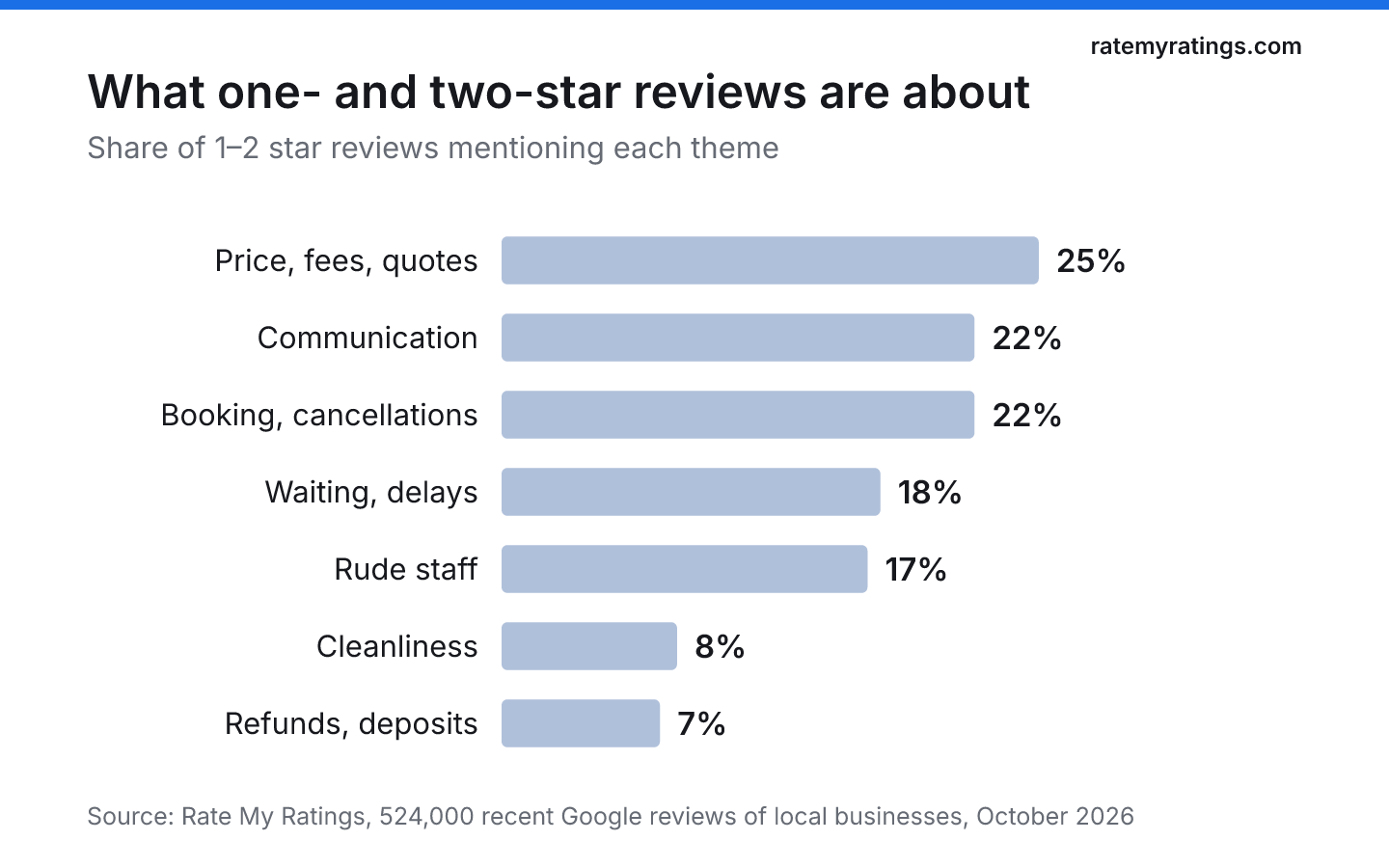
Across our data, the pattern is remarkably consistent: five-star reviews are mostly about people (41% mention friendly or helpful staff, 23% mention professionalism or expertise), while one- and two-star reviews are mostly about process. A quarter mention price or fees, and about one in five mention communication, booking problems or waiting. Customers rarely leave one star because the work was poor; they leave it because they felt ignored, surprised or kept waiting.
That is good news for you. Process problems are fixable, and they are exactly the gaps a competitor leaves open.
Step 5: Turn the scorecard into decisions
Once you have tagged 100 to 200 critical reviews across the market, count the themes per competitor and for the market as a whole. Three kinds of finding are worth acting on.
A weakness the whole market shares
If most competitors are criticised for the same thing, you have found a market-wide gap. Price surprises are a common example: they appear in a quarter of the one- and two-star reviews we analysed. If customers across your market keep complaining that they did not know the final price until the bill arrived, a business that publishes clear prices and quotes upfront answers the market's biggest grievance, and can say so in its marketing.
A strength one competitor owns
If one competitor is praised again and again for the same thing (a named nurse who is brilliant with nervous pets, same-day call-outs, free parking), that is their moat. Decide whether to match it or to compete on something else rather than drifting into a weaker copy.
A competitor in decline
A business whose recent reviews are noticeably worse than its overall rating is often going through change: new owners, staff turnover, overstretched capacity. Its customers are the ones most likely to be looking elsewhere right now.
Step 6: Read the owner replies
How competitors respond tells you about their culture and their priorities. In our data, 53% of reviews get a reply from the business, and replies come quickly: 48% within 24 hours. But middling reviews are answered least, with only 42% of three-star reviews getting a reply, even though they are often the most constructive.
Look for:
- Defensive replies that argue with customers. These businesses rarely fix underlying problems.
- Copy-and-paste replies to every review. Polite, but a sign nobody is reading closely.
- Specific, helpful replies that name a fix. This competitor is learning from feedback, and you should expect them to improve.
Our guide on how to respond to negative Google reviews covers what good looks like, if you want to compare your own replies.
Step 7: Check whether the reviews are trustworthy
Before drawing conclusions from a competitor's glowing rating, check it is real. Warning signs include a sudden burst of five-star reviews after a long quiet spell, many reviews from accounts with no other reviews, and vague praise that could describe any business. In our data, 17% of five-star reviews come from accounts that have only ever written one review, compared with 6% of three-star reviews. That alone proves nothing, as plenty of genuine customers only review once, but a profile where most praise comes from such accounts deserves scepticism. Our guide to spotting fake Google reviews goes through the signals in detail.
Do not respond to a suspicious competitor by posting reviews of your own. Google's prohibited and restricted content policy bars reviews written from a conflict of interest, which includes reviewing competitors, and fake reviews are now illegal under UK and US consumer law. You can report reviews that break the rules through Google instead.
Step 8: Repeat it, briefly, every quarter
A one-off analysis goes stale. Set a reminder to refresh your scorecard every three months: new review counts, recent rating, any new themes. It takes an hour once the spreadsheet exists, and it will show you when a competitor opens, slips or starts investing in reputation.
What to do with the findings
Competitor analysis is only useful if it changes something. The most common actions we see local businesses take after a market review are:
- Rewrite the website and Google profile around the strength customers value and competitors lack (clear pricing, fast response, a specialism).
- Fix one process that the market complains about before your own customers start to.
- Change how you ask for reviews, so your own profile reflects the strengths you want to be known for. Our guide to getting more Google reviews has a sustainable system.
- Brief the team with real quotes from competitor reviews. Nothing motivates a front desk like reading what customers said about the practice down the road.
For the internal side of the same exercise, see how to use customer reviews to improve your business.
When to do it yourself and when to get help
The manual method works well for markets of up to about 20 competitors. Beyond that, or if you want the whole market rather than a sample, reading becomes the bottleneck: a market of 40 vets can easily hold 10,000 reviews.
That is the work a Rate My Ratings market report does for you: it collects and reads the public reviews of every competing business in your category and area, then sets out the themes, the benchmark and the gaps. You can see what that looks like in a sample such as our report on vets in Greater Manchester.
The short version
- For competitor analysis, Google reviews are the best free source: read them as patterns, not anecdotes.
- Define competitors as customers do: whoever appears in Google Maps for your category and area.
- Record rating, review count, recent volume and reply rate for each; judge ratings by count and category, not alone.
- Read recent reviews and every critical one, and tag them by theme. One-star reviews are long and specific; that is where the insight is.
- Look for shared weaknesses, owned strengths and competitors in decline, then change one thing you offer or say.
- Refresh it every quarter, and never fight fake reviews with reviews of your own.
Frequently asked questions
- Is it legal to use competitors' Google reviews for research?
Yes. Google reviews are public, and reading them to understand a market is ordinary research. What you must not do is post reviews about competitors yourself, or pay anyone else to. Google's policies ban reviews written from a conflict of interest, and fake reviews are illegal in the UK, the US and Australia. When you quote reviews internally, leave out reviewers' names.
- How many competitor reviews do I need to read?
For a typical local market, reading the latest 20 to 30 reviews of each competitor plus every critical review from the past year gives you 100 to 200 reviews to tag, which is enough for clear patterns. Critical reviews carry more detail than praise, so they deserve more of your time. Beyond about 20 competitors, reading everything by hand becomes impractical.
- What should I look for in competitors' negative reviews?
Look for themes that repeat across reviews and across businesses: price surprises, poor communication, booking problems, delays and staff attitude are the most common. A weakness shared by most competitors is a gap you can fill. A weakness unique to one competitor tells you which of their customers may be ready to switch.
- How often should I update a competitor review analysis?
Every three months is enough for most local businesses. Refresh each competitor's rating, total reviews and number of recent reviews, and skim any new critical reviews for new themes. Quarterly checks catch new entrants, competitors in decline and rivals who start investing in their reputation, without turning the exercise into a chore.

Rate My RatingsNewsletter
What reviews say about local markets, in your inbox.
New articles and findings from the blog, as they're published.
Check your inbox.
If this address isn't subscribed yet, we've sent it a link to confirm. Nothing is sent until you click it.
That didn't go through. Check the email address and try again.
Hold on a moment, then subscribe again.