
What's a Good Google Review Rating and Does It Actually Matter?
For most local businesses a good Google rating now starts at 4.5, because three in four competitors already have one. Here is what good looks like in your category, and why review count changes everything.

A good Google rating for most local businesses today is 4.5 stars or higher. That is not because customers have become harder to please but because the average has crept up: across the 46,800 local businesses whose Google ratings we track in the UK and Australia, the median rating is 4.8 and three in four are rated 4.5 or more. A 4.3 that would have looked solid a few years ago now places a business in the bottom quarter of its market.
But "good" is relative. It depends on your category, on how many reviews sit behind the number, and on who appears next to you in search. This guide gives you the benchmarks and explains when the rating matters and when it does not.
What is a good Google rating in 2026?
Here is how the ratings of the businesses we track are spread, and how a customer comparing you against your neighbours is likely to read each band.
| Google rating | Share of businesses | How it reads to a customer |
|---|---|---|
| 5.0 | 39% | Excellent, but often treated with caution if there are few reviews |
| 4.8 to 4.9 | 19% | Excellent and believable |
| 4.5 to 4.7 | 17% | Good, normal for a well-run business |
| 4.0 to 4.4 | 17% | Acceptable, but below most competitors |
| 3.5 to 3.9 | 5% | A warning sign; many customers will look elsewhere |
| Below 3.5 | 4% | A serious problem in most categories |
So a good Google rating, in the plain sense of "at least as good as most of the businesses a customer will compare you with", is 4.5 or above. Only 9% of the businesses we track are below 4.0.
A good rating depends on your category
The single biggest mistake in rating advice is treating every business the same. Expectations vary sharply by trade.
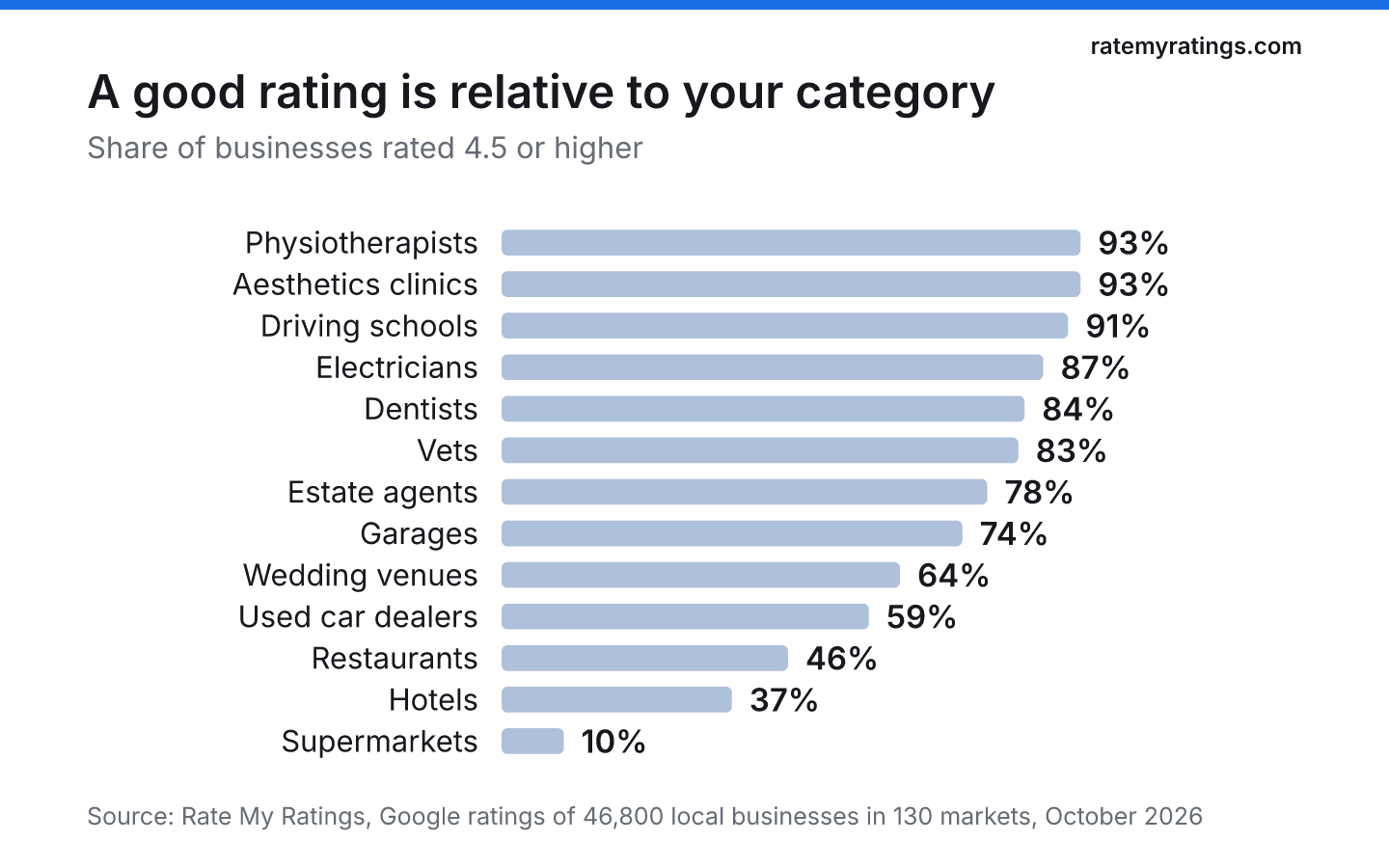
A few examples from our data:
| Category | Median rating | Share rated 4.5+ | Median review count |
|---|---|---|---|
| Physiotherapists | 5.0 | 93% | 19 |
| Dentists | 4.9 | 84% | 54 |
| Vets | 4.7 | 83% | 154 |
| Estate agents | 4.8 | 78% | 92 |
| Garages | 4.7 | 74% | 52 |
| Wedding venues | 4.6 | 64% | 165 |
| Restaurants | 4.4 | 46% | 358 |
| Hotels | 4.3 | 37% | 596 |
| Supermarkets | 4.0 | 10% | 93 |
A 4.4 is perfectly ordinary for a restaurant and weak for a physiotherapist. Categories where customers have one-to-one, appointment-based relationships (physios, aesthetics clinics, driving schools) cluster near 5.0. Categories with high volume, many touch points or emotionally loaded moments (restaurants, hotels, supermarkets) sit lower because more things can go wrong for more people.
The practical rule: compare yourself with the businesses that appear next to you for your main search, not with a national figure. If you run a vet practice and the three practices beside you in Google Maps are at 4.8, 4.7 and 4.9, your good Google rating is 4.7 or better.
Review count changes what a rating means
A rating is an average, and an average from six reviews is not the same as one from six hundred. Our data shows this clearly: the more reviews a business has, the lower and steadier its rating becomes.
- Of businesses with fewer than 10 reviews, 70% have a perfect 5.0.
- Of businesses with 100 to 249 reviews, 20% do.
- Of businesses with 1,000 or more reviews, just 1% do.
The median rating falls from 5.0 for businesses with fewer than ten reviews to 4.4 for those with more than a thousand. That is not because big businesses are worse. It is because a large sample captures the bad day, the misunderstanding and the difficult customer that a small sample has not met yet.
Customers sense this. The Spiegel Research Center at Northwestern University found that purchase likelihood peaks for ratings between 4.0 and 4.7 and falls as ratings approach a perfect 5.0, which buyers can read as too good to be true. A 4.8 from 250 reviews is usually more persuasive than a 5.0 from eight. Our guide to spotting fake Google reviews explains why a perfect score on very few reviews makes careful customers suspicious.
Does your Google rating actually matter?
Yes, in three concrete ways.
It filters you in or out. In BrightLocal's 2026 Local Consumer Review Survey, 68% of consumers said they need a business to have at least four stars before they would use it, and 31% said they would only use one rated 4.5 or higher. Below those thresholds, part of your market never calls.
It affects where you appear. Google says in its guidance on how local results are ranked that more reviews and positive ratings can help a business's local ranking. Rating is one input among many, but it is one you can influence.
It affects revenue. A Harvard Business School study of restaurant ratings found that a one-star increase was linked to a 5 to 9 percent rise in revenue for independent restaurants. We look at the wider evidence in do Google reviews increase sales.
Where the rating matters less is at the top. Once you are level with or above the businesses beside you, the extra tenth of a star does little. Volume, recency and the content of your reviews then do more work than the number.
How Google works out your rating
Your Google rating is the average of all the star ratings on your Business Profile, shown to one decimal place. Star-only ratings, left without any written text, count towards it in the same way as full reviews. In our data, 17% of recent ratings have no text at all. We explain the difference in Google reviews vs Google ratings.
Because it is an average, the number of new reviews you need to move it depends on how many you already have. Two worked examples, assuming every new review is five stars:
- From 4.2 with 50 reviews to 4.5 needs about 30 more five-star reviews.
- From 4.5 with 200 reviews to 4.7 needs about 134 more.
The larger your base, the slower the rating moves, in both directions. That is good news for an established business with a strong record and a reason for patience if you are recovering from a bad patch.
How to reach a good Google rating
- Fix the cause first. Read your one- and two-star reviews for repeated themes. In our data the most common are price surprises, poor communication, booking problems and waiting.
- Ask every customer, not just the happy ones. Asking only satisfied customers (review gating) breaks Google's policies. A steady habit of asking everyone raises your count and usually your rating, because most customers are satisfied but silent. Our guide on how to ask for Google reviews has wording you can use.
- Reply to criticism calmly. A good reply will not change the score, but it changes how the next customer reads it.
- Benchmark against your real competitors. A Rate My Ratings market report shows every competitor's rating, review count and the themes behind them, so you know where your bar actually is.
The short version
- For most local businesses, a good Google rating is 4.5 or higher; 74% of the businesses we track are already there.
- The bar moves by category: a 4.4 is normal for a restaurant and weak for a physiotherapist.
- Ratings on few reviews are treated with caution; most businesses with under ten reviews have a 5.0, and only 1% of businesses with over a thousand do.
- The rating matters most as a filter and a ranking input; beyond the level of your competitors, review count and recency matter more. If you are well below the pack, read what a 3.5 star rating costs compared with 4.5.
Frequently asked questions
- What is a good Google rating for a small business?
For most local businesses, 4.5 or higher. Across 46,800 businesses we track, the median Google rating is 4.8 and 74% are at 4.5 or above, so anything below that puts you behind most competitors. Compare with the businesses that appear next to you in Maps, because the bar varies by category.
- Is a 4.2 Google rating good?
It depends on your category. A 4.2 is close to normal for restaurants, hotels and supermarkets, where median ratings sit between 4.0 and 4.4. For dentists, physiotherapists, vets or trades, where most businesses are above 4.5, a 4.2 is below the pack and worth working on.
- Is a 5.0 Google rating suspicious?
Not by itself, but customers often discount it when there are only a few reviews. In our data, 70% of businesses with under ten reviews have a perfect 5.0, against 1% of those with over a thousand. Research on online buying found trust peaks between 4.0 and 4.7 stars.
- How many reviews does it take to raise a Google rating?
It depends on how many you already have. Moving from 4.2 to 4.5 with 50 existing reviews takes about 30 new five-star reviews; moving from 4.5 to 4.7 with 200 reviews takes about 134. The more reviews you have, the slower the average moves.

Rate My RatingsNewsletter
What reviews say about local markets, in your inbox.
New articles and findings from the blog, as they're published.
Check your inbox.
If this address isn't subscribed yet, we've sent it a link to confirm. Nothing is sent until you click it.
That didn't go through. Check the email address and try again.
Hold on a moment, then subscribe again.