
What's the ROI of Investing in Google Review Management?
Most of the cost of review management is staff time, and most of the return comes from customers who choose you over the business next door. Here is a simple way to work out the ROI, with three worked examples.

For most independent local businesses, the review management ROI is high, because the cost is mainly a few hours of staff time a week and the return is new customers who would otherwise have picked a competitor. A reasonable way to estimate it: work out the gross profit from the extra customers you expect, subtract what you spend in time and tools, and divide by that spend. With cautious assumptions, the worked examples below come out at roughly 200% to 300% a year. The return is lowest for businesses that are already fully booked or that win customers mainly by referral.
This guide sets out what review management costs, where the return comes from, how to calculate it for your own business and what does not pay.
What review management costs
Review management covers four jobs: asking customers for reviews, replying to them, reading them for problems, and keeping an eye on how you compare with competitors. The costs are:
- Staff time. Typically one to three hours a week for a single-site business: sending requests, replying, and a monthly look at themes.
- Tools. Optional. Google gives you a free review link and QR code. Paid software automates requests and monitoring across platforms; whether it is worth it depends on your volume, as covered in should you pay for review services.
- Fixes. The changes your reviews tell you to make, such as a call-back rule or clearer quotes. These cost money but usually pay for themselves.
Replying is now standard practice. In the 524,000 recent Google reviews we have collected, 53% have a reply from the business, and most replies arrive within a day or two.
Where the return comes from
More customers find you
Google says that more reviews and positive ratings can help your local ranking. More appearances in map results mean more profile views, calls and direction requests.
More of them choose you
A Harvard Business School study of restaurant ratings found that a one-star increase was linked to a 5 to 9 percent increase in revenue for independent restaurants, with no effect for chains. The Spiegel Research Center found that products with five reviews were 270% more likely to be bought than products with none. And in BrightLocal's 2026 consumer survey, 68% of consumers said they need at least four stars before they would use a business.
You fix what is costing you customers
This is the return most owners overlook. Your one- and two-star reviews are a free list of the problems that make customers leave. In our data, the most common themes in those reviews are about process rather than people.
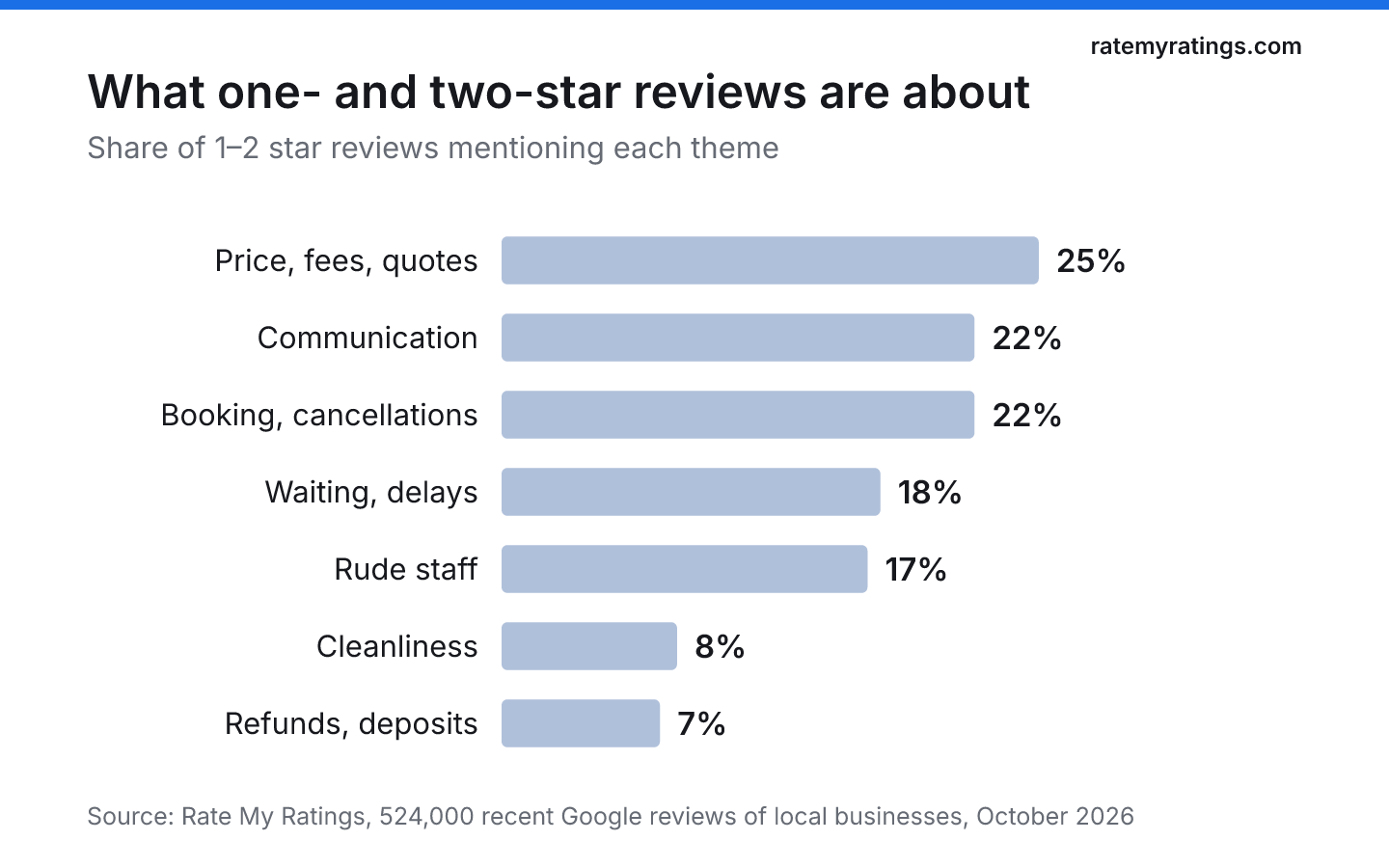
Fixing one of these, such as giving written quotes up front or calling back within a working day, reduces the next round of complaints and keeps customers who would otherwise never come back. Our guide on using customer reviews to improve your business shows how to turn themes into changes.
You protect the customers you already have
Reviews are public, so a complaint left unanswered is read by every future customer, and an existing client who sees the same problem described by others is more likely to leave. Unhappy customers also write at length: in our data the median one-star review runs to 74 words, against 27 for a five-star review. A calm, specific reply and a visible fix limit how far one bad experience spreads. The return here is customers you keep, which never shows up as a new enquiry but is often worth more.
How to calculate review management ROI
The formula:
ROI = (extra gross profit − cost) ÷ cost
Where:
- Extra gross profit = extra customers a year × value of a customer over a year × your gross margin.
- Cost = hours a week × 52 × hourly cost of the person doing it, plus any tool costs.
The hard part is the extra customers. Be conservative: estimate from your Google Business Profile's calls and direction requests, or from how many new customers say they found you through Google. Below are three illustrations. The numbers are assumptions chosen to be cautious, not results from any real business.
| Vet practice | Roofer | Café | |
|---|---|---|---|
| Extra customers a year | 36 new clients (3 a month) | 4 extra jobs (1 a quarter) | 48 new regulars (4 a month) |
| Value of a customer in a year | £400 | £3,000 | £80 (10 visits at £8) |
| Gross margin | 60% | 35% | 65% |
| Extra gross profit | £8,640 | £4,200 | £2,496 |
| Time spent | 2 hours a week at £20 | 1 hour a week at £20 | 1 hour a week at £12 |
| Tools | £600 a year | £0 | £0 |
| Total cost | £2,680 | £1,040 | £624 |
| Review management ROI | about 220% | about 300% | about 300% |
Three things matter more than the exact figures. First, the cost is small for a single site, so even modest gains clear it. Second, high-value customers make the sum easy: one extra roofing job a quarter covers a year of effort. Third, the returns compound, because a customer won this year often comes back and refers others next year, which the table ignores.
How to measure it in practice
- Record a baseline. Note your rating, review count, number of reviews in the last three months, and your Business Profile calls, direction requests and website clicks for the last twelve months.
- Ask every new customer how they found you. One question on a booking form or intake call gives you a direct count.
- Compare year on year. Look at the same months a year apart to strip out seasonality. Allow three to six months before judging; our guide on how long Google reviews take to work explains why.
- Compare with your neighbours. If the businesses around you are adding reviews faster than you, standing still is going backwards. A market report like our vets in Greater Manchester report shows what that comparison looks like across a whole market.
What does not pay
- Chasing a perfect 5.0. In our data, only 1% of businesses with more than a thousand reviews have one. Customers trust a 4.7 from many reviews more than a 5.0 from a few.
- Replying in the hope of a higher rating. Businesses in our data that reply to three quarters or more of their reviews have a median rating of 4.7, against 4.9 for businesses that never reply. Reply for the customers reading, not for the score.
- Buying reviews or offering incentives. Beyond breaking Google's rules, it is illegal in the UK, the US and Australia, and UK businesses caught can have warnings put on their profile. The expected return is negative.
- Effort when you are already full. If you have a waiting list, the return from more reviews is mainly in pricing power and choosing better-fitting customers, not volume.
When the review management ROI is highest
- You are below your local competitors on rating or review count. Closing a gap is worth far more than extending a lead; see what a 3.5 star rating costs compared with 4.5.
- Each customer is worth a lot, as for vets, dentists, wedding venues, estate agents and trades.
- Customers choose online from several similar options.
- Your reviews are thin on recent detail, so the first impression is weak.
The short version
- Review management ROI comes from more customers finding you, more of them choosing you, and the problems your reviews help you fix.
- Use ROI = (extra gross profit − cost) ÷ cost, with cautious estimates of extra customers.
- For a single-site business the cost is mostly a few hours a week, so our cautious examples return roughly 200% to 300% a year.
- Measure with a baseline, a "how did you find us" question and a year-on-year comparison.
- Do not spend on perfect scores, reply tools sold as rating boosters or anything that buys reviews. For the wider evidence, read do Google reviews increase sales, and for replies that help, how to respond to negative Google reviews.
Frequently asked questions
- How do you calculate the ROI of review management?
Estimate the extra customers you expect in a year, multiply by what each is worth over that year and by your gross margin, then subtract the cost of staff time and tools and divide by that cost. Use cautious estimates and check them against your Business Profile calls and a 'how did you find us' question.
- Is review management worth it for a small business?
Usually, yes. For a single-site business the main cost is one to three hours a week, while one or two extra customers a month often covers it. The return is lowest for businesses that are already fully booked or that win almost all their customers by referral.
- How long before review management shows a return?
Expect three to six months. New reviews change first impressions within weeks, but ranking gains and extra enquiries build gradually. Compare the same months year on year to see the effect clearly.
- Does replying to reviews increase revenue?
Indirectly. Replies show prospective customers that you listen, and most consumers expect one within a week. In our data, though, businesses that reply to most reviews do not have higher ratings than those that never reply, so treat replies as customer service rather than a ratings tactic.

Rate My RatingsNewsletter
What reviews say about local markets, in your inbox.
New articles and findings from the blog, as they're published.
Check your inbox.
If this address isn't subscribed yet, we've sent it a link to confirm. Nothing is sent until you click it.
That didn't go through. Check the email address and try again.
Hold on a moment, then subscribe again.