
How to Respond to Negative Google Reviews Professionally
A calm, specific reply to a bad review is written for the next customer, not the angry one. Here is the structure we recommend, with examples and what half a million reviews say about how businesses actually reply.

The best way to respond to negative Google reviews is quickly, calmly and specifically: thank the person, acknowledge the problem in their own terms, explain what you have done or will do, and offer a direct line to put it right. Keep it short and keep it free of argument. Your reply is read by every future customer who opens your profile, so write it for them as much as for the reviewer.
That sounds simple. In practice, a one-star review lands at 9pm on a Friday, it is partly unfair, and the temptation is to set the record straight. This guide gives you a structure that holds up under that pressure, examples you can adapt, and what we found in 524,000 recent Google reviews about how local businesses actually reply.
What our data says about replies to bad reviews
We read the public reviews of every business in a category and area, so we see how whole markets handle criticism, not just the businesses that write blog posts about it. Across 524,000 recent Google reviews of local businesses in the UK and Australia:
- 53% of reviews have a reply from the business. One-star reviews are answered at almost exactly that rate (53%).
- Three-star reviews are answered least, at 42%. The lukewarm customer, who often had a fixable problem, is the one most often ignored.
- The median reply comes about a day after the review. Replies to one- and two-star reviews take a little longer (a median of 1.7 days) than replies to four- and five-star ones (1.1 days).
- Unhappy customers write nearly three times as much. The median one-star review runs to 74 words; the median five-star review to 27.
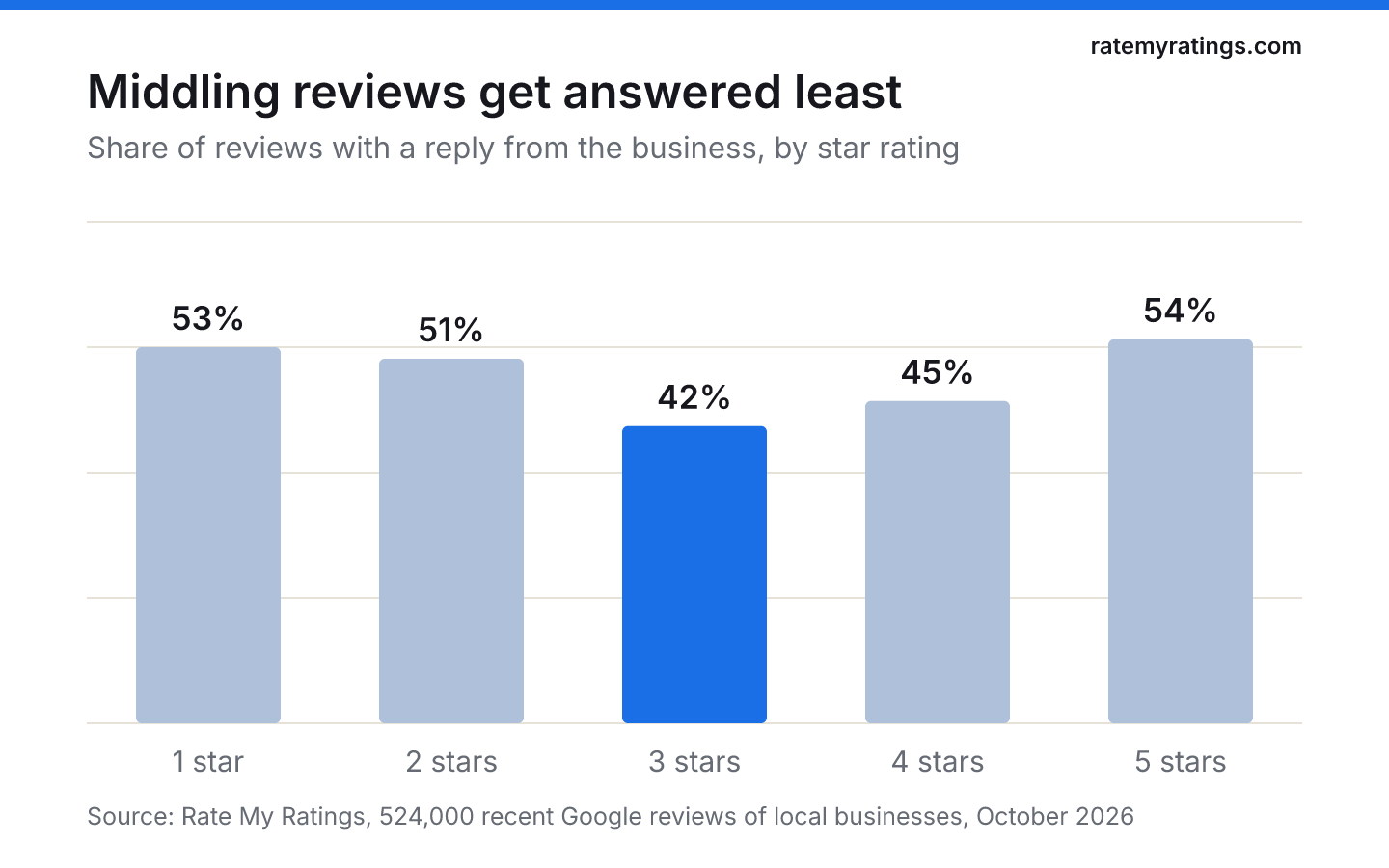
Two things follow. First, almost half of negative reviews sit unanswered, so a thoughtful reply is still a way to stand out in most markets. Second, a long, detailed complaint deserves a reply that shows it was read. A one-line "Sorry to hear this, please call us" under 150 words of specific frustration reads as a brush-off.
One honest caveat: in our data, businesses that reply to most of their reviews do not have higher star ratings than businesses that never reply (a median of 4.7 against 4.9). They tend to be bigger and busier, with a median of 378 reviews against 202. Replying will not lift your average on its own. What it changes is how the rating is read.
Why it is worth replying at all
Consumers expect it. BrightLocal's 2026 Local Consumer Review Survey found that 89% of consumers expect business owners to respond to reviews, and that generic or templated replies put off half of them. The same survey found 81% expect a response within a week.
Google also tells the reviewer. According to Google's own help page on managing customer reviews, the reviewer is notified of your reply and can still change their review after reading it. A fair, useful reply is the only route you have to a revised rating, and it works more often than owners expect when the original problem has genuinely been fixed.
How to respond to negative Google reviews: a five-part structure
Every good reply to a bad review we have read follows roughly the same shape. You can do it in four to six sentences.
- Thank them, briefly. "Thank you for taking the time to tell us about your visit." It costs nothing and sets a calm tone.
- Acknowledge the specific problem. Use their words. If they said "waited 40 minutes past my appointment", say "waiting 40 minutes past your appointment time isn't acceptable". Readers are checking whether you actually read the review.
- Take responsibility for what is yours. You do not need to accept every claim. Own the part that is true and leave the rest.
- Say what you have changed or will check. This is the sentence future customers care about most. "We've added a second receptionist on Saturday mornings" beats any apology.
- Offer a direct route. Give a named role and a contact method: "Please ask for the practice manager on our main number, or email us, so we can put this right."
Sign it with a first name or role if you are comfortable doing so. A reply signed "the practice manager" with a first name reads very differently from one signed "Management".
What to leave out
- Arguments about the facts. If the review is wrong, say so once, politely, without detail: "Our records show a different timeline, and we'd welcome the chance to go through it with you."
- Personal or confidential information. Never confirm a patient's treatment, a client's case or a booking reference in public. For vets, dentists, physiotherapists and solicitors this is a professional obligation as well as good manners.
- Specific offers. "We'll refund you in full" in public invites copycat complaints. Make offers privately.
- Copy and paste. Identical replies under every review are easy to spot and, per BrightLocal, put off half of readers.
Examples you can adapt
These are starting points, not scripts. Change the details until they could only have been written to that reviewer.
A service failure that was your fault (a garage):
Thank you for the review, and I'm sorry the car wasn't ready when we promised. You had arranged your day around collecting it, and we should have called you as soon as the part was delayed. We've changed how we handle late parts so the customer hears from us first. Please ring and ask for me, [first name], so I can make this right.
A complaint about price (a dental practice):
Thank you for your feedback. We're sorry the final cost came as a surprise; that should never happen. Every treatment plan should come with a written estimate before work starts, and we're reviewing why you didn't receive one. Please call the practice manager on our main number so we can go through your bill with you.
A review you believe is inaccurate:
Thank you for taking the time to write. We take every comment seriously, but we can't find a booking that matches this description. If you visited us, please get in touch on our main number so we can look into it properly.
That last one does two jobs: it is polite to a possibly genuine customer, and it signals to readers that the account may not match a real visit. If the review looks fake or breaks Google's rules, report it as well. Our guide to requesting removal of a false Google review explains what Google will and will not take down, and how to spot fake Google reviews covers the warning signs.
Timing: fast, but not instant
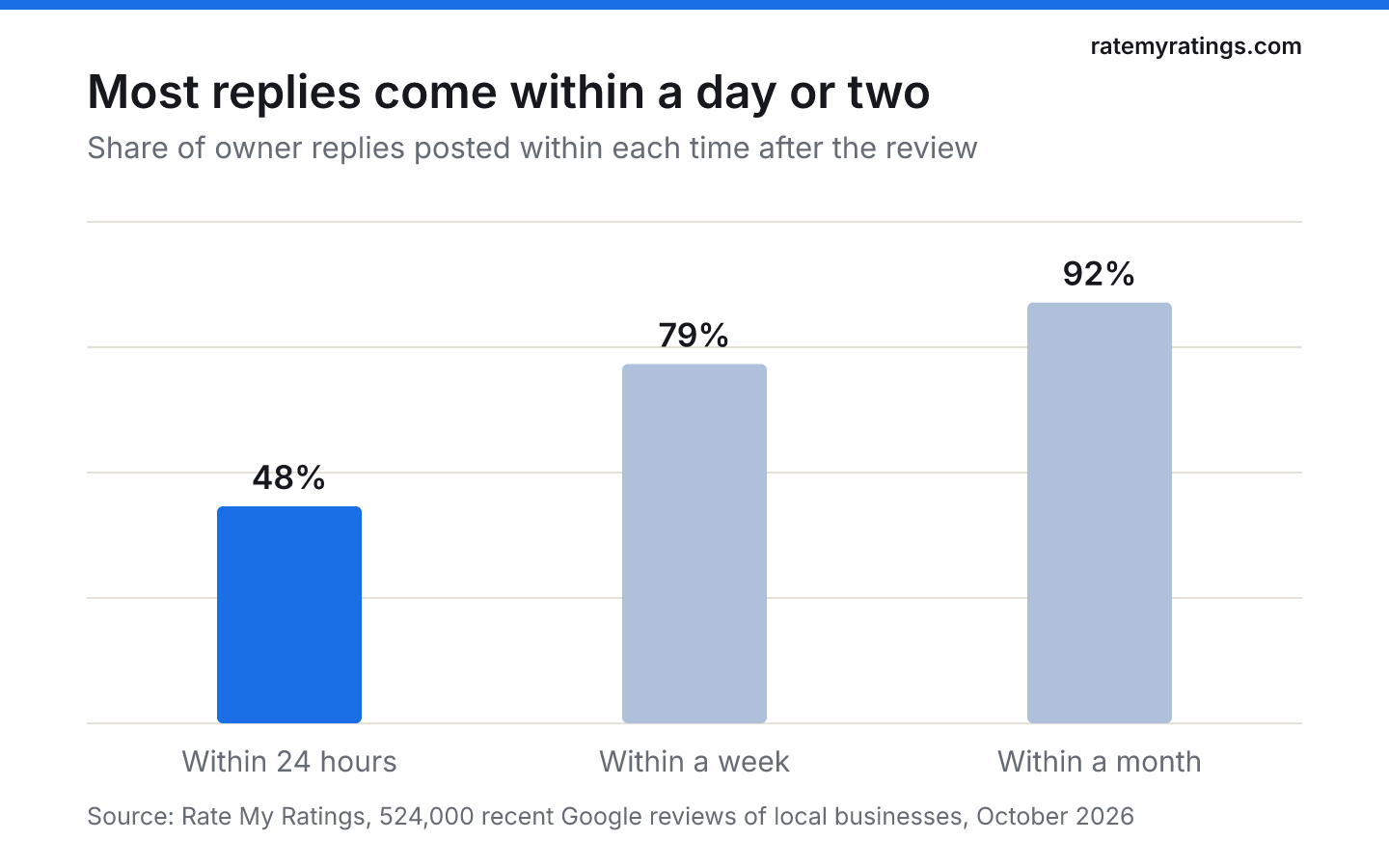
Reply within one or two working days. In our data, 48% of replies arrive within 24 hours and 79% within a week, so a reply after a fortnight puts you behind most of your market.
Do not reply in the first ten minutes of reading a bad review. Check the booking, talk to the staff member involved, and write the reply when you can do it calmly. Google checks replies against its content policies before they appear, which usually takes minutes but can take longer, so a reply written in anger may also be held.
When the complaint keeps coming back
A single bad review is an incident. The same complaint in five reviews is a process problem, and no reply will fix it. When we compare one- and two-star reviews across whole markets, the same themes dominate: price surprises, fees or quotes (25% of negative reviews), communication such as unreturned calls (22%), booking and cancellations (22%), and waiting or delays (18%). Rude staff come up in 17%.
If your negative reviews cluster on one of these, the reply is the second job. The first is fixing the cause, and our guide on how to use customer reviews to improve your business shows how to sort reviews into themes and act on them. For a single damaging review, turning one-star reviews into opportunities covers what to do after the reply.
Should you respond to negative Google reviews from years ago?
Yes, if they are still visible and the issue has since been fixed. A short reply ("Thank you for this. Since your visit we've moved to online booking, which has removed the phone queue you describe") turns an old complaint into evidence of improvement. Do not reply to dozens of old reviews in one evening, though: a burst of replies to years-old reviews reads as a clean-up exercise rather than care.
Making it a habit
Replies only work when they are consistent. A simple routine is enough for most small businesses:
- Turn on review notifications in your Business Profile so new reviews reach a named person.
- Answer negative and three-star reviews first, within two working days.
- Keep a short internal note of the problem raised and what you changed, so replies can say so.
- Once a month, read the month's reviews together as a team and pick one thing to fix.
If you want to see how your replies, rating and complaint themes compare with every competitor in your area, a Rate My Ratings market report reads all of their public reviews for you.
The short version
Reply to every negative review within a day or two, in four to six sentences: thank, acknowledge the specific problem, own your part, say what changed, and offer a direct contact. Keep facts, offers and personal details out of public view. Then look for the pattern behind the complaints, because fixing that is what moves your rating.
Frequently asked questions
- Should you reply to every negative Google review?
Yes, with very few exceptions. A reply shows people reading your profile that you take problems seriously, and the reviewer is notified and can update their review afterwards. The exceptions are reviews that break Google's policies, such as spam or reviews from someone who was never a customer: report those first, and if you reply at all, keep it short and factual.
- How quickly should a business respond to a bad review?
Within one or two working days. In our data the median reply arrives about a day after the review, and replies to one- and two-star reviews take slightly longer, about 1.7 days. Waiting a few hours to calm down and check the facts is sensible; leaving a complaint unanswered for weeks tells readers nobody is listening.
- Can a reply to a negative review be edited or deleted?
Yes. In your Business Profile you can edit or delete your reply at any time from the reviews section. Google checks replies against its content policies before they appear, which usually takes minutes but can take longer. Editing is useful when the issue is resolved and you want the public reply to say so.
- Should I offer a refund in my public reply?
Avoid making specific offers in public. It can look like you are paying for a review to change, and it invites others to complain for compensation. Acknowledge the problem publicly, then invite the reviewer to contact you directly, where you can discuss a refund, a redo or a goodwill gesture privately.

Rate My RatingsNewsletter
What reviews say about local markets, in your inbox.
New articles and findings from the blog, as they're published.
Check your inbox.
If this address isn't subscribed yet, we've sent it a link to confirm. Nothing is sent until you click it.
That didn't go through. Check the email address and try again.
Hold on a moment, then subscribe again.