
Can You Request Google Remove a False Review?
Google removes reviews that break its policies, not reviews that are unfair. What counts, how to report and appeal through the Reviews Management Tool, the legal route in the UK, and how to limit the damage meanwhile.

Yes, you can ask Google to remove a false Google review, but Google only takes down reviews that break its content policies. A review that is unfair, exaggerated or wrong about the facts usually stays up. A review that is fake (the person was never a customer), written by a competitor or former employee, off-topic, abusive or full of personal information can be removed. You report it from your Business Profile or the Reviews Management Tool, Google typically decides within several days, and you get one appeal.
The frustrating part is the gap between "false" and "against the rules". This guide explains where Google draws that line, how to report and appeal, when the law is an option, and how to limit the damage while you wait.
What Google will and will not remove
Google's help page on reporting reviews is blunt: you can flag any review, but only reviews that violate Google's policies can be removed, and you should not report a review just because you disagree with it or dislike it. Google also says it does not get involved in disputes between businesses and customers.
The rules that matter are in Google's prohibited and restricted content policy. For a business dealing with a false review, these are the useful ones:
| Likely to be removed | Usually not removed |
|---|---|
| The reviewer was never a customer (fake engagement) | A real customer's harsh but honest opinion |
| A competitor, current or former employee (conflict of interest) | A dispute about what happened, where both sides have a version |
| Content about something else entirely (off-topic) | A complaint about price you consider fair |
| Harassment, hate speech, threats or obscenity | A review that is out of date because you have since changed |
| Personal information, such as a staff member's phone number | A low rating with no text |
| Spam, advertising or links | A review you think is exaggerated |
| Several reviews from the same person or coordinated group | One customer's review that contradicts your records |
If the review sits in the right-hand column, reporting it will almost certainly fail and use up your appeal. Reply to it instead.
How to remove a false Google review: the process
- Gather your evidence first. Check your booking system, invoices, CCTV log or job sheets for the reviewer's name and the date described. Note which specific policy the review breaks.
- Report the review. From your Business Profile, open your reviews, find the review and choose the option to report it. Pick the reason that matches the policy breach, not the closest emotional fit.
- Use the Reviews Management Tool. Google's tool lets you report reviews and track them. A report shows one of three statuses: decision pending, report reviewed with no policy violation, or escalated (check your email).
- Wait, typically several days. Google says evaluation typically takes several days.
- Appeal once if it stays. If the review is not removed, you can submit a one-time appeal through the tool. Add the evidence you gathered in step 1, briefly and factually.
Do not ask friends, staff or customers to report the review too. Coordinated reporting does not speed anything up, and coordinated activity is exactly what Google's systems look for.
How to tell a fake review from a real but unfair one
Fake reviews do exist, and in the UK they are now illegal to write or commission under the Digital Markets, Competition and Consumers Act 2024. But many reviews that feel fake are from real customers who remember things differently.
Some signals point towards a review not being from a genuine customer:
- no record of anyone by that name or matching that description;
- details that do not fit your business (a service you do not offer, a location you do not have);
- a reviewer account with one review, or reviews of businesses in places hundreds of miles apart within days;
- several negative reviews arriving within hours of each other, especially after a dispute or a competitor's launch.
Treat the account history with care. In our analysis of 524,000 recent Google reviews, 16% came from accounts with only one review, and those accounts lean towards the extremes: they wrote 17% of five-star reviews and 13% of one-star reviews, but only 6% of three-star ones.
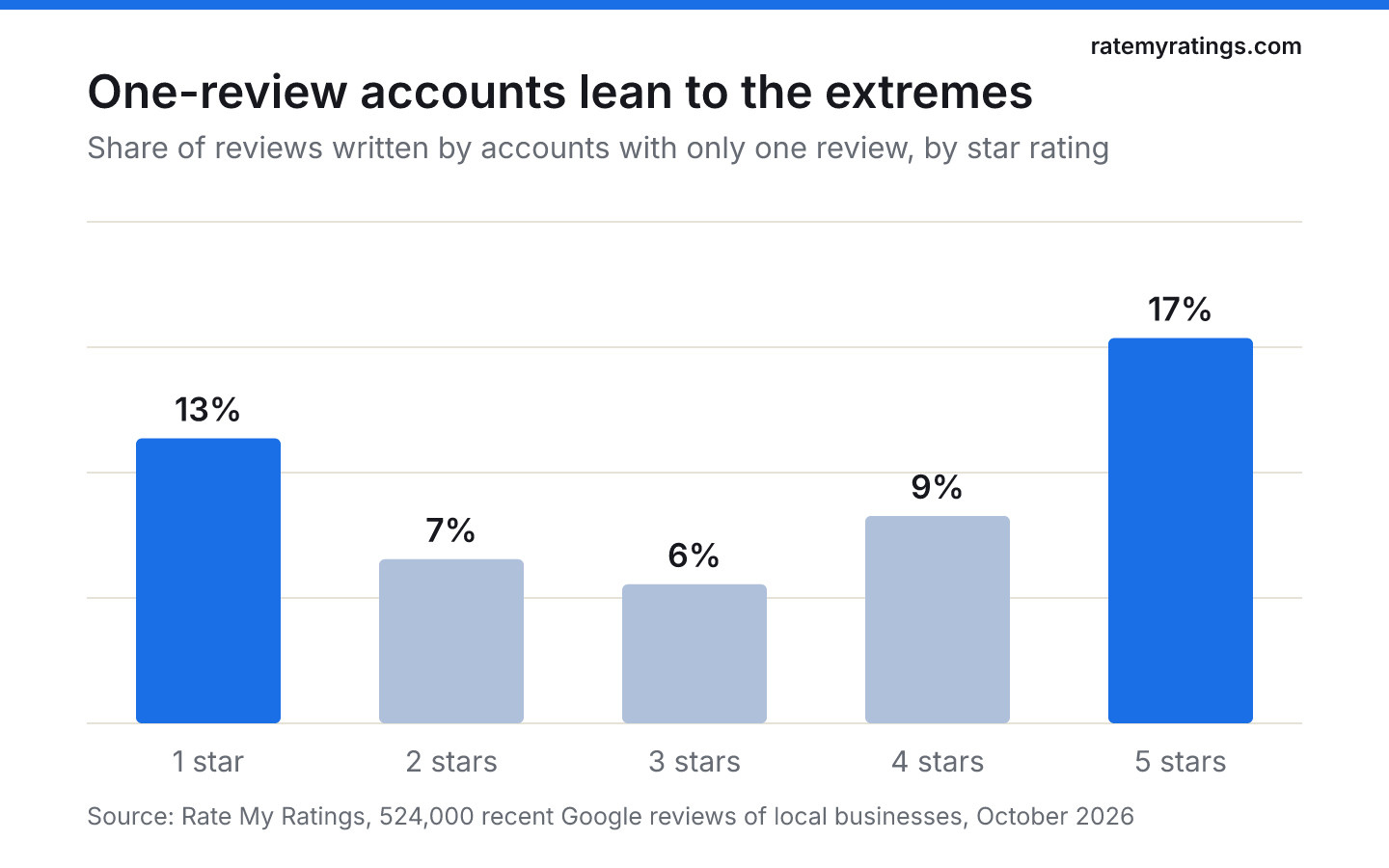
That pattern makes sense: people who only ever review once tend to do it when something was wonderful or terrible. A single-review account is a reason to look closer, not proof of a fake. Our guide on how to spot fake Google reviews covers the signals in more depth.
When the law is an option
If a review is false, damaging and Google will not remove it, there may be a legal route, but it is narrower and more expensive than most owners expect.
In England and Wales, the Defamation Act 2013 says a statement is only defamatory if it has caused or is likely to cause serious harm to reputation. For a business trading for profit, harm is not serious unless it has caused or is likely to cause the business serious financial loss. One unfair review on a profile with hundreds of good ones rarely meets that bar. A coordinated campaign of fabricated allegations, or a false claim of criminal conduct, might. Australia and other jurisdictions have their own rules on when businesses can sue over reviews.
If you think you are in that territory:
- keep dated screenshots of the review, the profile and the account;
- record any loss you can link to it, such as cancelled bookings that mention it;
- speak to a solicitor who handles online defamation before contacting the reviewer;
- avoid threatening the reviewer publicly, which tends to make things worse.
For suspected fake reviews in the UK, there is also a regulatory angle. As part of undertakings agreed with the Competition and Markets Authority in January 2025, Google committed to a reporting function for concerning reviews and to sanctions on people who repeatedly post fake ones, including removing their reviews and banning them from posting.
What to do while the review is still up
Removal takes days at best, and may not happen at all. Meanwhile, every reader of your profile can see the review. Reply to it.
A good reply to a review you believe is false is short, polite and factual:
Thank you for your review. We take every comment seriously, but we have no record of a visit matching this description. If you have used our service, please contact the practice manager on our main number so we can look into it properly.
This does two things. It treats a possibly genuine customer with respect, and it tells every other reader that the account may not match a real visit. Do not accuse the reviewer of lying, name a suspected competitor, or reveal anything about a real customer's visit. Our guide on how to respond to negative Google reviews has more examples.
Put one review in proportion
A single false review hurts most on a profile with few reviews. Of the 46,800 businesses we track across the UK and Australia, a quarter have eight or fewer Google reviews; for them, one fabricated one-star review can pull the average down by half a star. On a profile with 150 reviews, the same review barely moves it.
The long-term defence is a steady flow of genuine reviews from real customers, so that any one review, fair or not, is a small part of the whole record. Our guides to getting more Google reviews and to turning one-star reviews into opportunities cover how to build that.
If you want to see how your rating and review count compare with every competitor in your area, a Rate My Ratings market report reads all of their public reviews for you.
The short version
You can request that Google remove a false review, but only reviews that break its policies come down: fake, conflicted, off-topic, abusive, spam or containing personal information. Report it with the specific policy in mind, track it in the Reviews Management Tool, and use your single appeal with evidence. The legal route exists in the UK but needs serious financial loss. Meanwhile, reply calmly, and build a steady flow of genuine reviews so one false one matters less.
Frequently asked questions
- How long does Google take to remove a reported review?
Google says review evaluation typically takes several days. You can follow progress in the Reviews Management Tool, where a report shows as decision pending, reviewed with no policy violation, or escalated. If the review is not removed, you get one appeal. There is no guaranteed deadline, so reply publicly while you wait.
- Can I pay someone to remove a bad Google review?
No legitimate service can make Google remove a review that does not break its policies. Companies promising guaranteed removal for a fee either file the same reports you can file for free or use tactics that put your profile at risk. Be especially wary of anyone offering to post positive reviews to bury a negative one; that is fake review activity.
- Can I find out who wrote an anonymous Google review?
Not through Google's tools. Google does not disclose reviewers' identities to businesses. In serious legal cases, such as defamation, a court can order a platform to disclose information about an account, but that is a costly legal process and only worthwhile when a review is causing real financial harm.
- Will reporting a review get my business penalised?
Reporting a genuine policy breach will not harm your profile. Google does ask businesses not to report reviews simply because they disagree with them, and mass-reporting legitimate criticism wastes your one appeal per review. Report reviews that clearly break a specific rule, and reply to the rest.

Rate My RatingsNewsletter
What reviews say about local markets, in your inbox.
New articles and findings from the blog, as they're published.
Check your inbox.
If this address isn't subscribed yet, we've sent it a link to confirm. Nothing is sent until you click it.
That didn't go through. Check the email address and try again.
Hold on a moment, then subscribe again.