How to Spot Fake Google Reviews and Fake Ratings
Bursts of five-star ratings, reviewers with no history and praise that could describe anyone. Ten signs of fake Google reviews, and which of them actually mean something.
You can spot fake Google reviews by looking at patterns rather than single reviews: a sudden burst of five-star ratings, reviewers with no other activity, praise so vague it could describe any business, and a rating that looks too perfect for the number of reviews. No single sign proves a review is fake, but three or four together should make you sceptical.
This guide explains what to check, what each sign does and does not mean, and what to do if you find a business you think is cheating. It draws on how Google itself screens reviews and on our own analysis of more than half a million recent Google reviews of local businesses in the UK and Australia.
How common are fake Google reviews?
Common enough that Google treats them as a constant fight. In an April 2025 update, Google said its systems blocked or removed more than 240 million policy-violating reviews during 2024, most of them before anyone saw them, and took down more than 12 million fake Business Profiles.
So most fakes never reach the page. The ones that do tend to be the better disguised kind, which is why it helps to know how to read a profile with a critical eye. The rules have also hardened: fake reviews are now explicitly illegal in the UK under the Digital Markets, Competition and Consumers Act 2024, which bans writing or commissioning a review that "purports to be, but is not, based on a person's genuine experience", and in the US under the FTC's 2024 rule on consumer reviews and testimonials.
How to spot fake Google reviews: 10 signs to check
Work through these in order. The first few take seconds; the later ones need a minute or two of clicking.
1. A perfect score from a small number of reviews
A 5.0 rating is not suspicious in itself. In our data on 46,800 local businesses, 70% of businesses with fewer than 10 Google reviews have a perfect score, simply because a handful of happy customers is easy to get. But perfection becomes rarer as reviews accumulate: only 20% of businesses with 100 to 249 reviews hold a 5.0, and just 1% of those with 1,000 or more. A flawless rating across hundreds of reviews is unusual enough to deserve a closer look.
2. A burst of reviews in a short window
Sort the reviews by newest and scroll. If a business that normally gets a review or two a month suddenly receives 20 five-star reviews in a week, ask why. Google's own explanation of how it moderates reviews names "an unusually high number of 1 or 5-star reviews over a short period of time" as one of the patterns its systems watch for.
Be fair, though: bursts have innocent causes. A business that has just started asking customers for reviews, or that sent one email to its whole client list, will see a spike. In our data, two-thirds of established businesses whose full review history we hold had at least one week in which 10% or more of all their reviews arrived. A burst is a reason to read more closely, not a verdict. Our guide to review velocity explains how Google views it.
3. Reviewers with no history
Tap a reviewer's name. A genuine reviewer often has other reviews: local cafés, a garage, a holiday cottage. A fake account frequently has one review, or a handful all written on the same day for businesses in different cities.
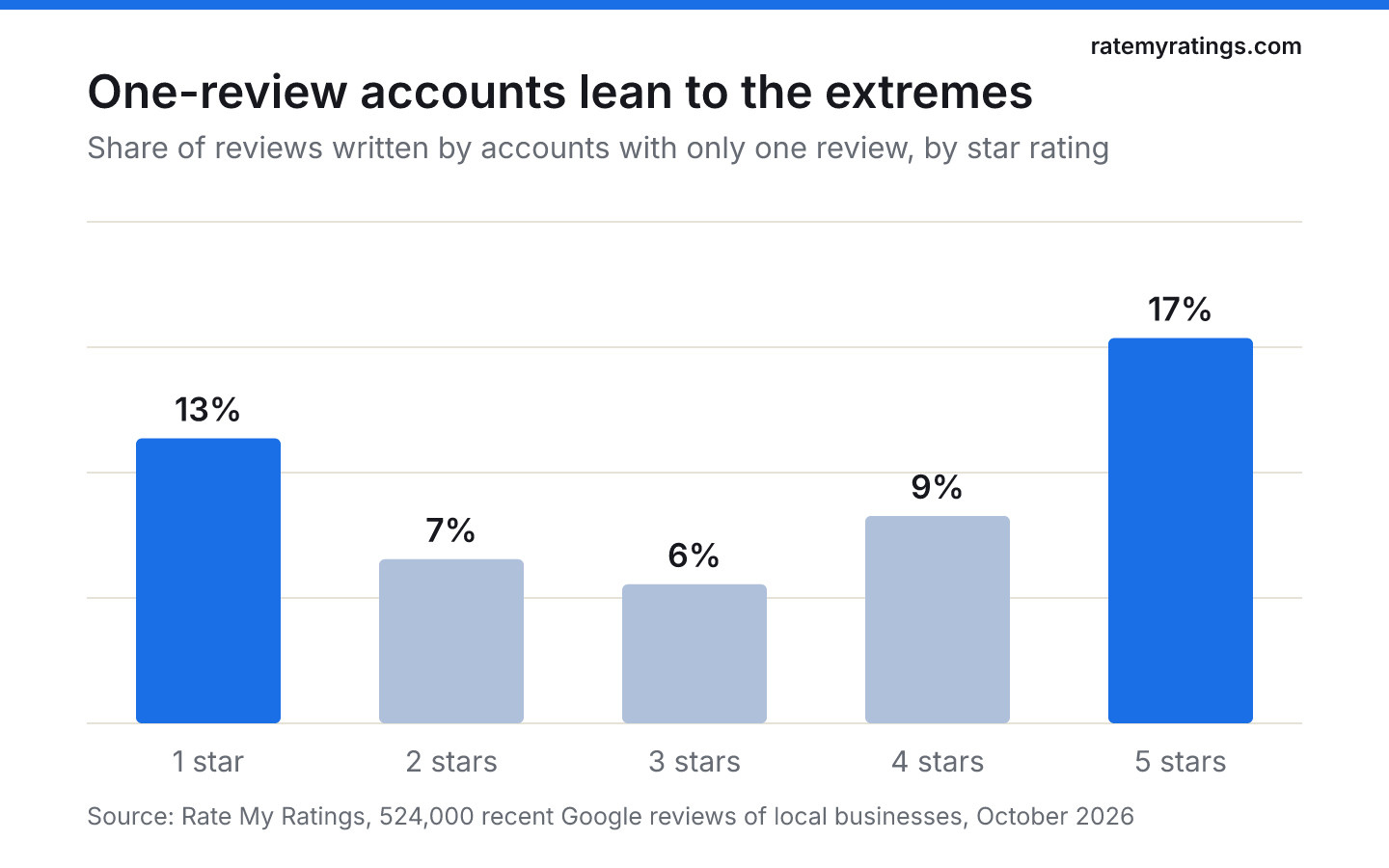
In the 524,000 recent reviews we analysed, 16% came from accounts with only one review. That share rises at the extremes: 17% of five-star reviews and 13% of one-star reviews, against just 6% of three-star reviews. Plenty of genuine customers only ever review once, so this is a weak signal on its own. It becomes a strong one when most of a business's praise comes from such accounts.
4. Vague praise that could describe anything
Real reviews mention specifics: the name of the hygienist, the dog who was nervous, the leak that turned out to be a cracked pipe, the wait. Fake reviews tend towards generic superlatives ("Amazing service, highly recommend, best in town!") with no detail a real customer would remember.
5. Repeated phrases across reviews
Read five or six reviews in a row. If several share unusual phrasing, the same structure or the same keywords (often the business's services and town name, written as if for a search engine), they may come from one writer.
6. Star-only ratings piling up
A rating with no text is normal: 17% of the Google ratings we analysed have no written review. But a sudden run of star-only five-star ratings adds to the score without leaving anything to check. Look at what the written reviews say rather than the headline number. Our explainer on Google reviews versus Google ratings covers the difference.
7. Reviews that do not match the business
Watch for reviews that describe services the business does not offer, mention the wrong town, or praise a product it does not sell. These are a common sign of reviews bought in bulk and posted carelessly.
8. Odd timing and language
Reviews written in the middle of the night in batches, or in a language most of the business's customers would not use, can indicate a review farm. On its own this means little: 15% of the reviews we analysed were written in a language other than English, and many came from genuine visitors.
9. A mismatch with the critical reviews
Read the one- and two-star reviews. If several genuine-sounding critics say "the five-star reviews must be fake" or describe being offered a discount for a good review, take it seriously. Offering anything in exchange for a review breaks Google's prohibited and restricted content policy.
10. A warning label from Google
Google now shows a warning on some profiles where it has removed suspicious reviews. In January 2025, the UK's Competition and Markets Authority secured commitments from Google to put prominent warnings on the profiles of UK businesses caught boosting their ratings with fake reviews, and to stop them receiving new reviews. If you see such a warning, believe it.
Fake negative reviews are a problem too
Not all fakes are flattering. Businesses are also hit by fake one-star reviews from competitors, disgruntled former staff or people who were never customers. Signs include a reviewer who describes a visit the business has no record of, a cluster of one-star reviews on the same day, and reviews that attack a person rather than describe a service.
If you run a business and this happens to you, our guide on whether you can get Google to remove a false review walks through the reporting process and what to expect.
What a fake-looking profile does not prove
Be careful about conclusions. A business can have a suspicious-looking profile for innocent reasons: a new owner who asked every regular customer for a review in one week, a local Facebook group that rallied round after a bad review, or a loyal older clientele who only ever review one business. Equally, a profile can look clean while hiding a few planted reviews.
That is why the useful question is not "is this review fake?" but "can I trust the profile as a whole?". If you remove the suspect reviews in your head and the business still looks good, it probably is. If the rating depends entirely on the suspicious ones, look elsewhere. Our guide to checking whether a business is legitimate adds the checks that go beyond reviews.
What to do if you find fake reviews
- Report them to Google. On Google Maps, open the review, tap the three dots and choose to report it. Google reviews reports against its policies; it will not remove reviews simply because you disagree.
- Report the business, not just the reviews, if you see evidence of paid or incentivised reviews. In the UK, the CMA's commitments with Google include an easier way to report incentivised reviews.
- Do not fight fakes with fakes. If you run a business and a competitor appears to be cheating, posting your own reviews would put you on the wrong side of the same law.
How we read reviews at market scale
When we analyse a whole local market for a Rate My Ratings report, we look at the shape of every competitor's reviews rather than taking star averages at face value: how ratings relate to review counts, who writes the reviews and what they actually say. The patterns above are the same ones anyone can check by hand for a single business.
The short version
- Judge patterns, not single reviews. Three or four warning signs together justify scepticism.
- A perfect 5.0 is normal with few reviews and rare with hundreds.
- Check bursts, reviewer histories, vague or repeated wording and mismatched details.
- One-review accounts and bursts both have innocent explanations, so treat them as clues, not proof.
- Report fakes to Google, and take Google's own warning labels seriously.
Frequently asked questions
- Can Google detect fake reviews?
Largely, yes. Google screens every new review automatically before it goes live, looking at the text, the reviewer's account history and unusual activity on the business profile. It says it blocked or removed more than 240 million policy-violating reviews in 2024, most before anyone saw them. Some fakes still get through, which is why it pays to read reviews with a critical eye.
- Is a 5-star rating with few reviews suspicious?
Not on its own. In our data on 46,800 local businesses, 70% of those with fewer than 10 Google reviews have a perfect 5.0, because a handful of happy customers is easy to collect. Perfection becomes rare as reviews add up: only 1% of businesses with 1,000 or more reviews keep a 5.0. A flawless score across hundreds of reviews deserves a closer look.
- Are fake reviews illegal in the UK?
Yes. Since 6 April 2025, the Digital Markets, Competition and Consumers Act 2024 has banned writing, commissioning or publishing fake consumer reviews, and hiding that a review was incentivised. The Competition and Markets Authority enforces the ban, and the US and Australia have similar rules.
- How do I report a fake Google review?
Open the review in Google Maps or Search, tap the three dots beside it and choose to report it, then pick the reason that fits, such as fake or conflict of interest. Business owners can also use Google's Reviews Management Tool to report reviews and track the decision. Google removes reviews that break its policies, not reviews that are simply negative.

Rate My RatingsNewsletter
What reviews say about local markets, in your inbox.
New articles and findings from the blog, as they're published.
Check your inbox.
If this address isn't subscribed yet, we've sent it a link to confirm. Nothing is sent until you click it.
That didn't go through. Check the email address and try again.
Hold on a moment, then subscribe again.