How Do You Know If a Business Is Trustworthy Online?
A trustworthy business is easy to verify in five minutes. The registers, review patterns and payment checks that separate real local businesses from convincing fakes.
To check if a business is legit, confirm it exists outside its own website (an official register, a real address, a landline that answers), read its reviews for patterns rather than the star average, and check that any licence or accreditation it claims is listed with the body that issues it. A trustworthy business is easy to verify in five minutes. One that is hard to pin down is telling you something.
Below is the checklist we would use, from the quick checks that catch most scams to the deeper ones worth doing before a large payment. It is written for the UK and Australia, with notes for the US where things differ.
Quick checks that catch most problems
Do these first. They take a couple of minutes and filter out the obvious fakes.
- Search the business name plus "reviews", "complaints" and "scam". If others have been caught out, they usually say so.
- Find it on Google Maps. A real local business normally has a Business Profile with a physical address, opening hours, photos from customers and reviews written over months or years.
- Look at the contact details. A landline, a street address and a named person are good signs. A mobile number only, a PO box, or a contact form and nothing else are not proof of anything, but they are reasons to look harder.
- Check the website's age and detail. Scam sites are often new, generic and full of stock photos. Look for terms and conditions, a returns policy and a registered company name and number in the footer.
- Notice the pressure. Countdown timers, "only two left", demands for payment by bank transfer or cryptocurrency and prices far below everyone else's are classic warning signs.
How to check if a business is legit using official registers
Official registers are the strongest evidence that a business is what it says it is, and they are free.
UK: Companies House
Search the business on the Companies House register. You can see for free its registered office, when it was formed, its current and former officers, previous names, filed documents and any insolvency information. Check that:
- the company is active, not dissolved or in liquidation;
- the name and address match what the business tells you;
- it was not incorporated last month with a director who has a long list of dissolved companies.
Sole traders and partnerships do not appear on Companies House, so absence is not proof of a scam for a small local tradesperson. In that case lean more on reviews, accreditations and a visit or call.
Australia: ABN Lookup
Every Australian business that invoices should have an Australian Business Number. ABN Lookup shows whether the ABN is active or cancelled, the entity type, whether it is registered for GST and its trading names. If the ABN on an invoice does not match the business name, stop and ask why.
Financial services: the FCA Firm Checker
Anyone offering investments, loans, insurance, pensions or financial advice in the UK must normally be authorised by the Financial Conduct Authority. The FCA Firm Checker shows whether a firm is authorised and has permission for the service it is selling. Use the contact details from the register, not the ones the firm gave you: scammers sometimes clone the names of genuine firms.
Trades: accreditation schemes
Builders, electricians, plumbers and roofers often display badges. Check each one on the scheme's own website rather than trusting the logo. In the UK, TrustMark is the government-endorsed quality scheme for work in and around the home, and its search lets you confirm a tradesperson is registered for the trade you need.
How to read the reviews properly
Reviews are where most people stop, and where most people read the wrong thing. The star average is the least informative part.
Judge the rating against the number of reviews
A 5.0 is far more common with few reviews than many. In our analysis of the Google ratings of 46,800 local businesses, 70% of businesses with fewer than 10 reviews had a perfect 5.0, compared with 20% of those with 100 to 249 and 1% of those with 1,000 or more.
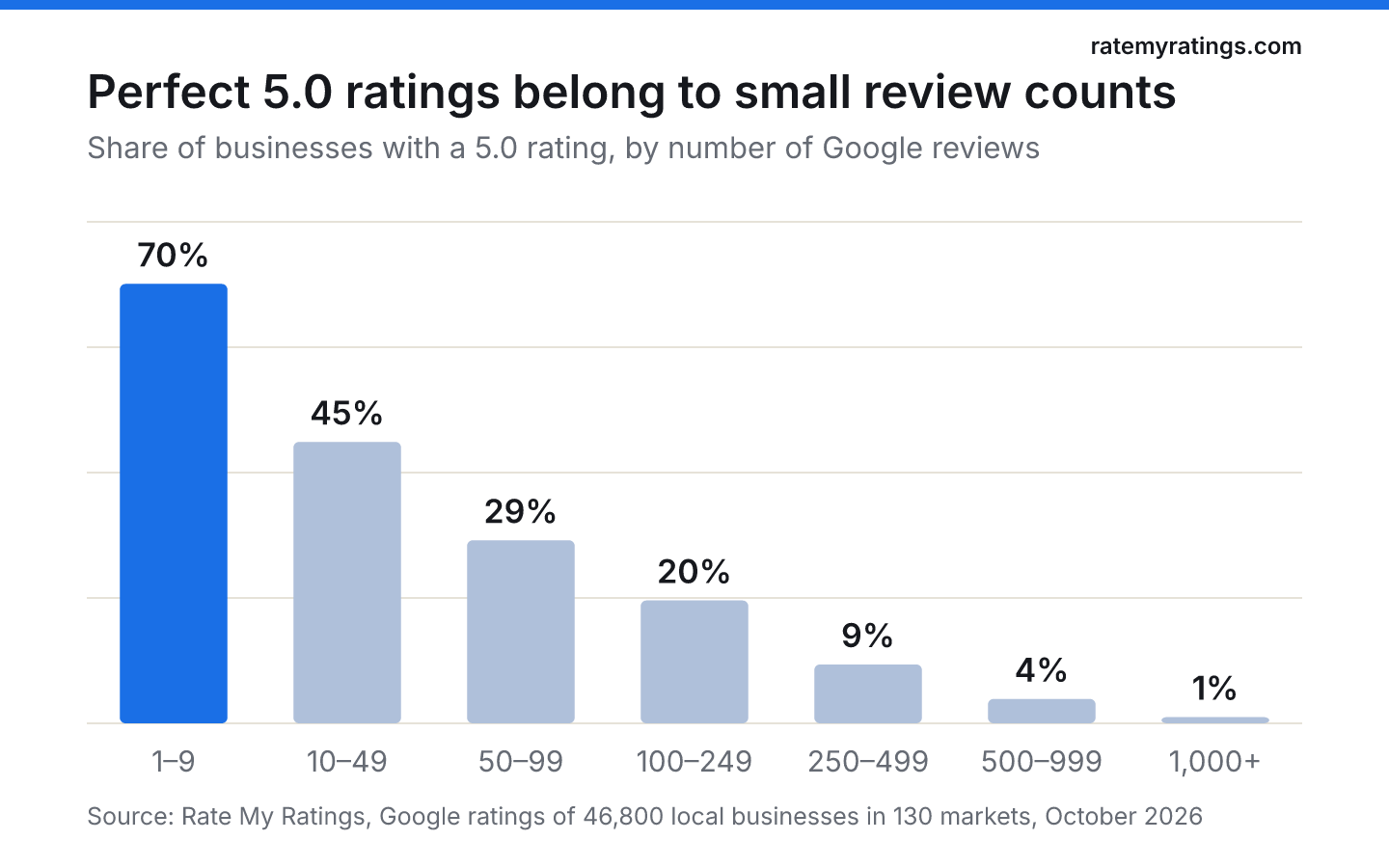
So a 4.7 from 300 reviews is a more reliable signal than a 5.0 from nine. Our article on why a business with low reviews can still be trusted covers how to read weaker ratings.
Read the most recent reviews and the worst ones
Sort by newest to see the business as it is now, then read every one- and two-star review from the past year. In the 524,000 recent Google reviews we analysed, unhappy customers write nearly three times as much as happy ones (a median of 74 words for a one-star review against 27 for a five-star one), so critical reviews tell you exactly what goes wrong. Ask whether those problems would matter to you.
Look for signs of fake reviews
Bursts of five-star reviews, reviewers with no other reviews and vague praise are the main warning signs. Google also now shows warnings on some profiles: in the UK, the Competition and Markets Authority secured commitments from Google in January 2025 to put prominent alerts on the profiles of businesses caught boosting their ratings with fake reviews. If you see one, take it seriously. Our guide on how to spot fake Google reviews has ten signs to check.
Check how the business replies
Owner replies show how a business behaves when things go wrong. In our data, 53% of reviews get a reply, usually within a day or two. Calm, specific replies that offer to put things right are a good sign. No replies to serious complaints, or replies that attack the customer, are not.
Before you pay
- Pay by card, not bank transfer. In the UK, section 75 of the Consumer Credit Act generally makes the credit card provider jointly liable for purchases costing between £100 and £30,000, and debit cards may be covered by chargeback. A bank transfer to a fraudster is much harder to recover.
- Get it in writing. A quote, an invoice with the company name, number or ABN, and clear terms.
- Never pay a stranger who contacted you first to "release" a parcel, a refund or a prize.
- For large jobs, visit or video call. A real business can show you its premises, its van or previous work.
If you think a business is a scam
- UK: report suspicious websites to the National Cyber Security Centre. If you have lost money, call your bank immediately and report it to the police fraud reporting service.
- Australia: report to Scamwatch and contact your bank.
- US: report at ReportFraud.ftc.gov.
- Leave an honest review describing what happened, factually and without abuse, so the next person can find it.
A checklist you can save
| Check | Good sign | Warning sign |
|---|---|---|
| Register (Companies House, ABN, FCA) | Active, name and address match | Missing, dissolved, recently formed, details differ |
| Google Business Profile | Real address, customer photos, reviews over time | No profile, or very new with a burst of reviews |
| Rating and review count | Good rating across many reviews | Perfect score from a handful |
| Critical reviews | Specific, minor, answered calmly | Same serious complaint repeated, unanswered |
| Accreditations | Confirmed on the scheme's own site | Logo only, not listed |
| Payment | Card accepted, written invoice | Bank transfer or crypto only, pressure to pay now |
Reviews also help with decisions beyond shopping, such as researching an employer before accepting a job. And if you are curious why people lean on Google in particular, see why people trust Google reviews.
The short version
- Confirm the business exists on an official register: Companies House in the UK, ABN Lookup in Australia, the FCA for financial firms.
- Check accreditations on the scheme's own website.
- Read reviews for patterns: rating against review count, the latest reviews, the worst reviews and the owner's replies.
- Pay by card where you can, get everything in writing and walk away from pressure.
- If something feels off after five minutes of checking, trust that feeling.
Frequently asked questions
- How can I check if a company is real in the UK?
Search the Companies House register, which is free. It shows whether a company is active, its registered office, when it was formed, its officers and its filed documents. Check the name and address match what the business told you. Sole traders do not appear there, so for small tradespeople also check accreditations, reviews over time and a real address.
- Can a business with good reviews still be a scam?
Yes. Reviews can be faked, especially on new profiles with a handful of perfect ratings. Look at how many reviews there are, whether they were written over months rather than days, whether reviewers have other reviews, and whether critical reviews describe problems you would care about. Combine reviews with an official register check before paying.
- Is a business with no reviews a red flag?
Not necessarily. New businesses and small trades often have few or no reviews: the median electrician we track has just seven. A lack of reviews means you need other evidence, such as a register entry, an accreditation you can confirm, a physical address and a written quote, rather than assuming the worst.
- What is the safest way to pay a business I don't know?
By credit card where possible. In the UK, section 75 of the Consumer Credit Act generally makes the card provider jointly liable for purchases between £100 and £30,000, and debit card payments may be recoverable through chargeback. Avoid bank transfers, cryptocurrency and gift cards with businesses you cannot verify.

Rate My RatingsNewsletter
What reviews say about local markets, in your inbox.
New articles and findings from the blog, as they're published.
Check your inbox.
If this address isn't subscribed yet, we've sent it a link to confirm. Nothing is sent until you click it.
That didn't go through. Check the email address and try again.
Hold on a moment, then subscribe again.