Why Do People Trust Google Reviews More Than Other Ratings?
Google is the review source most people consult and believe. The four reasons behind that trust, where it is deserved, and where a careful reader should look harder.
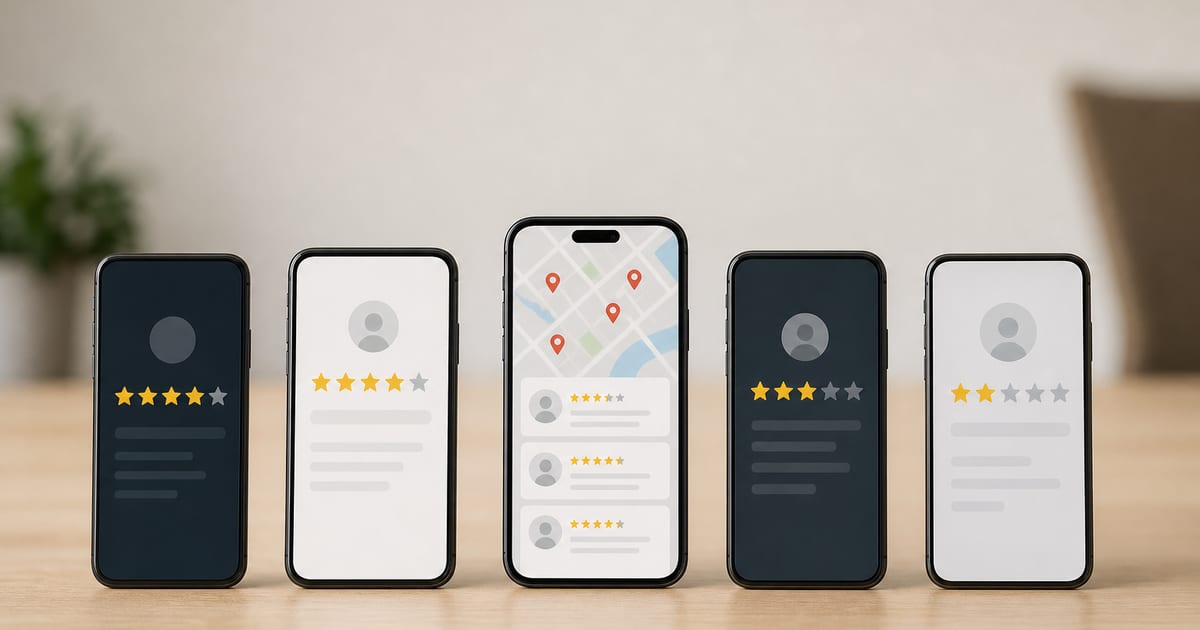
People trust Google reviews more than most other ratings for four reasons: there are far more of them, they appear exactly when people are choosing a local business, they come from named accounts with a visible history, and Google screens them before and after they go live. None of that makes every review true, but together it makes Google the most convincing crowd most people ever consult.
This article looks at why that trust exists, where it is deserved and where it is not, using consumer research and our own analysis of 524,000 recent Google reviews of local businesses in the UK and Australia.
Google is where people already are
Trust starts with familiarity. In BrightLocal's 2026 Local Consumer Review Survey, 97% of consumers said they read reviews of local businesses, and Google remained the most used source, at 71%. No other platform comes close for local services.
Reviews on Google also arrive at the moment of decision. Someone searching "vet near me" sees ratings beside each name on the map, before they have visited a single website. A Trustpilot score or a testimonial page has to be sought out; a Google rating is simply there, attached to the business, the address and the directions.
Why people trust Google reviews: the volume effect
A single review is an anecdote. Hundreds of them start to look like the truth, and Google holds far more reviews of local businesses than any rival. Across the 46,800 local businesses we track, the median has 41 Google reviews, the top quarter have 179 or more, and the top 10% have more than 540.
Volume makes ratings feel stable, and it is. In our data, the median rating falls steadily as review counts grow, from a perfect 5.0 for businesses with fewer than 10 reviews to 4.4 for those with more than 1,000. Large numbers smooth out the overexcited friends-and-family reviews that inflate a new profile, which is why a 4.6 from 600 reviews feels more trustworthy than a 5.0 from eight.
Reviews come from real accounts with a history
Every Google review is tied to a Google account with a name, a profile photo and a list of other contributions that anyone can open. That visibility is a quiet but powerful source of trust: readers can tap a reviewer and see whether they have reviewed a dozen local places over years or just this one business last Tuesday.
Much of Google's content comes from committed reviewers. In our data, 27% of recent reviews were written by Local Guides, Google's community of regular contributors, whose badges appear beside their names. At the other end, 16% came from accounts that had only ever posted one review. Most of those are genuine customers who review rarely, but readers have learned to weigh them a little less.
Research supports the instinct. Northwestern University's Spiegel Research Center found that reviews from verified buyers skew more positive than anonymous ones, and that a verified buyer badge improved the odds of purchase by 15%. Identity, even partial identity, makes reviews believable.
Google screens reviews, and says so
Google publishes how it moderates reviews, which matters for trust. It explains that every new review passes through an automated system that checks the content, the account's history and unusual activity on the business, such as a sudden burst of reviews. Human operators handle flagged content.
The scale is large. Google says it blocked or removed more than 240 million policy-violating reviews in 2024, most before anyone saw them, and it has started showing warnings on some profiles where it removed suspicious five-star reviews. In the UK, the Competition and Markets Authority secured commitments from Google in January 2025 to sanction businesses that inflate their ratings, including prominent warnings on their profiles.
People do not need to know the details to feel the effect. The sense that someone is policing the system is part of why the system is trusted.
Reviews read like real experience
Google reviews are mostly written, not just clicked. In our data, 83% of recent Google ratings include text, and critical ones are long: the median one-star review runs to 74 words. The detail that unhappy customers include (dates, names, what was promised and what happened) is exactly what makes reviews feel authentic.
Readers also see the business answer back. Over half of the reviews we analysed (53%) have a reply from the business, so readers get both sides. A platform where criticism stays visible and owners respond in public feels more honest than a hand-picked testimonial page.
Where the trust is less deserved
Trusting Google reviews is reasonable. Trusting them blindly is not.
Ratings are bunched at the top
Google ratings are generous. Of the 524,000 recent reviews we analysed, 87% were five stars and only 5% were one star; the middle barely exists.
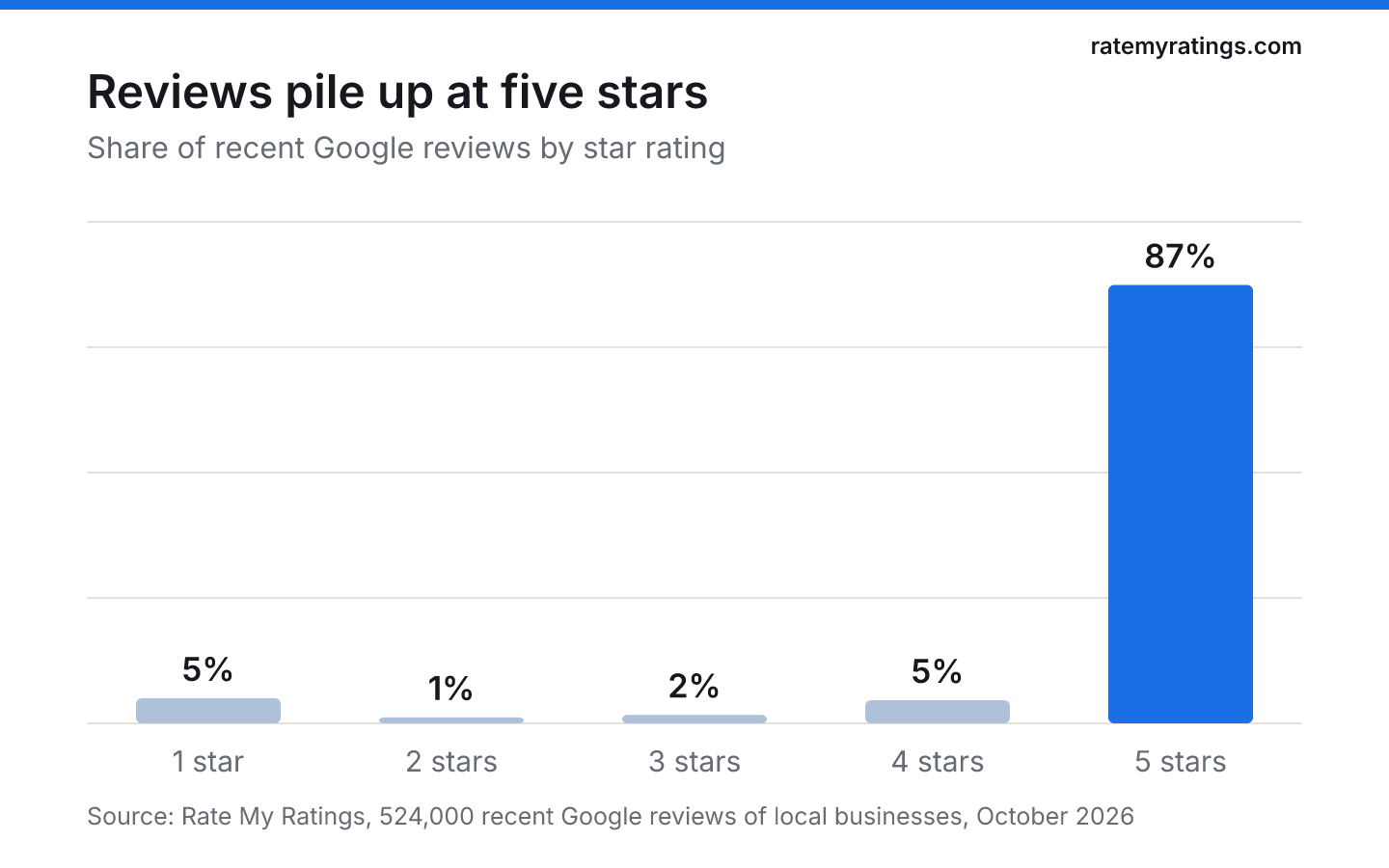
The result is that most businesses look good: the median local business we track is rated 4.8, and 74% are at 4.5 or above. The rating separates the poor from the rest, but it rarely separates the good from the excellent. That is why careful readers go to the text; our guide to what customers look for in reviews explains what they find there.
Fakes still get through
Moderation catches most fake reviews but not all, and fake negative reviews from competitors or people who were never customers are a real problem for businesses. Our guide on how to spot fake Google reviews sets out the signs.
A rating is not a guarantee
A strong rating tells you that most past customers were happy. It does not tell you a business is properly registered, insured or qualified. For bigger purchases, combine reviews with the checks in our guide to checking if a business is legit.
How Google compares with other review sources
| Source | Why people trust it | Limits |
|---|---|---|
| Google reviews | Huge volume, at the point of search, named accounts, visible replies, moderation | Ratings bunched at the top; some fakes get through |
| Independent review platforms | Dedicated to reviews, often with verification of purchase | Fewer reviews for most local services; some businesses invite only selected customers |
| Industry directories | Trade-specific, sometimes vetted members | Smaller volumes; the business may pay to be listed |
| Testimonials on a business's own site | Detailed and specific | Chosen by the business, so readers discount them |
| Friends and family | Personal knowledge | Small sample, not always available |
The BrightLocal survey found 49% of consumers trust online reviews from strangers as much as personal recommendations from people they know. For a local business, Google is where most of those strangers are.
What this means for businesses
Because people trust Google reviews, they also act on them. The best known evidence is Michael Luca's Harvard Business School study of Yelp ratings, which found a one-star rise in rating led to a 5 to 9% increase in revenue for independent restaurants. Our article on whether Google reviews bring in more sales looks at the evidence in more detail.
So the practical lessons are simple: keep reviews coming so the latest ones reflect the business today, reply to criticism calmly and specifically, and never try to shortcut the system. The same trust that makes reviews valuable is what Google and regulators protect.
The short version
- People trust Google reviews because of volume, timing, visible reviewer identity, replies from businesses and active moderation.
- 97% of consumers read local reviews, and Google is the most used source.
- The trust is mostly deserved, but ratings are bunched at the top (87% of recent reviews are five stars), so the text matters more than the number.
- Fakes still slip through, and a rating is not proof a business is licensed or insured.
Frequently asked questions
- Are Google reviews more reliable than other review sites?
For local businesses they are usually the most complete, because Google holds far more reviews than any rival, ties each one to a named account and screens new reviews automatically. That makes patterns more reliable. But Google ratings are bunched at the top, and some fakes get through, so the text of recent reviews is more informative than the star average.
- Do people trust online reviews as much as personal recommendations?
Many do. In BrightLocal's 2026 Local Consumer Review Survey, 49% of consumers said they trust online reviews from strangers as much as recommendations from people they know, and 97% said they read reviews of local businesses. Google was the most used review source, at 71% of consumers.
- Does Google check reviews before they are published?
Yes. Google says every new review goes through an automated moderation system that checks the content, the reviewer's account history and unusual activity on the business profile, with human operators handling flagged content. It reported blocking or removing more than 240 million policy-violating reviews in 2024, most before anyone saw them.
- Why are most Google reviews five stars?
Most customers who bother to rate a local business had a good experience, and people tend to use the ends of the scale rather than the middle. In our analysis of 524,000 recent Google reviews, 87% were five stars, 5% were one star and only about 8% fell anywhere in between. That is why readers look past the average to the written reviews.

Rate My RatingsNewsletter
What reviews say about local markets, in your inbox.
New articles and findings from the blog, as they're published.
Check your inbox.
If this address isn't subscribed yet, we've sent it a link to confirm. Nothing is sent until you click it.
That didn't go through. Check the email address and try again.
Hold on a moment, then subscribe again.