How to Research a Company Before Accepting a Job
An hour of checking can save you from a toxic team, a company in trouble or a fake job offer. Six checks, including the one most candidates miss: the employer's customer reviews.
To research a company before accepting a job, check four things: that it is real and financially sound (an official register and its filed accounts), what employees say about working there, what customers say about its service, and what the offer itself commits to in writing. An hour of checking can save you from a toxic team, a company in trouble or, increasingly, a fake job offer.
Most advice stops at "read Glassdoor". This guide goes further, including a source most candidates overlook: the company's customer reviews on Google, which often reveal more about day-to-day pressure than any careers page.
1. Confirm the company is real
Job scams have become common enough that this step comes first. The US Federal Trade Commission's April 2026 warning about job offer texts lists the classic signs: an unsolicited message about a job you never applied for, a vague remote role with pay but no detail, and any request to pay money or take part in paid online "tasks" such as leaving ratings or reviews. Fake recruiters often claim to represent well-known companies, so a famous name is not proof.
Before you go further, check:
- The official register. In the UK, search the Companies House register. In Australia, use ABN Lookup to check the business number is active and matches the name.
- The recruiter. Look them up on LinkedIn and check the email domain matches the company's real website.
- The process. Real employers interview you properly and never ask you to pay for training, equipment or checks up front.
2. Check whether the company is financially sound
You are about to depend on this company for your income, so it is worth a look at its health.
On Companies House you can see, free of charge, a company's officers past and present, when it was formed, its filed documents and any insolvency information. For a limited company, the filing history includes its annual accounts. Things worth noticing:
- Overdue accounts or confirmation statements. Late filing can be a sign of disorder.
- Frequent director changes in a short period.
- Charges registered against the company (secured loans), which are normal for many businesses but worth understanding.
- Insolvency notices, which are a clear red flag.
Small companies file abbreviated accounts, so you will not always see profit and loss. Even so, a balance sheet that shows net liabilities growing year after year is worth asking about politely at interview.
For larger companies, read recent news coverage and, for listed companies, the annual report. Look for redundancy rounds, restructuring and changes of ownership.
3. Read what employees say
Employer review sites such as Glassdoor and Indeed carry reviews from current and former staff. Read them the way you would read any reviews:
- Sort by most recent. A company can change a lot after new management arrives.
- Look for patterns, not outliers. One furious review is a story; ten describing the same manager or the same overtime culture is evidence.
- Read the middle ratings. Three-star reviews are often the most balanced.
- Check the role and location. Reviews from the warehouse may not describe life in head office.
Treat employer reviews with the same caution as any other reviews: they are written disproportionately by people who feel strongly. Our guide to spotting fake reviews applies here too; a sudden wave of glowing employee reviews after a run of bad ones is a warning sign.
4. Read what customers say: the source candidates miss
If the company serves the public (a dental practice, a vet group, an estate agent, a garage, a hotel), its Google reviews are an underrated window into what working there is like. Customers describe the symptoms of a stretched or badly run team long before employees go public.
In our analysis of 524,000 recent Google reviews of local businesses in the UK and Australia, the themes in one- and two-star reviews are mostly about process rather than the core work: 22% mention communication problems such as calls not returned, 22% mention booking problems, 18% mention waiting and delays, and 17% mention rude or unprofessional staff.
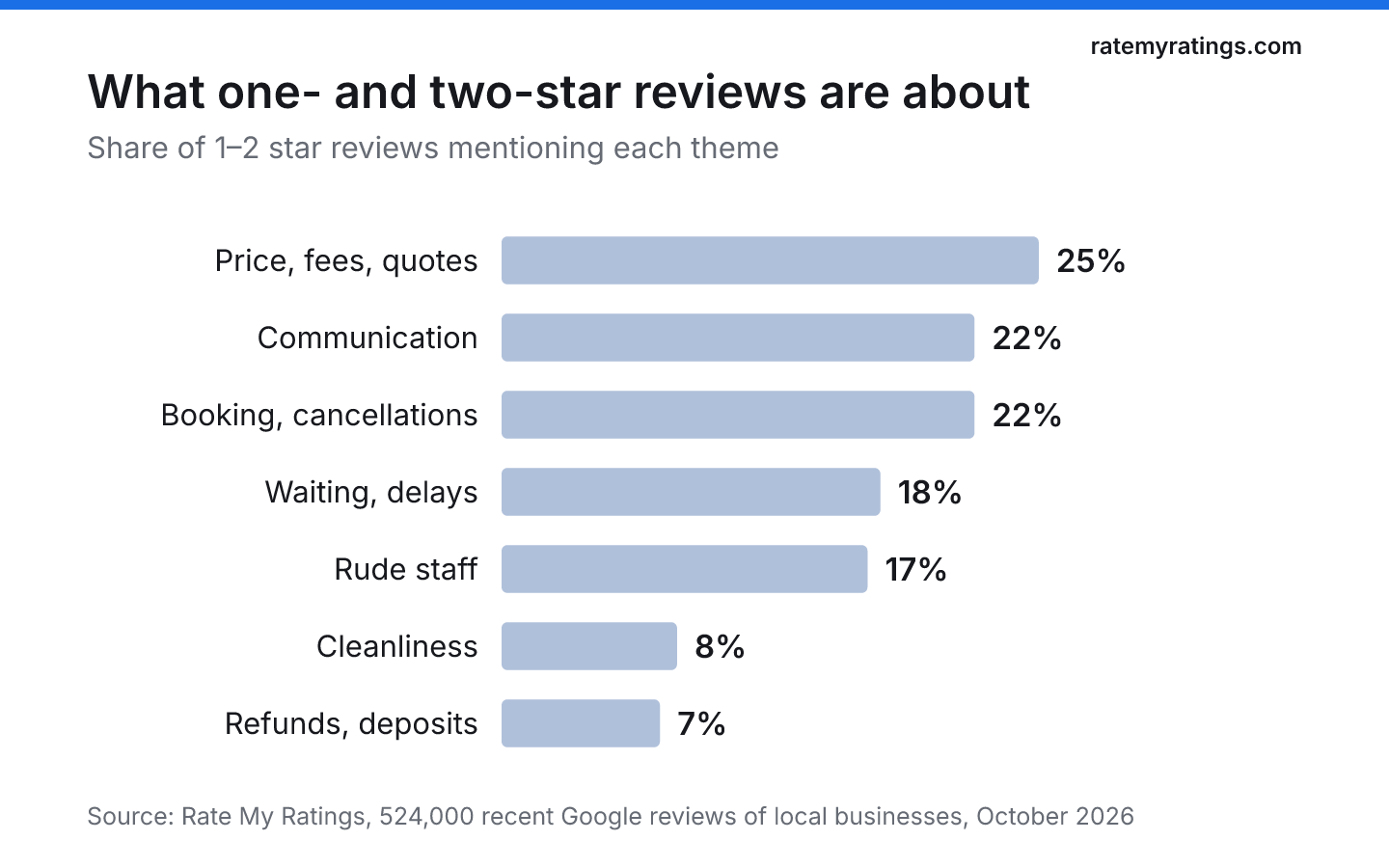
When those complaints cluster at one employer, they often point to too few staff, poor systems or high turnover, and the people who absorb the customers' frustration are the front-line team you would be joining. Things to look for:
- "Nobody answers the phone" or "never called back" repeated across months: understaffing.
- Customers naming different staff every few months: turnover.
- Complaints that start suddenly after years of good reviews: a change of owner or manager.
- The tone of the owner's replies. A manager who argues with customers in public will rarely treat staff better in private. In our data, 53% of reviews get a reply; calm, specific replies suggest a business that learns from problems.
Our guide to what customers look for in reviews explains how to read a profile quickly, and our competitor analysis method shows how to compare one business with others nearby, which can tell you whether a complaint is about this employer or the whole sector.
5. Check the offer in writing
Before you resign from your current job, make sure the offer is concrete. In the UK, employers must give employees a written statement of employment particulars, and the main part of it is due on your first day. It must cover, among other things, your pay and how often it is paid, hours and days of work, holiday entitlement, place of work, any probation period and the employer's name.
Ask for the key terms in writing before you accept: salary, hours, notice period, probation, benefits and start date. If an employer is reluctant to put basic terms on paper before you start, that tells you something.
6. Ask good questions at interview
Your research should give you specific questions. Some that tend to get honest answers:
- "Why is this role open?" (Growth or replacement? How long did the last person stay?)
- "How many people have joined and left this team in the past year?"
- "What does a busy week look like, and what happens when the team is short?"
- "I noticed customers mention wait times on your Google reviews. How is the team handling that?"
The last one, asked politely, shows you have done your homework, and the answer will tell you whether management sees the problem.
Checklist: how to research a company before accepting a job
| Check | Where | Red flags |
|---|---|---|
| Company is real | Companies House, ABN Lookup, LinkedIn | Not listed, details differ, recruiter email on a free domain |
| Financial health | Companies House filings, news | Overdue accounts, insolvency notices, repeated restructuring |
| Employee experience | Employer review sites, LinkedIn tenure | Repeated complaints about the same manager or overtime |
| Customer experience | Google reviews | Recurring communication, waiting or staff complaints; hostile replies |
| The offer | Written terms | Vague pay, no written terms, any request for money |
For a broader set of credibility checks on any business, see our guide to checking if a business is legit.
The short version
- Confirm the company and recruiter are real before anything else; never pay to get a job.
- Check Companies House (or ABN Lookup) for status, filings and insolvency.
- Read employee reviews for recent patterns, not single stories.
- Read customer reviews on Google: complaints about phones, waiting and staff often reveal a stretched team.
- Get the key terms in writing before you resign from your current job.
Frequently asked questions
- How do I check if a job offer is real?
Check the company on an official register such as Companies House or ABN Lookup, confirm the recruiter on LinkedIn and make sure their email uses the company's real domain. Be wary of unsolicited messages, vague remote roles and any request to pay money or complete paid online tasks such as rating products. Real employers never ask you to pay to get a job.
- Can I see a company's finances before accepting a job?
For UK limited companies, yes, partly. Companies House shows filed documents for free, including annual accounts, officers and any insolvency information. Small companies file abbreviated accounts, so profit is not always visible, but you can see overdue filings, growing liabilities and director changes. For listed companies, read the annual report and recent news.
- Are Glassdoor reviews reliable?
They are useful when read for patterns. Sort by most recent, look for complaints repeated by several people, read the middle ratings, and check the reviewer's role and location. Like all reviews, they come disproportionately from people with strong feelings, and a sudden burst of glowing reviews after a run of bad ones is a warning sign.
- What should a job offer include in writing?
At minimum: salary and how often it is paid, hours and days of work, holiday entitlement, place of work, probation, notice period, benefits and start date. In the UK, employers must provide a written statement of employment particulars, with the main part due on your first day, but it is wise to get the key terms in writing before you resign.

Rate My RatingsNewsletter
What reviews say about local markets, in your inbox.
New articles and findings from the blog, as they're published.
Check your inbox.
If this address isn't subscribed yet, we've sent it a link to confirm. Nothing is sent until you click it.
That didn't go through. Check the email address and try again.
Hold on a moment, then subscribe again.