What Makes People Trust a Business With Low Reviews?
A 3.8 with honest detail can beat a 5.0 with nothing behind it. What makes customers trust a business with a low rating or few reviews, and what makes them walk away.

People trust a business with low reviews when the reviews they can read explain the score: the complaints are specific and fixable, the owner replies calmly, recent reviews are better than old ones, and the praise sounds real. A 3.8 with honest detail can win more customers than a 5.0 with nothing behind it. What people rarely forgive is silence, vagueness or a rating that looks too good to be true.
"Low reviews" means two different things, and both matter: a low star rating, or very few reviews. This article covers both, using what consumer research says about how people read reviews and what we see in the Google ratings of 46,800 local businesses we track across the UK and Australia.
What "low" actually means on Google today
Ratings on Google are high across the board. In our data, the median local business is rated 4.8, and 74% of businesses sit at 4.5 or above. Only 9% are below 4.0.
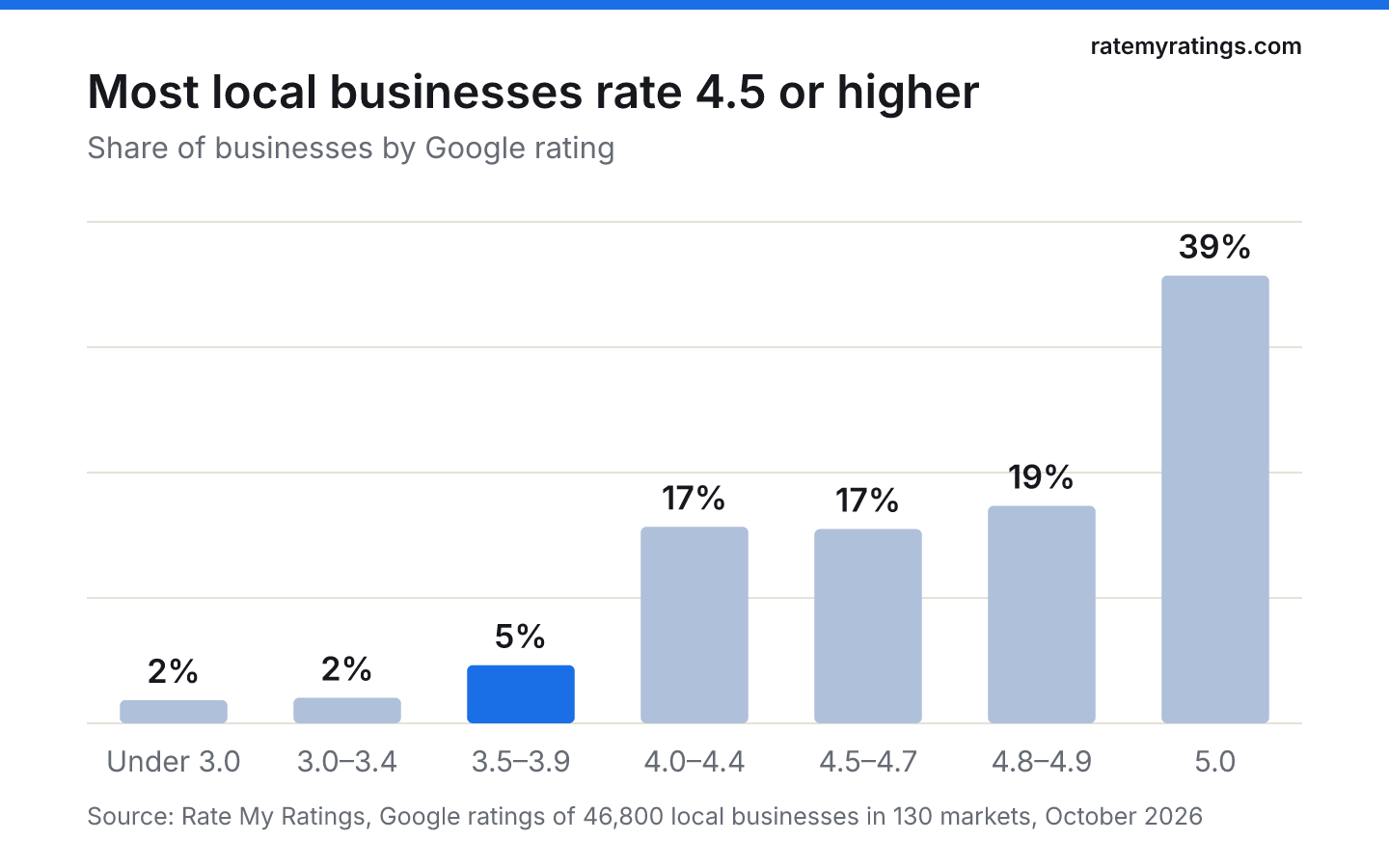
That changes what customers expect. In the 2026 edition of BrightLocal's Local Consumer Review Survey, 68% of consumers said they need a business to have at least four stars before they will use it, and 31% said 4.5 or more. So a business rated 3.9 is not "nearly four"; to many searchers it is below the line.
But category matters enormously. A 4.4 is ordinary for a restaurant (the median restaurant we track is rated 4.4) and weak for a physiotherapist (median 5.0). Supermarkets have a median of 4.0, and 38% of them sit below four stars. Our guide to what counts as a good Google rating has the figures by trade.
Why a perfect score can be less trusted than a slightly lower one
The most useful finding in review research is that people do not simply prefer the highest number. Northwestern University's Spiegel Research Center found that purchase likelihood typically peaks for ratings between 4.0 and 4.7, then falls as ratings approach 5.0, because a perfect score can seem too good to be true. In the same BrightLocal survey, only 10% of consumers said they require five stars.
Our data shows why shoppers are right to be wary. Perfect scores are mostly a feature of small numbers: 70% of businesses with fewer than 10 Google reviews have a 5.0, compared with 20% of those with 100 to 249 reviews and 1% of those with 1,000 or more. As reviews accumulate, almost every business picks up a few critics. A 4.6 across 400 reviews is a proven track record; a 5.0 from six reviews is a promising start.
What makes people trust a business with low reviews
When the headline number is weak, customers go looking for reasons. These are the ones that persuade them.
The complaints are understandable
A customer reading one-star reviews is asking: would this happen to me? Complaints about a car park, a long wait on a Saturday or a price that felt high are things people can weigh up. Complaints about rudeness, dishonesty or poor core work are not. In the recent Google reviews we analysed, one- and two-star reviews mostly describe process problems (a quarter mention price or fees; about one in five mention communication, booking or waiting) rather than the quality of the work itself.
The owner replies, and replies well
A calm, specific reply under a bad review tells the reader two things: someone is listening, and the business will try to put things right. A defensive reply does more damage than the original review. Across our data, 53% of reviews get a reply from the business, but three-star reviews are answered least, at 42%. See our guide on responding to negative Google reviews for wording that works.
Recent reviews are better than the average
Readers care far more about the last few months than the last few years. BrightLocal found 74% of consumers only care about reviews written in the past three months. If a business with low reviews has a run of good recent ones, many customers will read it as a business that has improved, not one that is bad.
The praise is specific
Five-star reviews that name a member of staff, describe a problem solved or mention a detail only a real customer would know do more to offset a low score than any number of "great service!" reviews. In our data, 41% of five-star reviews mention friendly or helpful staff and 23% mention professionalism or expertise. Detail is what makes praise believable.
There are enough reviews to judge
A 3.9 from 15 reviews is volatile; two more good reviews could lift it past 4.0. A 3.9 from 900 reviews is a settled verdict. Spiegel's research found that a product with five reviews had a purchase likelihood 270% higher than one with none, and that the gains slow after the first handful. Readers want enough reviews to see a pattern, not necessarily hundreds.
What destroys trust in a business with low reviews
- No replies at all, especially to serious complaints.
- Arguing with customers in public, or revealing private details.
- A sudden wave of glowing reviews right after a run of bad ones. It looks manufactured, and Google's systems watch for exactly this pattern. Our guide on spotting fake Google reviews explains the signals.
- The same complaint, over and over, for months, with no sign of a fix.
Does a low rating actually cost sales?
Yes, measurably, at least for independent businesses. The best known evidence is Michael Luca's Harvard Business School study of Yelp ratings, which found that a one-star increase in a restaurant's rating led to a 5 to 9% increase in revenue. The effect was driven by independent restaurants; ratings did not affect chain restaurants, whose brand already tells customers what to expect.
That is the core of the problem for a small business: without a famous name, your reviews are your reputation. Our article on whether a 3.5 rating hurts compared with 4.5 goes into the competitive maths.
If you are the business with low reviews
You cannot delete reviews or switch them off, so the way forward is the same three steps in every market we study.
- Fix the thing people keep complaining about. Read your last 30 critical reviews and tag the themes. One recurring problem usually accounts for most of the damage. Our guide to turning one-star reviews into opportunities shows how.
- Reply to every critical review from the last year, briefly and without arguing, and keep replying to new ones within a day or two.
- Ask every happy customer for a review, consistently, so your recent reviews reflect the business as it is now. A low score from few reviews moves quickly; a low score from many moves slowly, which is why steady asking matters more than a one-off push.
If you want to know where you stand against the businesses around you, a Rate My Ratings market report benchmarks every competitor's rating, review count and themes in your category and area.
The short version
- On Google, "low" now starts below about 4.0. Most local businesses rate 4.5 or higher.
- People do not demand perfection: purchase likelihood tends to peak between 4.0 and 4.7, and perfect scores mostly come from small review counts.
- Trust in a business with low reviews comes from understandable complaints, good replies, better recent reviews and specific praise.
- Silence, arguments and suspicious bursts of praise destroy it.
- The fix is operational first, then replies, then a steady flow of new reviews.
Frequently asked questions
- Would you use a business with a 3.5 star rating?
Many people would, if the reviews explain the score. Consumer surveys show most people want at least four stars, so a 3.5 starts at a disadvantage, but readers look at why it is low. Specific, fixable complaints, calm owner replies and better recent reviews can win customers back. In our data, a 3.5 puts a business in roughly the bottom 5% of local businesses.
- Why do people distrust perfect 5-star ratings?
Because perfection is rare once a business has many customers. In our data, 70% of businesses with fewer than 10 Google reviews have a 5.0, but only 1% of those with 1,000 or more do. Research from Northwestern University's Spiegel Research Center found purchase likelihood typically peaks between 4.0 and 4.7 stars, as a perfect score can look too good to be true.
- How many reviews does a business need to be trusted?
There is no fixed number, but the first few reviews matter most. Spiegel Research Center found a product with five reviews was 270% more likely to be bought than one with none, with smaller gains after that. For local businesses, what counts is having enough recent reviews for a pattern to show, judged against what is normal in your trade.
- Can a business remove its bad Google reviews?
No. Businesses cannot delete reviews or turn reviews off on Google. They can report a review that breaks Google's policies, such as spam or a review from someone who was never a customer, and Google decides whether to remove it. For genuine negative reviews, the effective response is a calm public reply and fixing the underlying problem.

Rate My RatingsNewsletter
What reviews say about local markets, in your inbox.
New articles and findings from the blog, as they're published.
Check your inbox.
If this address isn't subscribed yet, we've sent it a link to confirm. Nothing is sent until you click it.
That didn't go through. Check the email address and try again.
Hold on a moment, then subscribe again.