
How to Turn One-Star Reviews Into Opportunities
A one-star review is the most detailed feedback you will get, and the most read. What to do after you reply: recover the customer, fix the cause, and let the review show future customers how you handle problems.

One-star reviews hurt, but they are also the most detailed, most specific and most widely read feedback a business gets. You turn them into opportunities in five steps: reply calmly and quickly, contact the customer privately to put things right, find the process that failed, fix it, and then let your public reply show future customers that you listened. Done well, a one-star review becomes evidence that you handle problems properly, which is exactly what a cautious buyer is looking for.
This guide is about what happens after the reply. If you need help with the wording itself, start with our guide on how to respond to negative Google reviews.
What one-star reviews look like across a whole market
We read the public Google reviews of every business in a category and area. Across 524,000 recent reviews of local businesses in the UK and Australia, a few facts about one-star reviews stand out:
- They are rare. 5% of reviews are one-star, against 87% five-star.
- They almost always explain themselves. 89% include written text.
- They are long. The median one-star review is 74 words, nearly three times the 27 words of a typical five-star review.
- Only about half get a reply. 53% of one-star reviews have a response from the business, and those replies take longer to arrive (a median of 1.7 days) than replies to positive reviews.
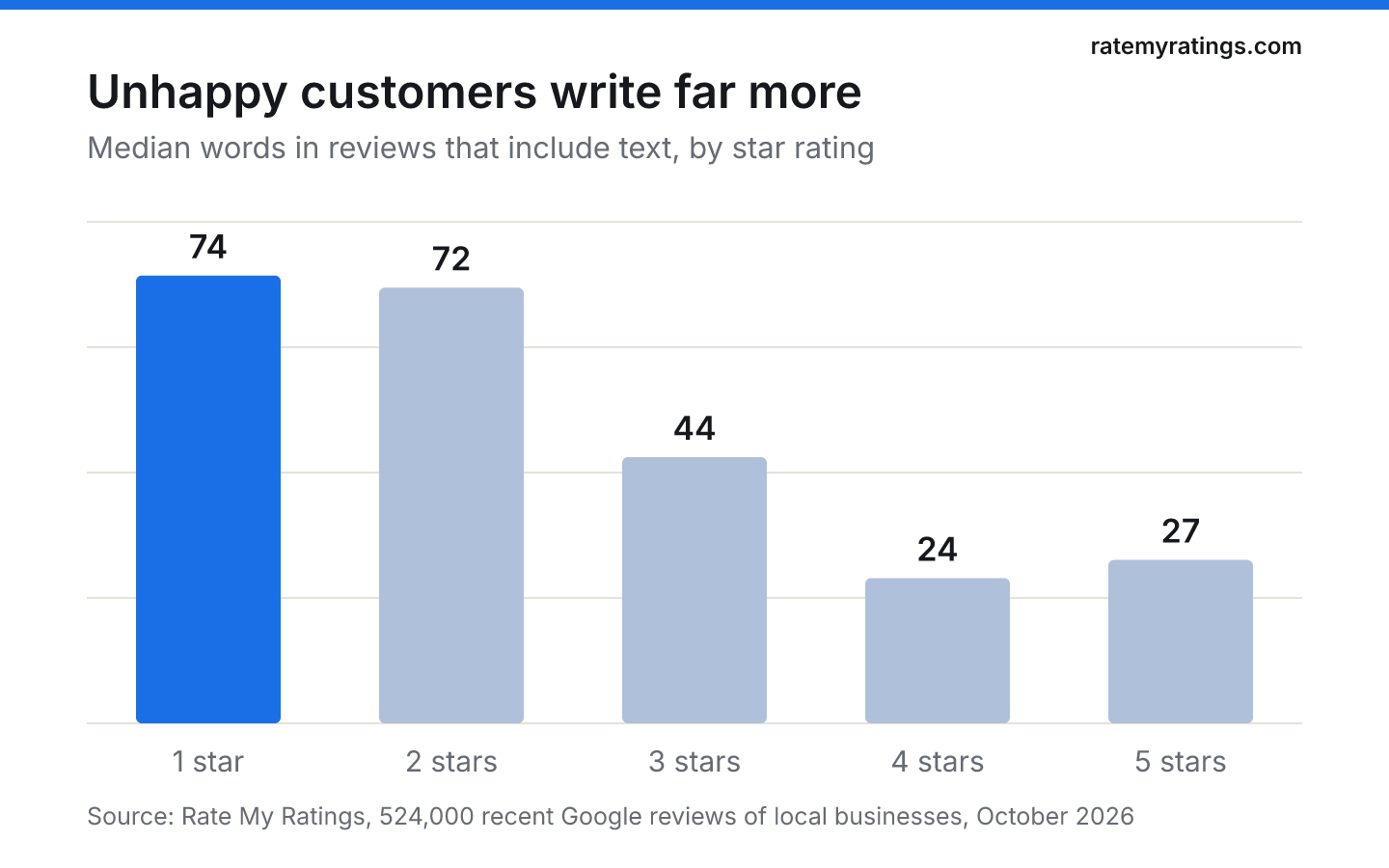
That length is the opportunity. A five-star review tells you a customer was happy. A one-star review usually tells you exactly when, where and how something went wrong: who they spoke to, how long they waited, what they were charged, what they were told. No survey would get you that much detail.
Why one-star reviews are not the disaster they feel like
Readers expect some criticism. Research from Northwestern's Spiegel Research Center found that purchase likelihood tends to peak at ratings between 4.0 and 4.7, falling as ratings approach a perfect 5.0, and that negative reviews can establish credibility and authenticity. A profile with no criticism at all can look too good to be true.
That does not make bad reviews harmless. BrightLocal's 2026 Local Consumer Review Survey found negative reviews put off 77% of consumers. The difference between a one-star review that costs you customers and one that reassures them is what surrounds it: how many good reviews sit around it, whether you replied, and whether the problem appears to have been fixed.
Step 1: Reply publicly within a day or two
The public reply is for everyone who reads the review after it. Keep it to four to six sentences: thank them, acknowledge the specific problem, take responsibility for your part, say what you are changing, and give a direct contact. Never argue the details in public or reveal information about the customer.
Step 2: Recover the customer privately
If you can identify the customer, contact them directly: a phone call is usually better than an email. The goal is not to get the review removed. It is to solve their problem, which is the only thing that genuinely changes how they feel.
- Listen first. Let them tell the whole story again, even though you have read it.
- Fix what can be fixed. Redo the work, correct the bill, rebook the appointment.
- Make a proportionate gesture where it is deserved, and never make it conditional on changing the review.
Recovery does not always work. Some customers will not take your call. That is fine; your public reply has already done the work for readers.
Step 3: Find the process that failed
Treat the review as an incident report. Ask what step in your process produced the problem, not who was to blame. In our data, one- and two-star reviews cluster around process failures: price, fees or quotes appear in 25% of them, communication in 22%, booking and cancellations in 22%, and waiting or delays in 18%. Rude staff are mentioned in 17%.
Some questions that usually find the cause:
- Was the customer told the price before the work started, in writing?
- Who was responsible for updating them when something changed, and did they know that?
- Did the booking system allow something it should not have, such as a double booking?
- Has this complaint appeared before, in other reviews or in complaints that never became reviews?
Then check your other reviews for the same theme. One review is an anecdote; the same complaint in five reviews is a pattern. Our guide on how to use customer reviews to improve your business shows how to tag reviews and count themes.
Step 4: Fix it, and tell the team
Write the fix as a rule someone can follow on a busy day, such as "every estimate over £200 is sent by email before work starts", not "be clearer about prices". Share the review and the new rule at a team meeting. Read the review out without naming the staff member involved; the point is the process, not the person.
Teams respond well to this when it is consistent. If every one-star review leads to one small, concrete change, staff stop seeing reviews as blame and start seeing them as useful.
Step 5: Close the loop in public
Once something has changed, go back to your reply and update it, or add a line: "Since your visit we've introduced written estimates for all treatments over £200." Google's help page on managing reviews explains that the reviewer is notified when you reply and can change their review at any time. If you have genuinely put things right privately, it is reasonable to ask whether they would consider updating their review. Many do. Some will not, and that is their right.
Every future reader now sees a complaint, a calm reply and a concrete change. That sequence is more persuasive than another five-star review.
Turn one-star reviews into marketing, carefully
The complaint that keeps coming up in your one-star reviews is also an objection many silent customers share. Answer it before they ask:
- On your website: if customers worry about surprise costs, publish how your pricing works.
- At the point of booking: if people complain about waiting, say what happens when appointments run late.
- In your review requests: if customers praise how a problem was handled, that is a story worth telling.
Look at your competitors' one-star reviews too. If every garage in your area is criticised for not calling when a job overruns, being the one that always calls becomes a reason to choose you. Our guide on competitor analysis using Google reviews explains how to do this systematically, and a Rate My Ratings market report does it for every business in your category and area.
When a one-star review is not genuine
Some one-star reviews are fake, from competitors, former employees or people who were never customers. Those can be reported to Google, though only reviews that break Google's policies are removed. Our guides on removing a false Google review and spotting fake Google reviews cover what qualifies. Reply politely even while a report is pending.
Keep one-star reviews in proportion
A single one-star review moves a small profile a long way. Of the 46,800 businesses we track, a quarter have eight or fewer Google reviews, and one bad review there can drop the average by half a star. On a profile with a few hundred reviews, it barely registers. The steady answer to one-star reviews is a steady flow of genuine reviews from happy customers. Our guide to getting more Google reviews covers how to build one without nagging.
The short version
One-star reviews are detailed, widely read and, in our data, only 5% of reviews. Reply calmly within a day or two, recover the customer privately, trace the complaint to the process that failed, fix it, and tell your team. Then update your reply to show what changed. A critical review followed by a visible fix is some of the most convincing evidence a business can put in front of future customers.
Frequently asked questions
- Can a one-star review actually help a business?
It can. Research from Northwestern's Spiegel Research Center found that negative reviews can establish credibility and that purchase likelihood tends to peak at ratings between 4.0 and 4.7, not at a perfect 5.0. A few critical reviews with calm, constructive replies make the good reviews more believable and show readers how you handle problems.
- Should I ask a customer to change their one-star review?
Only after you have genuinely fixed the problem, and only by asking whether they would consider updating it, never as a condition of a refund or goodwill gesture. Google notifies reviewers when you reply and they can edit their review at any time. Making compensation conditional on a changed review is an incentivised review.
- How many one-star reviews is normal?
Some is normal for any busy business. In our analysis of 524,000 recent Google reviews of local businesses, 5% were one-star. A business with no criticism at all is usually a business with very few reviews. What matters more is the trend over time, whether complaints repeat, and how you respond.

Rate My RatingsNewsletter
What reviews say about local markets, in your inbox.
New articles and findings from the blog, as they're published.
Check your inbox.
If this address isn't subscribed yet, we've sent it a link to confirm. Nothing is sent until you click it.
That didn't go through. Check the email address and try again.
Hold on a moment, then subscribe again.