
How to Use Customer Reviews to Improve Your Business
Your reviews are free, unprompted customer research. A simple monthly method for turning them into operational changes, based on what half a million local reviews actually talk about.

To use customer reviews to improve your business, treat them as research rather than reputation: collect every review in one place, tag each one by theme (price, communication, waiting, staff and so on), count which themes recur, fix the process behind the most common complaint, and then watch whether that theme fades from new reviews. Do it monthly. The whole method takes an hour or two, and it uses feedback your customers have already written for free.
Most businesses read reviews one at a time, as they arrive, and react to each as an event. That is the right way to reply, but the wrong way to learn. One review is an anecdote. Forty reviews are data.
Why reviews are better research than you think
Reviews have three qualities that surveys and feedback forms struggle to match:
- They are unprompted. Nobody asked the customer about waiting times; they mentioned it because it mattered to them.
- They are written after the customer paid. The feedback comes from people who actually used the service, not from people imagining they might.
- They cover your competitors as well. You can read the same feedback about every business your customers compare you with.
They also come with a known bias: people review when they are delighted or annoyed. Across 524,000 recent Google reviews of local businesses we have collected, 87% are five-star and 5% are one-star, with the middle very thin. Keep that in mind: reviews tell you what matters and what goes wrong, not what an average customer felt.
What reviews are actually about
Before you build your own themes, it helps to know what local business reviews usually discuss. When we matched keywords across our reviews, a clear split appeared between praise and complaints.
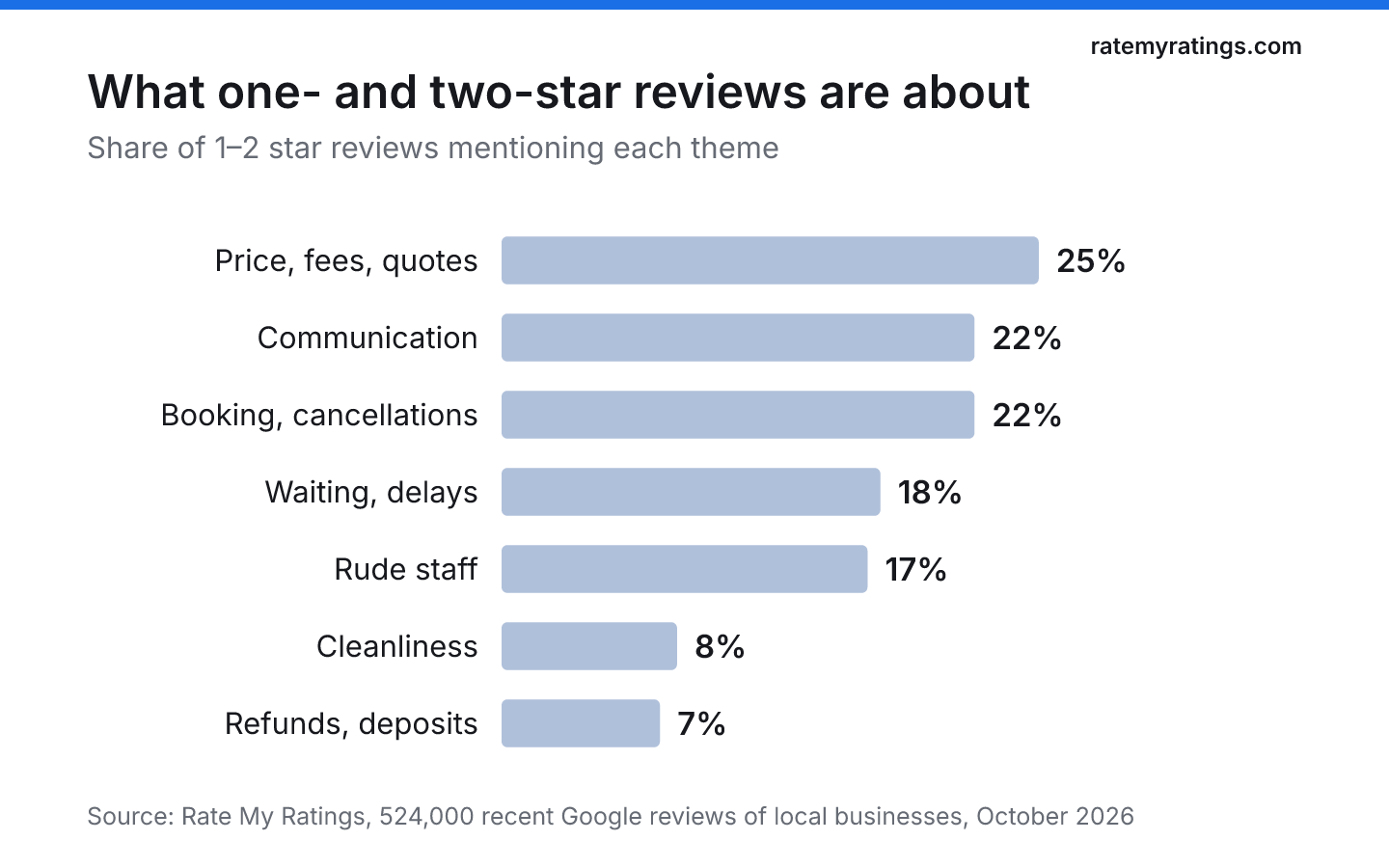
Five-star reviews are mostly about people: 41% mention friendly, helpful or kind staff, and 23% mention someone being professional, knowledgeable or explaining things well. One- and two-star reviews are mostly about process: price surprises, unreturned calls, cancelled appointments and long waits. Rude staff appear in 17% of negative reviews, but it is the systems around the staff that generate most complaints.
That split is good news. Processes are fixable in a way personalities are not. A clear written quote, a call-back rule or a text when an appointment is running late can remove an entire category of one-star reviews.
How to use customer reviews to improve your business, step by step
1. Collect every review in one place
Copy your reviews from Google, and from Facebook, Trustpilot or your industry's directory if customers use them, into a spreadsheet: one row per review with the date, star rating, platform and full text. Start with the last 12 months. Do it monthly after that, which takes ten minutes.
If English is not the only language your customers write in, include the others. In our data, 15% of Google reviews were written in another language, and they are easy to overlook.
2. Tag each review with one or two themes
Use a short, fixed list so the counts are comparable month to month. For most service businesses this works:
| Theme | What it covers |
|---|---|
| Price and value | Cost, quotes, fees, surprise charges, value for money |
| Communication | Calls, emails, updates, being kept informed |
| Booking | Availability, appointments, cancellations, online booking |
| Waiting | Lateness, queues, delays, turnaround time |
| Staff | Friendliness, attitude, named team members |
| Expertise | Quality of the work, explanations, results |
| Premises | Cleanliness, parking, access, comfort |
Tag the positive reviews too. A theme that appears in praise is one to protect.
3. Count, then rank
After tagging, count how often each theme appears in one- to three-star reviews, and separately in four- and five-star reviews. Rank the negative themes by frequency. The top one is your first project.
Read the three-star reviews with special care. They are the most balanced reviews you will get, usually naming one good thing and one bad thing. In our data they are also the reviews businesses reply to least: only 42% have an owner reply, against 53% of one-star reviews.
4. Find the process behind the theme
A theme is a symptom. Ask what step in your process produces it. "Price" complaints at a dental practice usually trace back to estimates given verbally rather than in writing. "Communication" complaints at a garage usually trace back to nobody owning the call when a job overruns. "Waiting" complaints at a vet usually trace back to emergency cases with no system for warning the rest of the waiting room.
Write the fix as a rule someone can follow: "Every treatment over £100 gets a written estimate before work starts", not "be clearer about prices".
5. Fix one thing, then check
Change one process at a time, so you can tell what worked. Then watch new reviews for that theme over the next two or three months. If complaints about it fall, keep the change and move to the next theme. If they do not, the cause was somewhere else.
6. Close the loop in public
When a review raises something you have since fixed, say so in your reply. Google's help page on managing reviews notes that reviewers are notified of replies and can still change their review. A reply that says "we've introduced written estimates since your visit" is also evidence of improvement for everyone else reading. Our guide on how to respond to negative Google reviews has a structure for these replies.
Use the length of reviews as a signal
Unhappy customers write much more. The median one-star review in our data is 74 words, against 27 words for a five-star review. Long negative reviews often contain a full timeline of what went wrong: when they called, who they spoke to, what they were told. That makes them the most useful reviews for finding the broken step, even when the tone is hard to read.
Short reviews are useful in aggregate. "Lovely staff" in 50 reviews tells you something about your team. "Great value" turning up less often than it used to may be the earliest warning that a price rise is being noticed.
Read your competitors' reviews too
Your own reviews tell you how you are doing. Your competitors' reviews tell you where the openings are. If every estate agent in your town is criticised for not returning calls, being the one that does becomes a selling point. If every wedding venue nearby is praised for its coordinator, a weak coordinator is a bigger problem for you than it looks.
This is the approach behind our market reports: reading the reviews of every business in a category and area, so a business sees the whole field, not only its own feedback. You can do a smaller version by hand, and our guide to competitor analysis using Google reviews shows how.
Mistakes to avoid
- Reacting to the loudest review. One furious review is not a trend. Act on counts, not on how a review made you feel.
- Only reading the bad ones. Praise tells you what to protect and what to say in your marketing.
- Changing everything at once. You lose the ability to see what worked.
- Ignoring patterns because individual reviews seem unfair. A review can be exaggerated and still point to a real gap. BrightLocal's 2026 consumer survey found the top thing consumers look for is a review "backed up by other reviews with similar sentiment"; your future customers are counting patterns too.
- Hiding from criticism. Research from Northwestern's Spiegel Research Center found that negative reviews can help establish credibility. A business that visibly learns from them looks more trustworthy, not less.
Going further
Reviews show what customers volunteer. To test a specific idea, such as a new opening time or a price change, ask directly. Our guides to customer pain points questions and to what customers look for in reviews are good next steps.
The short version
Treat reviews as research. Collect them monthly, tag each by theme, count the themes in your negative and positive reviews, and fix the process behind the most common complaint first. Most complaints are about process (price clarity, communication, booking and waiting), which is why they can be fixed. Check new reviews to see whether the fix worked, say so in your replies, and read your competitors' reviews to see where the market is failing customers.
Frequently asked questions
- How many reviews do you need before the patterns mean anything?
Fewer than you might think, as long as you look across time. Twenty or thirty reviews that mention the same issue in similar words are a clear signal. With a small review count, add your competitors' reviews: the complaints customers make about businesses like yours usually apply to you too, and they give you a much larger sample.
- Should you focus on negative or positive reviews?
Both, for different reasons. Negative reviews tell you which process is failing, usually price clarity, communication, booking or waiting. Positive reviews tell you what customers value enough to mention, usually particular staff and expertise, which is what to protect and put in your marketing. Three-star reviews are often the most useful of all, because they are specific and fair.
- What tools do you need to analyse customer reviews?
For one business, a spreadsheet is enough: one row per review, columns for date, stars, theme and action. Copy reviews in monthly and tag them by hand. Beyond a few hundred reviews, or when you want to compare a whole local market, software or a market report that groups reviews by theme saves days of reading.

Rate My RatingsNewsletter
What reviews say about local markets, in your inbox.
New articles and findings from the blog, as they're published.
Check your inbox.
If this address isn't subscribed yet, we've sent it a link to confirm. Nothing is sent until you click it.
That didn't go through. Check the email address and try again.
Hold on a moment, then subscribe again.