
Does a 3.5 Star Rating Hurt Your Business Compared to 4.5 Stars?
Yes, and by more than most owners think. A 3.5 sits below the line two in three customers draw, while 4.5 is now close to the middle of the pack. Here is what the gap costs and how to close it.

Yes. A 3.5 star rating hurts most local businesses badly compared with 4.5, for two reasons. First, it falls below the line many customers draw before they will even consider a business: in one large consumer survey, 68% said they need at least four stars. Second, it is rare. Across the 46,800 local businesses whose Google ratings we track, only about 4% are rated below 3.5 and 9% below 4.0, so a 3.5 typically sits in the bottom 5% of its market, while 4.5 is close to the middle.
The gap between those two numbers is not one star of quality. It is the difference between being on the shortlist and being skipped. This article shows where each rating sits, what the gap is likely worth, and how to close it.
Where a 3.5 star rating puts you
Here is how the ratings of the businesses we track are spread. The 3.5 to 3.9 band is highlighted.
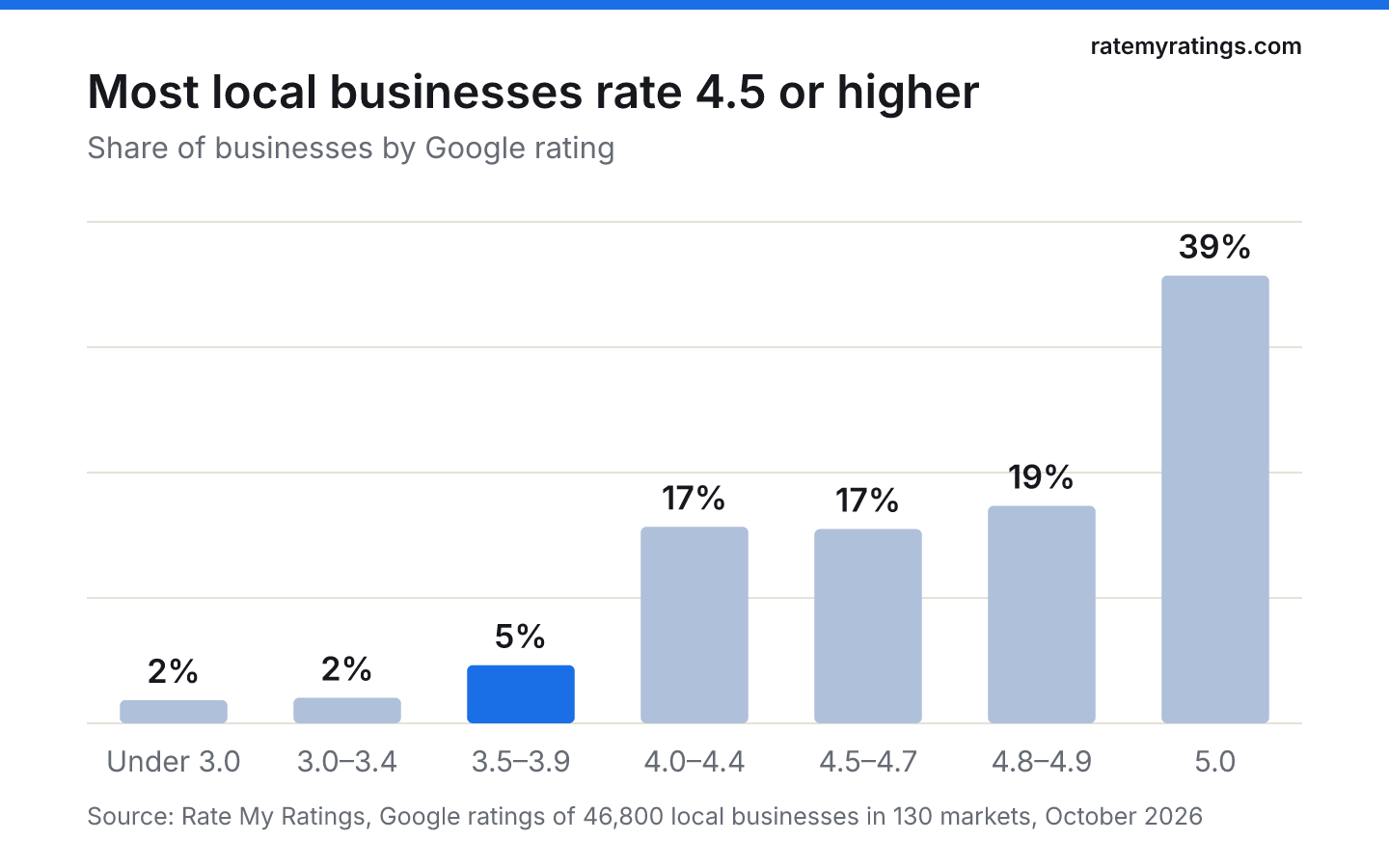
- 74% of businesses are rated 4.5 or higher.
- 17% sit between 4.0 and 4.4.
- 5% sit between 3.5 and 3.9.
- 4% are below 3.5.
So a business on 4.5 is roughly a quarter of the way up its market, and a business on a 3.5 star rating is in roughly the bottom 5%. When a customer looks at four nearby options in Google Maps, the 3.5 is very often the lowest number on the screen.
How customers treat 3.5 and 4.5
Many customers filter out a 3.5 before they read anything
BrightLocal's 2026 Local Consumer Review Survey found that 68% of consumers need a business to have at least four stars before they would use it, and 31% will only consider 4.5 or higher. A 3.5 star rating is below the first threshold, so most potential customers never get as far as your reviews, your photos or your prices. A 4.5 clears both.
Customers compare, not judge in isolation
Local search is a side-by-side decision. The same 4.0 that looks fine on its own looks weak next to three competitors on 4.7, 4.8 and 4.9. That is why the gap that matters is not between your rating and five stars, but between your rating and the businesses shown alongside you.
A small gap at the top matters less than a gap at the bottom
Research from the Spiegel Research Center at Northwestern University found that purchase likelihood peaks for ratings between 4.0 and 4.7. Moving from 4.5 to 4.8 brings little; moving from 3.5 to 4.0 moves you across the line where most customers start to trust you at all.
What the gap is worth in revenue
The best known estimate comes from a Harvard Business School study of Yelp ratings, which found that a one-star increase in rating led to a 5 to 9 percent increase in revenue for independent restaurants, with no measurable effect for chains.
As an illustration only: an independent business turning over £400,000 a year, if it behaved like the restaurants in that study, would be giving up somewhere between £20,000 and £36,000 a year by sitting a full star below where it could be. Your own figure will differ, but the order of magnitude explains why a 3.5 star rating deserves attention ahead of most marketing spend. We work through the calculation in more detail in the ROI of review management.
Does your category make a difference?
Yes, a lot. A 3.5 is much less unusual in some trades than in others. Share of businesses rated below 4.0, by category, in our data:
| Category | Median rating | Share below 4.0 |
|---|---|---|
| Supermarkets | 4.0 | 38% |
| Hotels | 4.3 | 20% |
| Restaurants | 4.4 | 16% |
| Used car dealers | 4.6 | 15% |
| Roofers | 5.0 | 14% |
| Estate agents | 4.8 | 9% |
| Dentists | 4.9 | 6% |
| Vets | 4.7 | 3% |
| Physiotherapists | 5.0 | 3% |
For a supermarket, a 3.5 is below average but not alarming. For a vet practice or a physiotherapist, where only around 3% of businesses are below 4.0, a 3.5 star rating stands out sharply, and in a high-trust decision like choosing someone to treat a pet or an injury, customers are least willing to take a chance. Our piece on what a good Google rating is has the full category benchmarks.
When a 3.5 is less of a problem
- Very few reviews. A 3.5 from four reviews is one unhappy customer and a small sample. Customers discount it, and it will move quickly once more reviews arrive.
- No real alternative. A rural garage or the only venue in a village loses fewer customers to a low rating because there is nowhere else to go.
- A strong brand. Chains lean on brand recognition, which is why the revenue effect in the Harvard study was found for independents only.
- Customers who come through referrals. If almost every client arrives by personal recommendation, fewer of them check Google first.
Even then, a 3.5 limits growth: every new customer who does search will see it. For more on how customers weigh a low rating against other signals, read what makes people trust a business with low reviews.
How to get from 3.5 to 4.5
Because your rating is an average, the maths is unforgiving. With 40 reviews averaging 3.5, you need about 20 new five-star reviews to reach 4.0 and about 80 to reach 4.5. That makes the order of work important.
- Find the cause. Read every one- and two-star review and tally the themes. In the half a million recent reviews we have collected, the most common complaints in one- and two-star reviews are price, fees or quotes (25%), communication (22%), booking and cancellations (22%), waiting (18%) and rude staff (17%). Usually two or three of these explain most of a low rating.
- Fix the process, not the wording. If customers complain that nobody calls back, add a call-back rule. A better reply will not stop the next one-star review; a fixed process will. Our guide on using customer reviews to improve your business shows how to turn themes into changes.
- Ask every customer. Low-rated businesses often have a small, skewed sample: the angry customers wrote and the satisfied ones did not. Asking everyone, consistently, usually raises the average on its own. Our guide on how to ask for Google reviews has wording that works.
- Reply to every negative review. It will not change the number, but it changes how the next customer reads it. See how to turn one-star reviews into opportunities.
- Report reviews that break Google's rules, and only those. Fake reviews, reviews about someone else's business or abusive content can be reported. Reviews that are simply unfair usually stay. Our guide on removing a false Google review explains what Google will and will not take down.
If you want to know exactly where you sit, a Rate My Ratings market report puts your rating, review count and complaint themes next to every competitor in your area.
The short version
- A 3.5 star rating puts most local businesses in the bottom 5% of their market; 4.5 is close to the middle, with 74% of businesses at 4.5 or above.
- Two in three customers need at least four stars, so a 3.5 removes you from most shortlists before your reviews are read.
- Research on independents links one star to 5 to 9 percent of revenue.
- The gap matters most in high-trust categories such as vets, dentists and physiotherapists.
- Getting from 3.5 to 4.5 starts with fixing the two or three issues behind the complaints, then asking every customer for a review.
Frequently asked questions
- Is a 3.5 star rating on Google bad?
For most local businesses, yes. Only about 9% of the 46,800 businesses we track are rated below 4.0, so a 3.5 usually sits in the bottom 5% of its market. In a 2026 survey, 68% of consumers said they need at least four stars before using a business.
- How much revenue does a one-star difference make?
A Harvard Business School study of restaurant ratings found a one-star increase was linked to 5 to 9 percent more revenue for independent restaurants, and no measurable effect for chains. Treat it as an order of magnitude, not a promise for your business.
- How many reviews do I need to go from 3.5 to 4.5?
It depends on how many you have. With 40 reviews averaging 3.5, you need about 20 new five-star reviews to reach 4.0 and about 80 to reach 4.5. With fewer existing reviews the rating moves faster; with more, it moves slower.
- Can I remove bad reviews to raise my rating?
Only reviews that break Google's content policy, such as fake reviews, conflicts of interest or abusive content, can be reported for removal. Negative but genuine reviews stay. The reliable way to raise a rating is to fix the causes and ask every customer for a review.

Rate My RatingsNewsletter
What reviews say about local markets, in your inbox.
New articles and findings from the blog, as they're published.
Check your inbox.
If this address isn't subscribed yet, we've sent it a link to confirm. Nothing is sent until you click it.
That didn't go through. Check the email address and try again.
Hold on a moment, then subscribe again.