
How Long Does It Take to See Results From Google Reviews?
A review appears in minutes, but the results come in layers: weeks for customers to notice, months for rankings and revenue. Here is a realistic timeline and what speeds it up.

How long do Google reviews take to make a difference? A new review usually appears on your profile within minutes. Customers start to see a different business within a few weeks of a steady flow of new reviews. Effects on local ranking and on calls and bookings typically build over two to six months. The single review is fast; the results are slow, because they depend on a pattern rather than a moment.
Owners who start asking for reviews often expect a jump the following week and give up when it does not come. This guide sets out what happens at each stage, how long each tends to take, and what you can do to shorten the wait.
How long do Google reviews take to appear?
In most cases, a review shows on your Business Profile almost immediately after the customer posts it. Sometimes it does not. Google runs automated checks on every contribution, and its Maps user-generated content policy says content that looks fake, incentivised or posted from a conflict of interest will be removed. Reviews caught by those checks can sit as pending for a while or never be published at all.
Reasons a genuine review can be delayed or hidden include:
- the reviewer's account is brand new or has little activity;
- several reviews arrive from the same place or network in a short time, such as customers using your shop Wi-Fi at the till;
- the text contains links, phone numbers or wording that looks like spam;
- the review was prompted by an offer or discount, which Google treats as an incentivised review.
If a customer tells you their review has vanished, the honest answer is that Google's filters decided, and the reviewer can check the status in their own Maps contributions. You cannot force a review to appear.
A realistic timeline for results
Here is what usually happens once you start asking every customer for a review. The timescales are typical rather than guaranteed; a busy café will move faster than a wedding venue with forty weddings a year.
| Stage | What changes | Typical timescale |
|---|---|---|
| Review appears | The review is visible on your profile | Minutes, occasionally days if held |
| You reply | Your reply shows under the review | Same day if you are organised |
| Recent reviews look different | The first reviews a customer reads are fresh and specific | 2 to 6 weeks |
| Your rating moves | The average shifts by a tenth or more | Weeks to many months, depending on your review count |
| Local ranking improves | You appear more often and higher in Maps results | 1 to 3 months, often longer |
| Calls, clicks and bookings rise | Profile actions and enquiries increase | 3 to 6 months |
The first few weeks: recency
The quickest visible win is recency. In BrightLocal's 2026 Local Consumer Review Survey, 74% of consumers said they look for reviews written in the last three months, and 32% want reviews from the last two weeks. If your newest review is from last spring, a handful of fresh ones changes the first impression within weeks, even before your rating or ranking moves.
Replies: the part you control fully
Replies are the one stage on your own clock. In the 524,000 recent Google reviews we have collected, about half of the reviews that got a reply from the business got it within 24 hours.
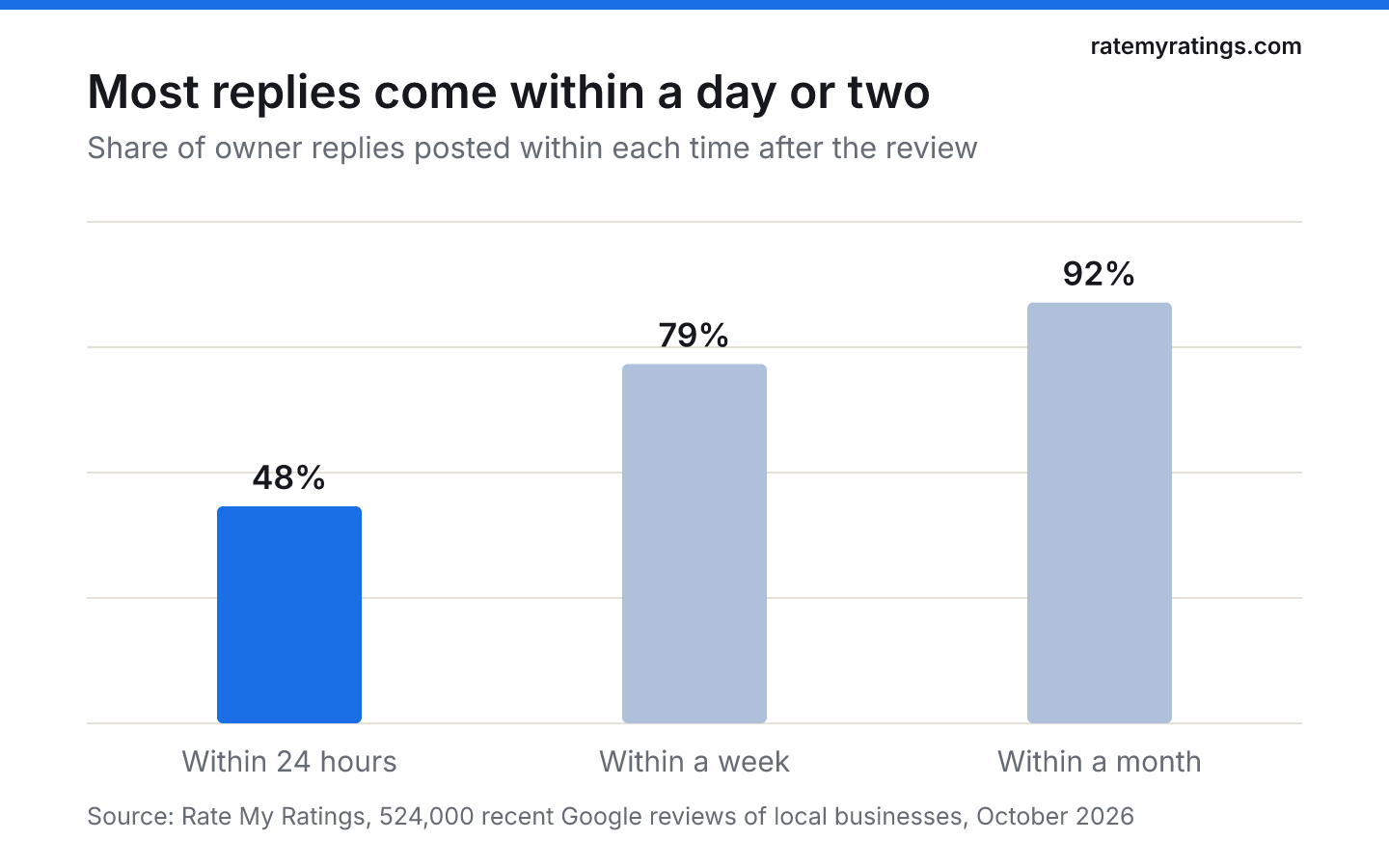
The same survey found 81% of consumers expect a reply within a week. A reply does not change your rating, but it shows the next reader that someone is listening.
Months: rating and ranking
Your rating is an average, so how quickly it moves depends on how many reviews you already have. A business with 20 reviews can move its rating noticeably in a month. One with 400 might need a year of steady reviews to move it by a tenth.
Ranking is slower and less predictable. Google says in its guide to how local results are ranked that more reviews and positive ratings can help, alongside relevance, distance and prominence, and it does not publish any timescale. Practitioners who study local search agree on the shape of what helps: the 2026 Local Search Ranking Factors survey by Whitespark ranks review recency and a sustained influx of reviews over time among the more important review signals for map results, ahead of bursts. Our guide on how many Google reviews you need to rank higher goes further.
Three to six months: revenue
Sales follow ranking and conversion, so they arrive last. Track the calls, direction requests and website clicks in your Business Profile's performance view, and compare each month with the same month a year earlier to strip out seasonality. Our article on whether Google reviews increase sales covers what to expect and when the effect is small.
Why a steady flow beats a big push
Many owners run a review drive: a week of asking everyone, a spike of reviews, then nothing. It feels productive, but it is the slowest route to results.
- Recency fades. A burst from March looks stale by September. Customers reading in autumn see a business that has gone quiet.
- Ranking signals reward consistency. A sustained influx ranks above bursts in the practitioner survey cited above.
- Bursts are noticed. Bursts on their own are not a problem; among businesses with 50 or more reviews whose full history we hold, two-thirds had at least one week in which 10% or more of all their reviews arrived. But a sudden spike from new accounts, after months of silence, is the pattern automated filters are built to catch. We cover this in does Google penalise too many reviews at once.
The better approach is a habit: ask every customer, at the same point in your process, every week. Our guide on how to get more Google reviews shows how to build it in without asking constantly.
What makes results slower
- Few customers a month. A roofer finishing six jobs a month will see slower change than a café serving six hundred. In our data the median roofer has six Google reviews in total; each new one carries real weight, but they arrive slowly.
- Long gaps between booking and service. A wedding venue's reviews arrive after the wedding, often a year or more after the couple first looked. Results show on that cycle. You can see how review volumes differ between venues in our wedding venues in Yorkshire report.
- A low starting rating. Recovering from 3.9 takes many more reviews than nudging 4.6 upwards.
- Asking at the wrong moment. A request sent a week after the visit gets far fewer responses than one sent the same day. Our guide to the best time to ask for a review covers when to ask.
A 90-day plan
- Week 1. Create your review link and QR code in your Business Profile. Decide the one moment you will ask every customer.
- Weeks 1 to 4. Ask every customer at that moment. Reply to every review, good or bad, within two working days.
- Weeks 4 to 8. Read your new reviews for repeated themes and fix one problem they raise.
- Weeks 8 to 12. Compare profile calls, direction requests and clicks with the same period last year, and your review count and recency with the three businesses that appear next to you.
The short version
- How long do Google reviews take? Minutes to appear, a few weeks to change how customers see you, one to three months or more to help ranking, and three to six months to show in sales.
- Reviews can be held or removed by Google's automated checks; you cannot force them through.
- A steady weekly flow beats a one-off push, for customers and for ranking.
- Set targets against your local competitors, and if you are just starting out, see a realistic review goal for a new business.
Frequently asked questions
- How long does it take for a Google review to show up?
Usually minutes. Google checks every review automatically, and a review that looks like spam, comes from a new or inactive account, or arrives in a cluster from one location can be held as pending for a while or never published. Businesses cannot force a review to appear.
- How long before Google reviews help my ranking?
Google does not publish a timescale. In practice, a steady flow of new reviews tends to help map rankings over one to three months, sometimes longer in competitive categories. Recency and a sustained flow matter more than a single burst.
- Why did a customer's Google review disappear?
Most often Google's automated filters removed or held it because it looked like it broke the content policy, for example because it seemed incentivised, came from a new account or contained a link. The customer can check its status in their Maps contributions and appeal if it was genuine.
- How many reviews a month should a small business aim for?
Enough to keep a few reviews from the last month visible at all times, since most consumers look for reviews from the last three months. For a low-volume trade that may be two or three a month; for a busy café or clinic, several a week.

Rate My RatingsNewsletter
What reviews say about local markets, in your inbox.
New articles and findings from the blog, as they're published.
Check your inbox.
If this address isn't subscribed yet, we've sent it a link to confirm. Nothing is sent until you click it.
That didn't go through. Check the email address and try again.
Hold on a moment, then subscribe again.