
How Many Google Reviews Do You Need to Rank Higher?
Google has no magic number of reviews, but your local market does. Here are review benchmarks for 20 trades from 46,800 businesses, the review signals that matter for map rankings, and a ten-minute way to set your own target.

There is no fixed answer to how many Google reviews to rank higher, because Google does not rank businesses against a number. It ranks them against each other. The practical target is to match or beat the review count, rating and recency of the businesses that appear above you for your most important search, in your area. In the 46,800 local businesses we track, that ranges from fewer than ten reviews for a typical electrician or roofer to several hundred for a vet or a wedding venue.
This guide explains how reviews feed local rankings, gives benchmarks for twenty trades and shows a ten-minute way to set your own target.
Is there a magic number of reviews?
No. Google's own guidance on how local results are ranked names three main factors: relevance (how well your profile matches the search), distance (how far you are from the searcher) and prominence (how well known your business is). Reviews sit under prominence. Google's words are that "more reviews and positive ratings can help your business's local ranking", and that there is no way to request or pay for a better local ranking.
Two consequences follow. First, reviews can lift you, but they cannot overcome distance: a business 200 metres from the searcher with 40 reviews can outrank one five miles away with 400. Second, more is relative. Forty reviews put you at the top in one market and nowhere in the next.
Which review signals matter for map rankings?
Google does not publish weights, so the best evidence is what experienced practitioners observe. The 2026 Local Search Ranking Factors survey from Whitespark, which polls local search specialists, ranks these review factors for map and local pack results, from most to least important among review signals:
| Review signal | Rank among all local pack factors |
|---|---|
| High numerical Google rating (for example 4 to 5) | 6 |
| Quantity of Google reviews with text | 9 |
| Recency of reviews | 11 |
| Sustained influx of reviews over time, rather than bursts | 14 |
| Keywords in Google reviews | 36 |
| Quantity of star-only ratings without text | 38 |
| Quantity of reviews with photos | 43 |
| Owner responses to most reviews | 122 |
Three points stand out. Reviews with text count for more than star-only ratings. Recency and a steady flow are rated nearly as highly as the total. And replying to reviews, while worth doing for customers, is a weak ranking signal. Treat the survey as informed opinion rather than a published rule, but it matches what we see in local markets.
How many Google reviews to rank higher in your trade
Review counts vary enormously by trade, so a national average is almost useless. Here is the median number of Google reviews per business by category in our data.
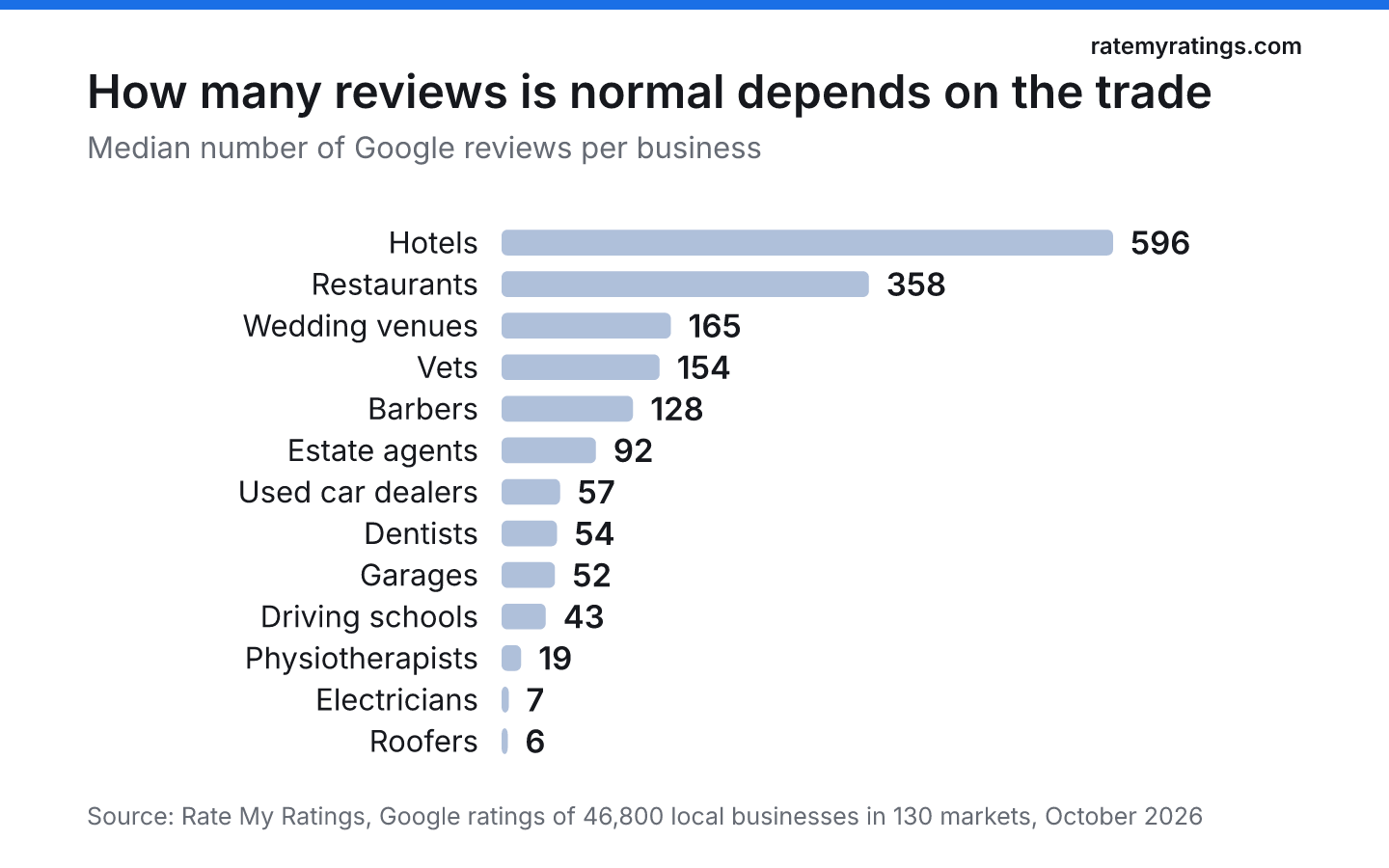
And the level you need to be among the best-reviewed businesses in each trade, shown as the top 10%:
| Category | Median reviews | Top 10% have at least |
|---|---|---|
| Restaurants | 358 | 2,223 |
| Wedding venues | 165 | 1,365 |
| Garages | 52 | 604 |
| Vets | 154 | 466 |
| Estate agents | 92 | 404 |
| Dentists | 54 | 324 |
| Driving schools | 43 | 249 |
| Physiotherapists | 19 | 133 |
| Electricians | 7 | 60 |
| Roofers | 6 | 48 |
Across all 46,800 businesses, a quarter have eight reviews or fewer, the median is 41, the top quarter start at 179 and the top 10% at 542. If you are an electrician with 60 reviews, you are already in the top tenth of your trade. If you are a vet with 60, you are well below the typical practice.
Does more reviews mean a lower rating?
Usually, yes, and that is fine. In our data, 70% of businesses with fewer than ten reviews have a perfect 5.0, against 20% of those with 100 to 249 reviews and 1% of those with more than a thousand. The median rating slides from 5.0 to 4.4 as review counts grow, because a larger sample captures the occasional bad day.
That matters for ranking because rating and count work together. A 4.7 from 200 reviews is a stronger signal, to customers and very likely to Google, than a 5.0 from eight. Do not hold back from asking every customer for fear of a few four-star reviews: the extra volume is worth more than the last tenth of a star. Our guide on what a good Google rating is shows where the bar sits in each trade.
How to set your own target in ten minutes
- Pick your money search. The one search that brings you the most valuable customers, such as "emergency vet" or "dentist near me", plus your town.
- Search from where your customers are. Use a phone in your area, or ask a customer to send you a screenshot. Rankings depend on the searcher's location.
- Note the top three map results. Write down each one's rating, review count and the date of its most recent review. Count how many reviews each has from the last three months.
- Set two targets. A total target equal to the middle of the three, and a recency target equal to the best monthly rate among them.
- Check the other factors honestly. If you are further away, in the wrong primary category, or your profile is thin, more reviews alone will not close the gap.
A worked example. A dental practice searches "dentist" in its town and finds the top three map results have 210, 140 and 95 reviews, with 14, 9 and 4 reviews from the last three months. Its total target is 140 reviews and its recency target about 14 new reviews a quarter, roughly one a week. If it currently has 60 reviews and two from the last quarter, the recency gap is the one to close first: one new review a week is achievable for any busy practice, and within a year it would be close to the total target too.
Repeat it every quarter. If you want the same comparison for every competitor in your area at once, a Rate My Ratings market report lists each business's rating, review count and the themes in its reviews; see an example in our electricians in Greater Manchester report. Our guide to competitor analysis using Google reviews shows how to do it by hand.
Why reviews alone will not get you to the top
- Distance is fixed. You cannot move closer to every searcher. In a dense city, the map results change street by street.
- Relevance comes from your profile. Your primary category, services, description and the words customers use in reviews all tell Google what you do. A dentist whose reviews mention "implants" is more relevant for an implant search than one whose reviews never do.
- Prominence is more than reviews. Links and mentions from other websites count too, as Google's own guidance says.
How to get there without tripping a filter
Chasing a number in a hurry is the most common way businesses get into trouble. A sudden flood of reviews from new accounts, or a burst prompted by an offer, is exactly what Google's filters look for, and incentivised reviews are prohibited. Our article on whether Google penalises too many reviews at once explains what is normal and what is risky.
The sustainable approach is a weekly habit of asking every customer, which our guide on how to get more Google reviews sets out. If you are just opening, start with a realistic review goal for a new business.
The short version
- There is no universal number for how many Google reviews to rank higher; you need to match or beat the businesses above you for your main search.
- Reviews count towards prominence, alongside relevance and distance; they cannot overcome being much further away.
- Benchmarks vary by trade: the median electrician has 7 reviews, the median vet 154, the median restaurant 358.
- Recency and a steady flow matter nearly as much as the total, and written reviews count for more than star-only ratings. See Google reviews vs Google ratings.
Frequently asked questions
- How many Google reviews do I need to rank in the top 3?
There is no fixed number. Look at the three businesses currently in the map results for your main search and aim to match the middle one's review count and its rate of new reviews. In some trades that is under 20 reviews; for vets, restaurants or wedding venues it can be hundreds.
- Do Google reviews affect local SEO?
Yes. Google says more reviews and positive ratings can help a business's local ranking, as part of prominence. They work alongside relevance, meaning how well your profile matches the search, and distance from the searcher, which reviews cannot change.
- Do star-only ratings help ranking as much as written reviews?
Practitioners believe written reviews carry more weight. In the 2026 Whitespark ranking factors survey, the quantity of Google reviews with text ranked far above the quantity of star-only ratings. Written reviews also give Google more information about what you do.
- Does replying to reviews improve my Google ranking?
Probably only a little. Owner responses rank low among review signals in the Whitespark survey. Replying is still worth doing because customers read replies and most expect one within a week, but do it for customers rather than for ranking.

Rate My RatingsNewsletter
What reviews say about local markets, in your inbox.
New articles and findings from the blog, as they're published.
Check your inbox.
If this address isn't subscribed yet, we've sent it a link to confirm. Nothing is sent until you click it.
That didn't go through. Check the email address and try again.
Hold on a moment, then subscribe again.