
What's a Realistic Review Goal for a New Business?
Five genuine reviews first, then the typical count for your trade: under ten for many trades, over a hundred for vets and venues. Benchmarks from 46,800 businesses.

A realistic review goal for a new business is five genuine Google reviews in the first month or two, ten soon after, and then the typical review count for your trade in your area within your first year, while keeping a steady flow of new reviews every month. For an electrician or a roofer, that typical count can be under ten. For a vet or a wedding venue, it is well over a hundred. The goal depends far more on your category than on any universal number.
We base that on the Google ratings of 46,800 local businesses we track across 130 markets in the UK and Australia. The headline figures surprise most new owners: a quarter of established businesses have eight reviews or fewer, and the median has 41.
Why the first five reviews matter most
A business with no reviews looks like an unknown quantity. A business with a handful looks real. Research from Northwestern University's Spiegel Research Center, How Online Reviews Influence Sales, found that purchase likelihood for a product with five reviews was 270% greater than for one with none, and that the benefit of each additional review starts to diminish rapidly after the first five.
That study looked at online products rather than local services, but the principle carries over. The step from zero to five reviews changes how a stranger sees you more than any later step. So your first goal is not a big number. It is five honest reviews from real customers, as soon as you have served enough people to earn them.
Where those first reviews should come from
Only from genuine customers. It is tempting to ask friends, family or the people who helped you fit out the premises, but Google's content policy treats reviews from people with a personal or business relationship to you as a conflict of interest, and they can be removed. In the UK, a review that does not reflect a genuine experience is a fake review under the Digital Markets, Competition and Consumers Act 2024.
Your first customers are often your most enthusiastic ones. Ask each of them, personally, with a direct link. Our guide to asking for Google reviews without being annoying has wording that works.
What is normal for your trade
Once you have your first five or ten, look at what established businesses in your category have. The difference between trades is enormous, because it follows customer numbers: a restaurant serves hundreds of people a week, an electrician a handful.
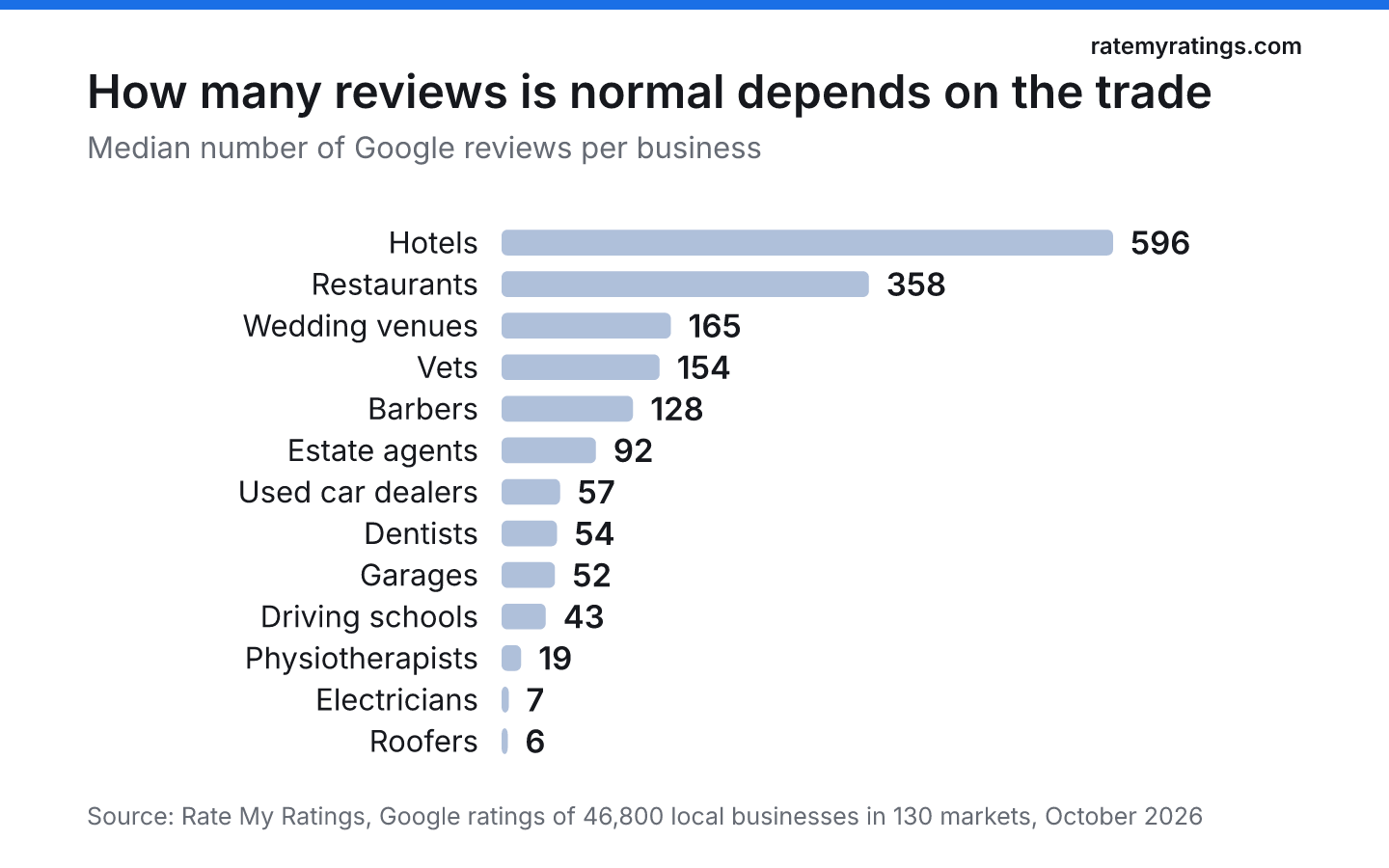
Read the chart as a guide to what "established" looks like in each trade:
| Trade | Median reviews | A sensible first-year goal |
|---|---|---|
| Electricians, roofers, accountants | 6–7 | 10 to 20, which already puts you above the typical competitor |
| Physiotherapists, aesthetics clinics | 19–25 | 20 to 30 |
| Driving schools, garages, dentists | 43–54 | 30 to 60 |
| Estate agents, barbers | 92–128 | 60 to 100 |
| Vets, wedding venues | 154–165 | 50 to 100, with the median as a two-year aim |
| Restaurants, hotels | 358–596 | Pace matters more than the total: aim for new reviews every week |
These are medians across our markets, not targets for your street. The real benchmark is the businesses a customer would compare you with: the five or six others that appear when someone searches for your service nearby. If they each have around 30 reviews, 30 is your goal. A Rate My Ratings market report shows exactly that, for every competitor in your category and area.
Turn your review goal for a new business into a monthly pace
A total is useful for direction, but a monthly pace is what you can actually manage. Readers also care far more about recent reviews than old ones. BrightLocal's 2026 Local Consumer Review Survey found that 74% of US consumers only care about reviews from the last three months.
To set a pace that fits your business:
- Count your customers. How many people or jobs do you serve in a typical month?
- Ask every one of them once. Put your review link on receipts, invoices and a follow-up message so asking does not depend on memory. Our guide on getting more Google reviews without asking constantly shows how.
- Measure your own rate for a month. Divide the reviews you received by the customers you asked. That is your real conversion rate, and it is the honest basis for any target.
- Set next month's goal from that rate. Then work on lifting the rate rather than the raw number: better timing, a warmer request, a simpler link.
For a business doing 40 jobs a month, two or three new reviews a month is a solid start. For a café serving hundreds of people a week, several a week is realistic once the system is in place.
A rating goal, not a perfect score
New businesses often start with a perfect 5.0, and most owners panic the first time a four-star or worse review arrives. They should not. In our data, 70% of businesses with fewer than ten reviews hold a perfect 5.0, but that share falls to 20% for businesses with 100 to 249 reviews and to 1% for those with over 1,000. As your count grows, your average will settle somewhere below five. That is normal and, to readers, more believable.
A better rating goal is to stay at 4.5 or above. BrightLocal found that 31% of US consumers will only use a business rated 4.5 or higher and 68% require at least four stars, while only 10% require five. Our article on what counts as a good Google rating breaks this down by trade.
How long should it take?
It depends on your customer numbers, but most new businesses that ask every customer can reach their first five reviews within weeks and their category's typical count within a year or two. Quieter trades get there faster in absolute terms because the bar is lower. Our guide to how long Google reviews take to work covers what to expect at each stage.
Do not worry if reviews arrive in clumps. A launch event or a busy opening fortnight can bring several in a week, and that is normal: two-thirds of the businesses whose full review history we hold had at least one week in which 10% or more of all their reviews arrived. Our article on Google review velocity explains why genuine bursts are not a problem.
Why the number matters for being found
Reviews do more than persuade. Google's guide to improving your local ranking says that more reviews and positive ratings can help a business's local ranking, as part of how prominent it looks. For a new business competing with established names, steadily building reviews is one of the few ranking factors you control from day one. Our article on how many Google reviews you need to rank higher goes further.
Mistakes that slow new businesses down
- Waiting until you are established. The first customers are the easiest to ask and often the warmest. Start from week one.
- Copying a chain. A national brand's branch with hundreds of reviews is not your benchmark. The independent businesses a customer would compare you with are.
- Asking once, in a burst, then stopping. A launch push followed by silence leaves your profile looking stale within months.
- Ignoring the reviews you get. Reply to each one. It shows the next customer that reviews are read, which encourages more.
The short version
- Aim for five genuine reviews first; they change how strangers see you more than any later reviews.
- Then set a realistic review goal for a new business from your trade's typical count: under ten for many trades, over a hundred for vets and venues.
- Turn the total into a monthly pace based on how many customers you serve and your own measured rate.
- Expect your rating to settle below 5.0 as reviews grow; aim to stay at 4.5 or above.
- Never fill the gap with reviews from friends, family or staff.
Frequently asked questions
- How many Google reviews should a new business have?
Aim for five genuine reviews as soon as you can, because the first few change how strangers see you more than any later ones. Then work towards the typical count for your trade in your area. Across 46,800 local businesses we track, the median is 41 reviews, but it ranges from about 6 for roofers to over 150 for vets.
- How quickly can a new business get Google reviews?
A new business that asks every customer, with a direct link and a short follow-up message, can usually collect its first five reviews within a few weeks of opening. How fast the count grows after that depends mainly on how many customers you serve each month, so set a monthly pace rather than a fixed deadline.
- Can friends and family leave Google reviews for my new business?
They should not. Google's policy treats reviews from people with a personal or business relationship to you as a conflict of interest, and they can be removed. In the UK, reviews that do not reflect a genuine customer experience are fake reviews under the Digital Markets, Competition and Consumers Act 2024. Ask real customers instead.
- Is a 5.0 rating a good goal for a new business?
It is a nice start but not a realistic long-term goal. In our data, 70% of businesses with under ten reviews have a perfect 5.0, but only 1% of businesses with over 1,000 reviews do. As reviews grow, ratings settle. Aim to stay at 4.5 or above, which most consumers treat as a strong rating.

Rate My RatingsNewsletter
What reviews say about local markets, in your inbox.
New articles and findings from the blog, as they're published.
Check your inbox.
If this address isn't subscribed yet, we've sent it a link to confirm. Nothing is sent until you click it.
That didn't go through. Check the email address and try again.
Hold on a moment, then subscribe again.