Why Do Big Companies Get So Many Google Reviews So Fast?
More customers, a profile for every location and automatic review requests explain most of it. Our data on 46,800 businesses shows why their ratings are often beatable.

Big companies get so many Google reviews so fast for three ordinary reasons: they serve far more customers, every one of their locations collects reviews of its own, and they ask every customer automatically, every time, through receipts, apps and post-visit messages. There is rarely a secret beyond that. When you look at big companies' Google reviews closely, the speed is mostly arithmetic and process, not magic and usually not fraud.
We track the Google ratings of 46,800 local businesses across 130 markets in the UK and Australia, and the numbers make the point. The median business has 41 reviews. The top 1% have more than 2,770. That gap is not mostly about quality. It is about how many people walk through the door, and how reliably someone asks them.
Volume: more customers, more reviews
Only a small share of customers ever write a review, so the count a business builds is roughly its customer numbers multiplied by how often it asks. A supermarket or a busy hotel serves thousands of people a week. A roofer finishes a handful of jobs. Even if both asked with equal skill, one would end the year with hundreds of reviews and the other with dozens.
You can see this in our data by trade. The median hotel in our markets has 596 Google reviews and the median restaurant 358. The median electrician has 7, and the median roofer 6. Nobody would conclude that hotels are a hundred times better at customer service than electricians. They simply have a hundred times more customers.
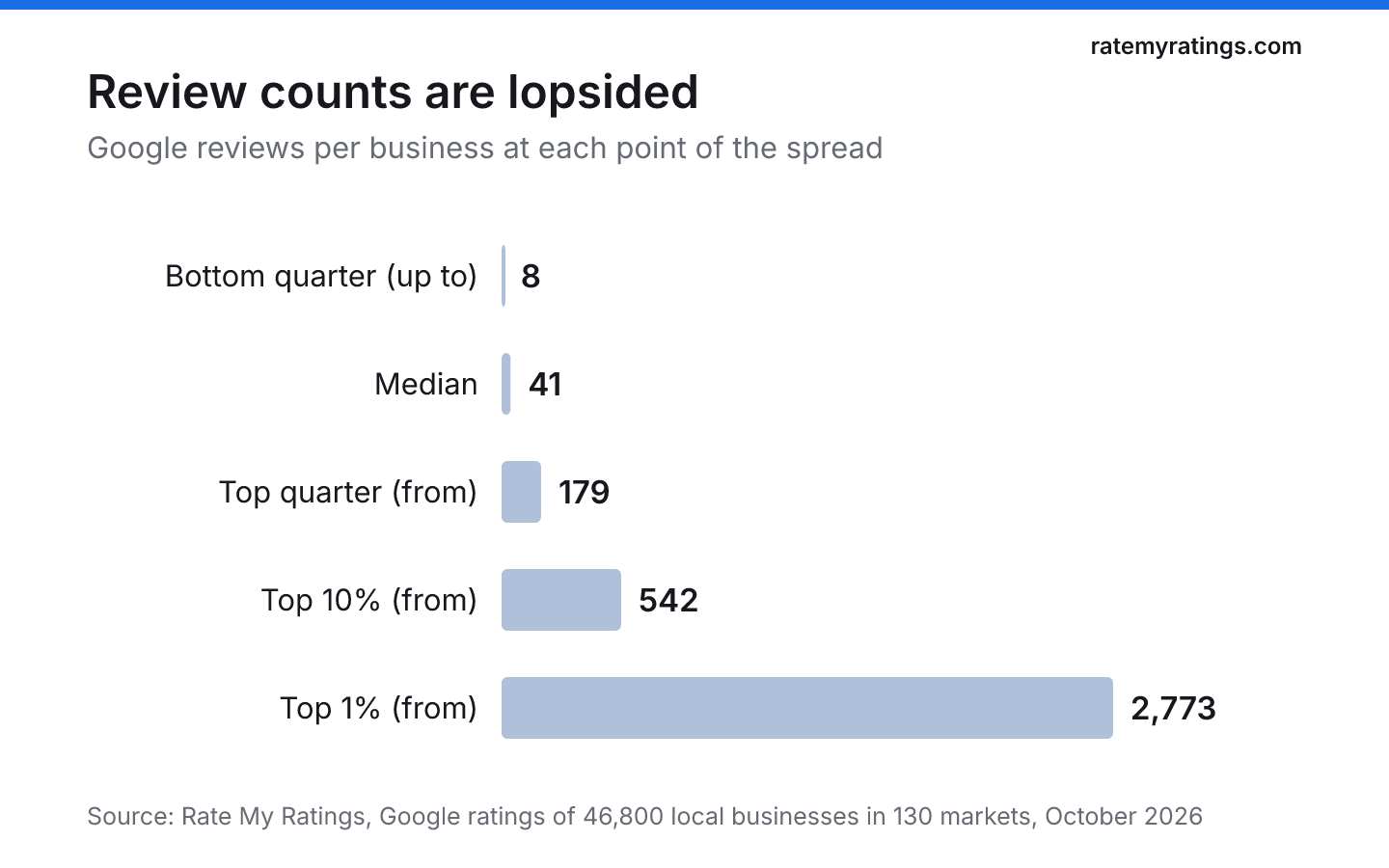
The spread is lopsided. A quarter of businesses have 8 reviews or fewer, while the top tenth have 542 or more. If you compare yourself with a national brand's busiest branch, you are comparing yourself with the far right of that chart.
Every location is its own profile
A chain with 300 branches does not have one Google Business Profile. It has 300, and each one gathers reviews from its own customers. When people say a big company "has thousands of reviews", they are often adding up many local profiles, each with a perfectly ordinary count.
This matters when you size up a competitor. A national chain's branch on your high street is not competing with you on its national total. It competes on the reviews of that one location, which are often closer to yours than the brand's size suggests. Open the branch's own profile and read its last few months of reviews. You will often find the same complaints our data shows across busy operations: waiting, booking problems and slow replies to calls and emails. Those are the gaps a smaller, more attentive business can fill.
Big companies' Google reviews come from systems, not favours
The real advantage large businesses have is not budget. It is that review requests are built into what happens after every sale, so nobody has to remember to ask.
Requests triggered automatically
A booking system, a till, a delivery app or a customer account can send a message with a review link once the visit is complete. Google itself recommends putting the review link on receipts, in thank-you emails and at the end of chat conversations in its guide to creating a review link or QR code. Large companies simply do all of these, at once, for every customer.
Staff who are trained, not pressured
At a well-run chain, the person at the counter knows when and how to mention reviews. What they should not have is a quota: Google's content policy treats asking staff to collect a set number of reviews as rating manipulation.
Someone whose job is the reviews
Many larger firms have a person or a team watching reviews across all locations, replying quickly and passing problems to the right manager. In our data of 524,000 recent reviews, businesses that reply to most of their reviews have a median of 378 Google reviews, against 202 for businesses that never reply. Replying does not cause more reviews by itself, but it is a habit that goes with being organised about reviews in general.
Why big numbers do not mean big ratings
Here is the part that should reassure a smaller business. As review counts climb, ratings fall. Across the 46,800 businesses we track, 70% of those with fewer than 10 reviews have a perfect 5.0. Among businesses with more than 1,000 reviews, just 1% do. Their median rating is 4.4, compared with 4.8 for businesses with 100 to 249 reviews.
Large volumes bring in every kind of customer, including the unlucky ones, and a high-volume operation finds it harder to make every visit personal. So a big company's thousands of reviews often come with a rating you can beat. Readers notice that too: BrightLocal's 2026 consumer survey found that 31% of US consumers will only use a business rated 4.5 or higher.
Is it ever fake?
Sometimes. Sudden floods of five-star reviews from new accounts, or reviews that all sound the same, can be a sign of bought reviews, and big names are not immune. But a fast rise in reviews is not proof of anything. Two-thirds of the businesses whose full review history we hold had at least one week in which 10% or more of all their reviews arrived, usually after a busy event, a new booking system or a push to ask.
The penalties for faking are now serious. The UK's Digital Markets, Competition and Consumers Act 2024 bans submitting or commissioning fake reviews, and the US FTC's rule on fake reviews does the same. If you suspect a competitor, our guide on how to spot fake Google reviews explains what to look for, and our piece on Google review velocity covers whether a fast run of reviews is risky.
How a smaller business keeps up
You cannot match a national chain's customer numbers. You can match its process, and you can beat it on the things its volume makes hard.
- Ask every customer, automatically. Put your review link on receipts, invoices, booking confirmations and follow-up emails, so asking stops depending on memory. Our guide to getting more Google reviews without asking constantly sets out the systems.
- Aim for steady, not huge. A regular flow of recent reviews matters more to readers than a giant historic total. BrightLocal found that 74% of consumers only care about reviews from the last three months.
- Compare like with like. Benchmark yourself against businesses in your own trade and area, not national averages. Our article on how many Google reviews you need to rank higher shows typical counts by category.
- Win on detail. Personal service produces specific, warm reviews that mention names and outcomes. Those read better than a thousand two-word ratings.
- Reply to everything. It costs a few minutes a day at your size, and it signals care that a busy chain often cannot.
If you want to see exactly how your review numbers compare with every competitor nearby, chains included, a Rate My Ratings market report reads the whole local market and shows who is ahead and why. For a sense of what is achievable from a standing start, see a realistic review goal for a new business.
The short version
- Big companies have more customers, more locations and automatic review requests. That explains most of the speed.
- Review counts are lopsided: the median local business has 41 reviews, the top 1% more than 2,770.
- More reviews usually means a lower rating: only 1% of businesses with 1,000+ reviews hold a perfect 5.0.
- Fast growth is not proof of fakes, though fakes do exist and are now illegal in the UK and US.
- A small business wins by asking every customer automatically and competing on the warmth and detail of its reviews.
Frequently asked questions
- How do big companies get so many Google reviews?
Mostly through volume and process. They serve far more customers than a small business, each of their locations has its own Google profile collecting reviews, and they send review requests automatically after every purchase, booking or delivery. A small share of a very large customer base still adds up to hundreds or thousands of reviews.
- Do more Google reviews mean a better business?
Not on their own. Review counts mostly reflect how many customers a business serves. In our data on 46,800 local businesses, ratings actually fall as review counts rise: the median rating for businesses with over 1,000 reviews is 4.4, against 4.8 for those with 100 to 249. Read the rating, the recency and the content, not just the total.
- Are big companies' Google reviews fake?
Usually not. Fast growth is normally explained by customer numbers and automated requests. Fake reviews do exist at businesses of every size, and they are illegal in the UK under the Digital Markets, Competition and Consumers Act 2024 and in the US under the FTC's 2024 rule. Look for clusters of new accounts and repetitive wording before assuming fraud.
- Can a small business compete with a chain on Google reviews?
Yes. Compete on the reviews of the single nearby branch, not the brand's national total, and on recency and quality rather than volume. Ask every customer automatically, reply to every review and aim for a steady flow of recent, specific reviews. Many consumers weigh the last few months of reviews far more than a large historic count.

Rate My RatingsNewsletter
What reviews say about local markets, in your inbox.
New articles and findings from the blog, as they're published.
Check your inbox.
If this address isn't subscribed yet, we've sent it a link to confirm. Nothing is sent until you click it.
That didn't go through. Check the email address and try again.
Hold on a moment, then subscribe again.