Does Google Penalise Businesses for Getting Too Many Reviews Quickly?
Google does not punish a business for a busy week of genuine reviews. It filters reviews that look fake, and in the UK it can now flag the profile. Here is what a normal spike looks like and which patterns get caught.
No. Google does not penalise a business simply for getting a lot of reviews in a short time. What Google does is filter individual reviews that look fake, incentivised or coordinated, and since 2025 it has also put warnings on UK profiles caught inflating their ratings. So the risk is not the speed itself; it is what the speed usually signals. A spike from genuine customers after a busy event is normal. A spike from brand-new accounts after months of silence is the pattern filters are built to catch.
This is where the idea of Google review velocity comes from: the rate at which new reviews arrive. Here is what our data says a normal rate looks like, which patterns attract attention, and how to grow your reviews quickly without putting your profile at risk.
What Google review velocity means
Review velocity is simply how many new reviews a business receives over a period: per week, per month or per quarter. It matters in two ways:
- To customers, as recency. In BrightLocal's 2026 Local Consumer Review Survey, 74% of consumers said they look for reviews from the last three months.
- To Google, as one of the patterns its systems use to judge whether reviews are genuine, and very probably as a ranking signal in its own right.
Google does not publish any threshold. There is no number of reviews per week above which a profile is penalised.
Does Google penalise a sudden increase in reviews?
Not as a penalty on the business for speed alone. Google's Maps user-generated content policy is about what reviews are, not how fast they arrive. It says fake engagement is not allowed and will be removed, and it prohibits reviews that are paid for, incentivised, written by people with a conflict of interest, or posted from multiple accounts at one person's request. Reviews that fail those checks are removed or never published.
The consequences for the business have hardened, though. In January 2025 the UK's Competition and Markets Authority secured commitments from Google that businesses found boosting their star ratings with fake reviews get a prominent warning on their profile and lose the ability to receive new reviews, and that repeat offenders can have all their reviews deleted for six months or more. Fake reviews are also illegal under UK, US and Australian consumer law. So while a genuine spike is safe, a manufactured one can now cost you your whole review history.
What a normal spike looks like
Bursts are far more common than most owners think. Among the businesses with 50 or more reviews whose full review history we hold, two-thirds had at least one week in which 10% or more of all their reviews arrived. Genuine reasons include:
- a grand opening, relaunch or new owner;
- a seasonal peak, such as a garden centre in spring or a ski shop before winter;
- an event: a wedding fair, a charity day, a busy bank holiday;
- a new habit of asking every customer, which lifts the rate overnight;
- an email to past customers asking for honest feedback.
None of these is a problem if the reviews come from real customers who chose to write them. Google review velocity becomes a risk only when the pattern underneath does not look like real customers.
Patterns that do attract Google's filters
The reviews that get held or removed tend to share some of these features:
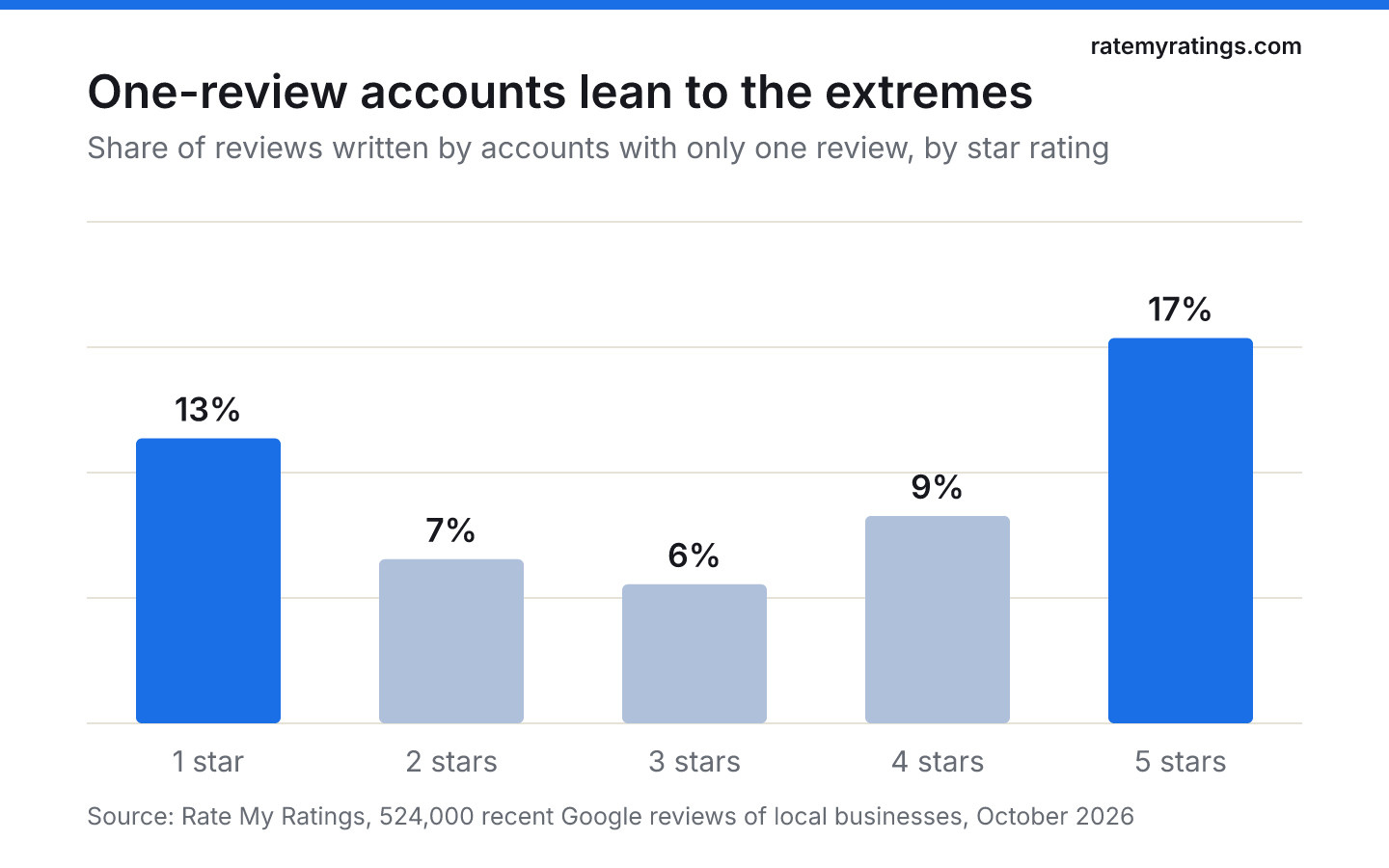
- Accounts with no history. In our data, 16% of reviews come from accounts that have written only one review, and that share is highest for five-star reviews (17%) and one-star reviews (13%). One-review accounts are normal; a spike made up almost entirely of them is not.
- The same location or network. Several reviews posted from the same Wi-Fi, often a tablet at the counter, can look like one person posting many times.
- Similar wording. Reviews that use the same phrases, length or structure suggest a script.
- Incentives. Reviews prompted by a discount, a prize draw or a free extra break Google's rules, however genuine the customer.
- Burst then silence. Fifty reviews in a fortnight and none for six months looks like a campaign, not a business.
- Reviewers far from the business with no plausible reason to have visited.
Put side by side, the difference is usually easy to see:
| Normal spike | Suspicious spike |
|---|---|
| Follows something real: an event, a launch, a new asking routine | Comes from nowhere after months of silence |
| Reviewers have their own history of reviews and photos | Most reviewers have no other reviews |
| Different lengths, details and opinions, including some four-star reviews | Similar length and wording, all five stars |
| Mentions specific staff, services or dates | Generic praise that could fit any business |
| The flow continues at a higher level afterwards | Stops as suddenly as it started |
Does review velocity affect your ranking?
Probably, but in favour of steadiness rather than speed. Google says only that more reviews and positive ratings can help local ranking. The 2026 Local Search Ranking Factors survey from Whitespark, based on the views of local search specialists, ranks recency of reviews and a "sustained influx of reviews over time (rather than bursts)" among the more important review signals for map results.
In other words, Google review velocity helps most as a steady rhythm. Ten reviews a month for a year is worth more, to customers and probably to Google, than 120 reviews in one month followed by silence. We look at targets in how many Google reviews you need to rank higher.
How to grow reviews quickly without risk
- Ask every customer, not a chosen few. Selectively asking happy customers is against Google's policy.
- Ask on the customer's own device and in their own time. Send the link by text or email after the visit rather than handing over a shop tablet.
- Never offer anything for a review. Not a discount, not a draw, not a free coffee.
- Spread a catch-up campaign out. If you email past customers, send it in batches over several weeks rather than all at once.
- Keep it going. Build asking into your process so the flow does not stop when the campaign ends. Our guide on how to get more Google reviews shows how.
- Watch your wording. Requests that suggest a rating or what to write cause problems; see what not to say when asking for a review.
What to do if reviews vanished after a spike
If a batch of genuine reviews disappears, do not ask the same customers to post again straight away; that repeats the pattern that triggered the filter. Ask one or two to check the status in their own Maps contributions, and appeal through Google Business Profile support if you are confident they were genuine. Then return to a steady rhythm. Our article on why Google reviews get hidden covers the other reasons reviews disappear, and how long Google reviews take to work explains the timing of a normal review.
If you are worried that a competitor's sudden run of reviews is not genuine, our guide to spotting fake Google reviews shows what to look for. A Rate My Ratings market report also shows every competitor's review count and rating side by side, which makes an unusual pattern easy to see.
The short version
- Google does not penalise a business for receiving many genuine reviews quickly; it filters reviews that look fake, incentivised or coordinated.
- In the UK, businesses caught inflating ratings with fake reviews can get a warning on their profile and lose the ability to receive new reviews.
- Bursts are normal: two-thirds of established businesses in our data have had a week with 10% or more of all their reviews.
- Google review velocity helps most as a steady rhythm; a sustained flow beats a one-off spike for customers and ranking.
- Ask every customer, on their own device, with no incentive, and spread any catch-up campaign over weeks.
Frequently asked questions
- Can getting too many Google reviews at once hurt my business?
Not if they are genuine. Google does not penalise speed itself, but its filters may hold or remove reviews that look coordinated, such as many posts from new accounts or from the same Wi-Fi network. Fake or incentivised reviews can now lead to a warning on a UK profile.
- How many Google reviews per month is safe?
There is no published limit. What matters is that reviews come from real customers who chose to write them, on their own devices and without incentives. A rate that fits your customer numbers, kept steady over time, is both safe and better for ranking than a short spike.
- Why did several new Google reviews disappear at once?
Usually Google's automated filters removed them because the pattern looked unnatural, for example several reviews posted from your premises, from brand-new accounts or after an offer. Ask a reviewer to check the status in their Maps contributions and appeal if they were genuine; do not ask them to repost immediately.
- Is it OK to email all my past customers asking for a review?
Yes, as long as you ask everyone rather than only happy customers, offer nothing in return and do not suggest a rating. Sending the email in batches over a few weeks avoids a sudden burst and keeps your reviews recent for longer.

Rate My RatingsNewsletter
What reviews say about local markets, in your inbox.
New articles and findings from the blog, as they're published.
Check your inbox.
If this address isn't subscribed yet, we've sent it a link to confirm. Nothing is sent until you click it.
That didn't go through. Check the email address and try again.
Hold on a moment, then subscribe again.