
What Should You Never Say When Asking for a Review?
Never mention stars, offer rewards, filter out unhappy customers, ask for it on the spot or script the words. The phrases to drop and what to say instead.

Never mention a star rating, never offer anything in return, never suggest that only happy customers should review, never ask someone to do it on the spot while you watch, and never tell them what to write. Those five are the core of what not to say when asking for a review. Each one either breaks Google's rules, breaks consumer law in the UK, US or Australia, or makes a request feel like pressure. Usually more than one.
Most of these phrases are said with good intentions by busy owners and staff who have never seen the rules. Here they are, grouped by the problem they cause, with what to say instead.
Phrases that ask for a rating
"Could you leave us five stars?"
This is the most common one, and it is a request for specific review content. Google's content policy lists requesting specific content from reviewers as rating manipulation. It also tells the customer that you care about the score more than their honest view.
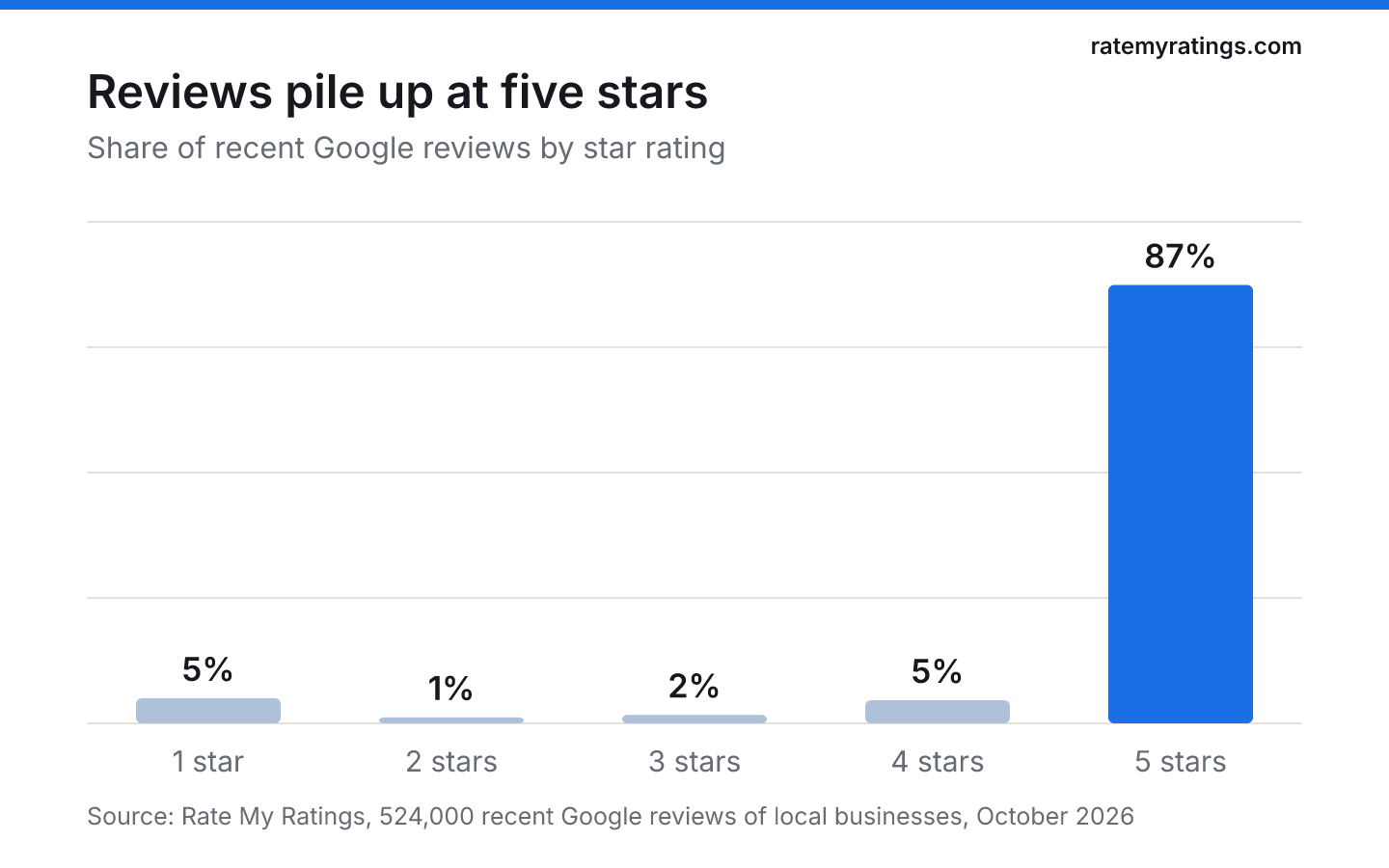
It is also unnecessary. In the 524,000 recent Google reviews we have collected across 130 local markets, 87% are already five-star. Customers who are pleased give five stars without being told.
And a perfect score is not what persuades readers. Northwestern University's Spiegel Research Center found in How Online Reviews Influence Sales that purchase likelihood typically peaks for ratings between 4.0 and 4.7, then falls as ratings approach 5.0, because a flawless score looks too good to be true.
Say instead: "We'd really value an honest review of your visit."
"Anything less than five stars counts as a fail for us"
Common in car sales and some franchises, this turns the customer into the judge of a staff member's job. It is pressure, it is a request for a particular rating, and it reliably produces resentful reviews when customers discover it.
Say instead: nothing about scores at all.
Phrases that filter out unhappy customers
"If you were happy, review us on Google. If not, contact us first."
This is review gating: steering satisfied customers to the public review site and unhappy ones to a private channel. Google's policy forbids businesses from discouraging negative reviews or selectively soliciting positive ones. The ACCC warns that suppressing negative reviews or rewarding only positive ones can mislead customers under Australian Consumer Law, and the US FTC's rule on fake reviews targets the suppression of negative reviews.
You can absolutely invite feedback privately. Just do not make the public review conditional on the answer.
Say instead: "If anything wasn't right, please tell us so we can fix it. And either way, we'd welcome an honest Google review."
"Only leave a review if you can give us top marks"
The same problem in blunter words. A review request has to be open to every answer.
Phrases that offer something in return
"Leave a review and get 10% off your next visit"
Any reward linked to reviewing, whether a discount, a free coffee, a prize draw entry or loyalty points, is ruled out. Google's tips to get more reviews state that offering incentives such as free or discounted goods in exchange for reviews is strictly prohibited, and reviews posted because of an incentive can be removed.
In the UK, submitting or commissioning a review that conceals it was incentivised is a banned practice under the Digital Markets, Competition and Consumers Act 2024, in force since 6 April 2025. In the US, the FTC rule bans incentives conditioned on a review expressing a particular sentiment.
Say instead: "Thank you for choosing us." A thank-you is not an incentive.
"Everyone who reviews this month goes into our draw"
A prize draw is still an incentive, even if the customer might not win and even if a negative review would qualify. Leave competitions for other marketing.
Phrases that pressure
"Could you do it now, before you go?"
Watching someone write a review, or handing them a tablet at the till, puts them on the spot. Google's policy names pressuring customers to review while on the premises as rating manipulation. The customer who would have written a warm review at home writes a hurried line, or nothing.
Say instead: "Here's a card with the link, if you have a minute later."
"I get a bonus for every review"
It may even be true, but it shifts the request from the customer's experience to your pay packet. It also hints at a practice Google forbids: its policy treats asking staff to collect a set number of reviews as manipulation. If your business sets review quotas for staff, stop.
"My manager checks how many reviews we each get"
Same problem. Ask because the feedback matters, not because someone is counting.
Phrases that script the review
"Could you mention our new treatment room?" or "Please mention my name"
Asking customers to include particular points is asking for specific content. Let them write about what mattered to them. In our data, five-star reviews mention friendly or helpful staff 41% of the time without anyone prompting them; if your team made an impression, it will show.
"Here's some wording you can copy"
A pre-written review is no longer the customer's genuine experience in their own words. Readers notice pasted text too. Our guide to spotting fake Google reviews explains why identical phrasing is a red flag.
Phrases that add friction
These are not against any rule, but they lose you reviews.
| Phrase | Problem | Better |
|---|---|---|
| "Search for us on Google and find the reviews bit" | Too many steps | A direct link or QR code from your Business Profile |
| "Review us on Google, Facebook, Trustpilot and Yelp" | Choice overload | One platform, one link |
| "Dear valued customer" | Feels automated | Their first name and what you did for them |
| "We would be extremely grateful if you could possibly find the time..." | Long and needy | One plain sentence |
| A third or fourth reminder | Feels like chasing | One request, one reminder, then stop |
Google's guide to creating a review link or QR code shows how to get the direct link.
What not to say when asking for a review, and what to say instead
Strip out everything above and what is left is short, honest and easy:
"Thanks for coming in today, Jo. If you have a minute, we'd really value an honest Google review: [link]. It helps other people nearby find us."
That is the whole formula: thanks, a reason, a link, and an open invitation to say what they actually think. Our guide to asking for Google reviews without being annoying has more templates, and the best time to ask for a review covers when to send it.
If you are being offered services that promise to fix your reviews through tactics like these, read our piece on whether small businesses should pay for review services first. And if you want to see what customers in your market actually praise and criticise, a Rate My Ratings market report reads every competitor's reviews for you.
The short version
- What not to say when asking for a review: anything about stars, rewards, who should review, doing it now, or what to write.
- Asking for five stars is unnecessary (87% of reviews already are) and counterproductive (perfect scores look too good to be true).
- Incentives and gating break Google's rules and consumer law in the UK, US and Australia.
- Keep the request to thanks, a reason, a direct link and an open invitation.
Frequently asked questions
- Is it against the rules to ask for a five-star review?
Yes, on Google. Its policy bars businesses from requesting specific review content, and a star rating is about as specific as a request gets. Asking for five stars also pressures customers and is unnecessary: in our data, 87% of recent Google reviews are already five-star. Ask for an honest review instead and let customers choose the rating themselves.
- What is review gating?
Review gating means sending only satisfied customers to a public review site while steering unhappy ones to private feedback, for example asking how the visit went and showing the Google link only to people who answer positively. Google forbids selectively soliciting positive reviews, and in Australia the ACCC warns that suppressing negative reviews can mislead customers. Every customer should get the same open invitation.
- Can I offer a discount in exchange for a Google review?
No. Google strictly prohibits offering free or discounted goods or services in exchange for reviews, and such reviews can be removed. In the UK, reviews that conceal an incentive are banned under the Digital Markets, Competition and Consumers Act 2024. Prize draws and loyalty points count as incentives too, even if the review could be negative.
- What should a review request say?
Keep it to a thank-you, a short honest reason, a direct link and an open invitation. For example: thanks for coming in today; if you have a minute, we would really value an honest Google review; it helps other people nearby find us. Use the customer's name, mention the service, and send it once with one reminder at most.

Rate My RatingsNewsletter
What reviews say about local markets, in your inbox.
New articles and findings from the blog, as they're published.
Check your inbox.
If this address isn't subscribed yet, we've sent it a link to confirm. Nothing is sent until you click it.
That didn't go through. Check the email address and try again.
Hold on a moment, then subscribe again.