
Best Times to Ask Customers for Reviews
Ask at the customer's high point, then send the link within hours, ideally late morning or mid-afternoon on a weekday. Timing data from 524,000 recent Google reviews.

The best time to ask for a review is right after the customer has experienced the result they came for, while the feeling is fresh, and the best time to send the message is during the day on a weekday. In practice that means asking in person at the moment of delight, then following up with a link within a few hours, ideally late morning or mid-afternoon. Asking before the result, late at night or days later all cost you reviews.
There are two clocks to get right: where the customer is in their experience, and what time of day the request lands. We will take them in turn, using what we see in 524,000 recent Google reviews across 130 local markets in the UK and Australia.
The moment in the customer journey
Every service has a high point: the moment the customer sees the outcome and feels relieved, pleased or impressed. That is the moment to ask. Before it, they have nothing to review. Long after it, the feeling has faded and the request competes with everything else in their day.
The high point is rarely the moment of payment. Price, fees and quotes come up in 25% of the one- and two-star reviews in our data, more than any other theme, so the till is often where satisfaction dips rather than peaks.
When the high point comes, by trade
| Business | Best moment to ask | Too early |
|---|---|---|
| Vet | As the owner leaves with a pet that is clearly better, or on a follow-up call after a procedure | At booking or check-in |
| Dentist | At the end of a completed treatment, or the appointment where the result shows | After the first of several sessions |
| Hair or beauty salon | At the mirror, when the client sees the finished look | Mid-appointment |
| Restaurant or café | When the bill arrives after a good meal, or the next morning for bookings | When ordering |
| Electrician, plumber, roofer | When the job is signed off and working; for roofs, after the first heavy rain | When the van arrives |
| Garage | On collection, or the next day once the customer has driven the car | When the car is dropped off |
| Estate agent | At completion and key handover | At offer or exchange |
| Driving school | Straight after the pupil passes their test | Mid-way through lessons |
| Wedding venue | A week or two after the wedding, once the couple has had time to enjoy it | During the final planning meeting |
| Physiotherapist | When the patient notices real improvement or is discharged | At the first assessment |
The pattern is the same everywhere: ask once the customer has the outcome, not the promise of it.
The time of day to send the request
Most review requests now go by text or email, so the second clock is the time the message arrives. People leave reviews when they have their phone in hand and a few spare minutes, and in our data that is overwhelmingly the working day.
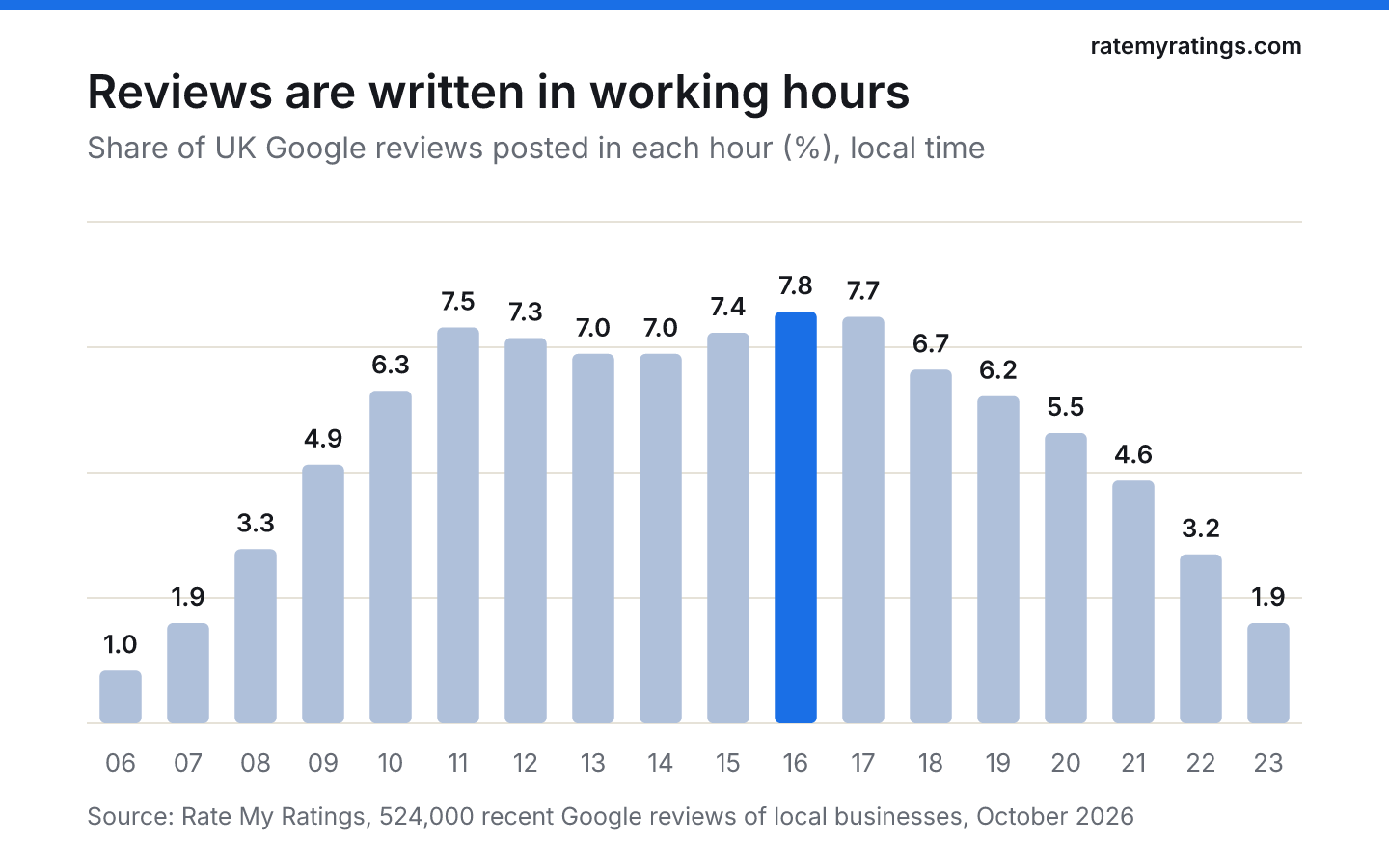
In the UK, 58% of reviews are posted between 10:00 and 18:00. The busiest hour is 16:00 to 17:00, with a second peak from 11:00 to 12:00. After 21:00 activity falls away quickly. Australia, measured in Sydney time, shows the same shape.
That gives a practical rule for timed messages:
- Same-day visits: send the message two to four hours after the visit, so a morning appointment gets its message around lunchtime and an afternoon one around 16:00.
- Evening visits: send the next morning, between 10:00 and 12:00, rather than late at night.
- Completed jobs: send the day after sign-off, in late morning or mid-afternoon.
A caveat on what this data shows. It tells us when people post reviews, not when they respond best to a request. But a request that lands when people are already looking at their phones and willing to write has the best chance of being acted on.
The best day of the week
The weekly pattern is just as clear. Tuesday to Friday each account for about 15–16% of the week's UK reviews. Monday and Saturday sit at around 13–14%, and Sunday is the quietest day at 11%.
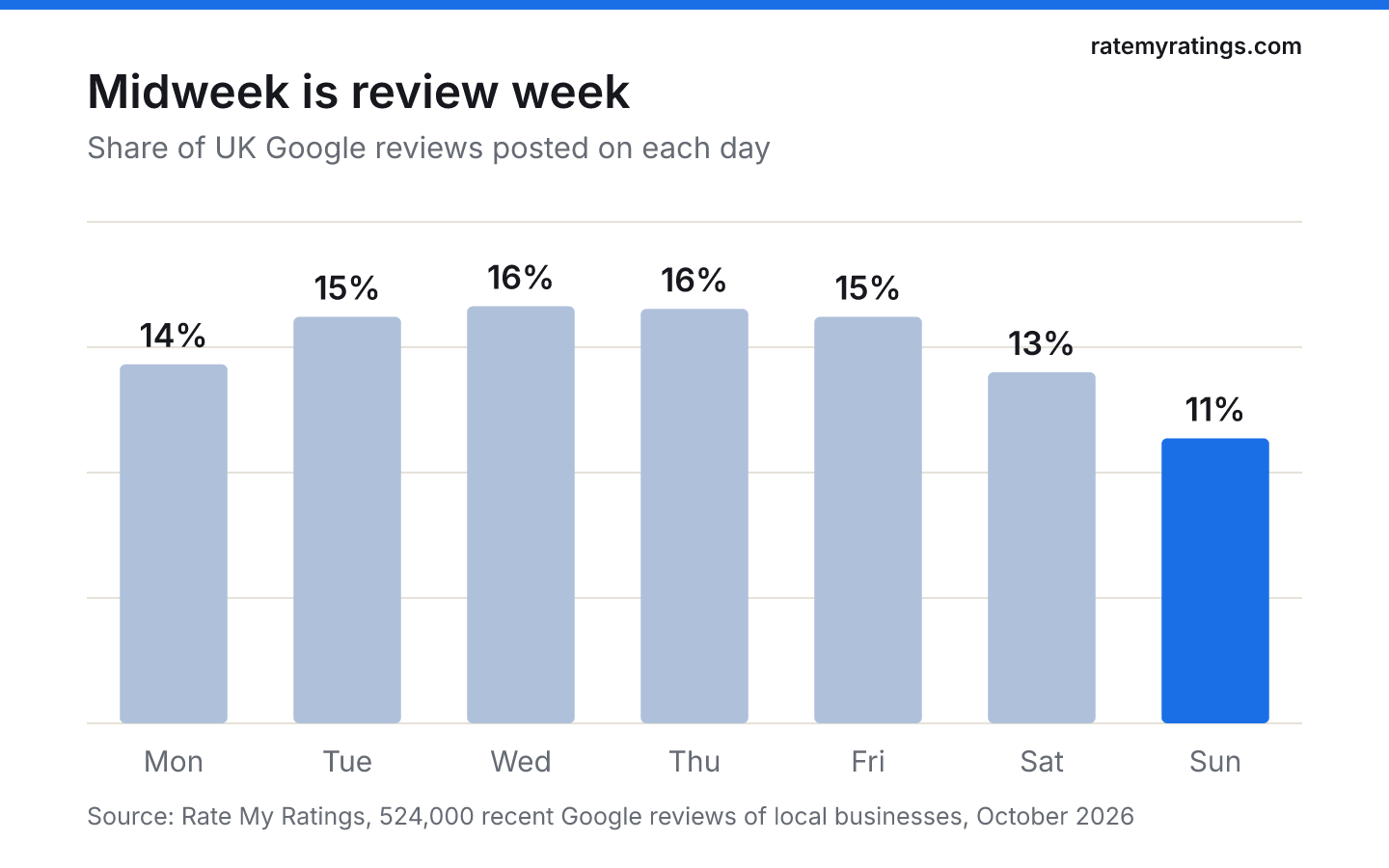
If you batch your review requests, send them midweek. If a customer visits on Saturday, a message on Monday or Tuesday will usually do better than one on Sunday evening.
How soon is too late?
The longer you wait, the less vivid the experience and the less likely the customer is to act. Within 24 hours is a good default for most businesses, with one exception: when the value of the service only shows over time. A roof, a course of physiotherapy or a car repair may be best reviewed after a week of living with the result. In those cases a short, honest message such as "now that you've had a week with it" reads naturally and earns more considered reviews.
Do not leave it for months. Readers weigh recent reviews heavily: BrightLocal's 2026 Local Consumer Review Survey found that 74% of US consumers only care about reviews from the last three months. A request sent long after the visit adds little and can feel odd to the customer.
When not to ask
Some moments are simply wrong:
- In the middle of a problem. If something went wrong, deal with it first. Ask once it is resolved, and accept whatever the customer writes.
- Before the outcome. At booking or check-in there is nothing to review yet.
- Repeatedly. One request and one reminder is enough. Our guide to asking for Google reviews without being annoying covers how to follow up politely.
What you must not do is decide not to ask certain customers because you expect a poor review. Google's content policy forbids businesses from selectively soliciting positive reviews. In Australia, the ACCC warns that suppressing negative reviews, or offering incentives only for positive ones, can mislead customers under Australian Consumer Law. Timing is about choosing the right moment for everyone, not choosing who to ask. Our article on what not to say when asking for a review explains where the line sits.
Make the best time to ask for a review automatic
Good timing is hard to keep up by hand on a busy day, which is why the best results come from building it into your systems. Most booking and invoicing software can send a message a set number of hours after a visit, and Google's guide to creating a review link or QR code suggests adding your link to receipts, thank-you emails and the end of chat conversations. Set the delay to match your trade's high point and the hours above, and the timing takes care of itself. Our article on getting more Google reviews without asking constantly walks through the setup.
If you want to see when and how often your competitors are collecting reviews, and what their customers say, a Rate My Ratings market report reads every business in your local market.
The short version
- The best time to ask for a review is right after the customer sees the result, not at booking or at the till.
- Ask in person at the high point, then send a link within a few hours.
- Send messages during the day: 58% of UK reviews are posted between 10:00 and 18:00, peaking at 16:00 to 17:00.
- Midweek beats Sunday: Tuesday to Friday each carry about 15–16% of reviews, Sunday 11%.
- Time requests for everyone; never skip customers you fear will be critical.
Frequently asked questions
- What is the best time of day to ask for a review?
During the working day. In our data from 461,000 recent UK Google reviews, 58% were posted between 10:00 and 18:00, with the busiest hour from 16:00 to 17:00 and a second peak from 11:00 to 12:00. Send review requests late morning or mid-afternoon, and avoid late evenings, when activity drops sharply.
- How long after a service should you ask for a review?
Within 24 hours for most businesses, while the experience is fresh. Ask in person at the moment the customer sees the result, then follow up with a link a few hours later. Where results take time to show, such as a roof repair or a course of physiotherapy, waiting about a week can produce more considered reviews.
- What day of the week do people leave the most reviews?
Midweek. In our UK data, Tuesday to Friday each account for about 15 to 16% of the week's Google reviews, Monday and Saturday for about 13 to 14%, and Sunday for just 11%. If you send review requests in batches, a midweek day is a safer choice than the weekend.
- Should you ask for a review at the till when the customer pays?
Usually not. Payment is rarely the high point of a visit, and price, fees and quotes are the most common theme in one- and two-star reviews in our data. Ask at the moment the customer sees the result instead, and use the receipt only to carry your review link or QR code for later.

Rate My RatingsNewsletter
What reviews say about local markets, in your inbox.
New articles and findings from the blog, as they're published.
Check your inbox.
If this address isn't subscribed yet, we've sent it a link to confirm. Nothing is sent until you click it.
That didn't go through. Check the email address and try again.
Hold on a moment, then subscribe again.