
Is There a Difference Between Google Reviews and Google Ratings?
A rating is the star score; a review is the written account that can come with it. One in six Google ratings in our data has no text at all. What each one does for your profile, and why the words matter more than they seem.

Yes, there is a difference. On Google, a rating is the star score from one to five that a customer gives a business. A review is the written account that can come with it, sometimes with photos. Every review includes a rating, but not every rating includes a review: Google lets people tap a star score and leave without writing a word. So when people compare Google reviews vs ratings, the short answer is that ratings drive your average, and reviews explain it.
The distinction sounds pedantic until you look at the numbers. In 524,000 recent Google reviews of local businesses we have analysed, one in six had no text at all. That has consequences for how your profile reads, what persuades new customers, and what you should ask for.
Google reviews vs ratings: the definitions
| Rating | Review | |
|---|---|---|
| What it is | A score from 1 to 5 stars | Written text, optionally with photos, plus a star score |
| Effort for the customer | One tap | A minute or more |
| Counts towards your average | Yes | Yes |
| Tells readers what happened | No | Yes |
| Can be replied to by the business | Yes | Yes |
| Can be edited or deleted by its author | Yes | Yes |
Google's own help page is titled add, edit, or delete Google Maps reviews and ratings, treating them as two related things: a person can change their rating, their text or their photos after posting, and the edited version takes the date of the latest edit.
On your Business Profile, the large number next to the stars (4.7, say) is your average rating. The count in brackets beside it reflects the ratings people have left. Below that sit the individual entries, some with text and some just stars.
How many Google ratings come without a review
Across our 524,000 recent reviews, 83% included written text and 17% were star-only. The mix varies a lot by star rating.
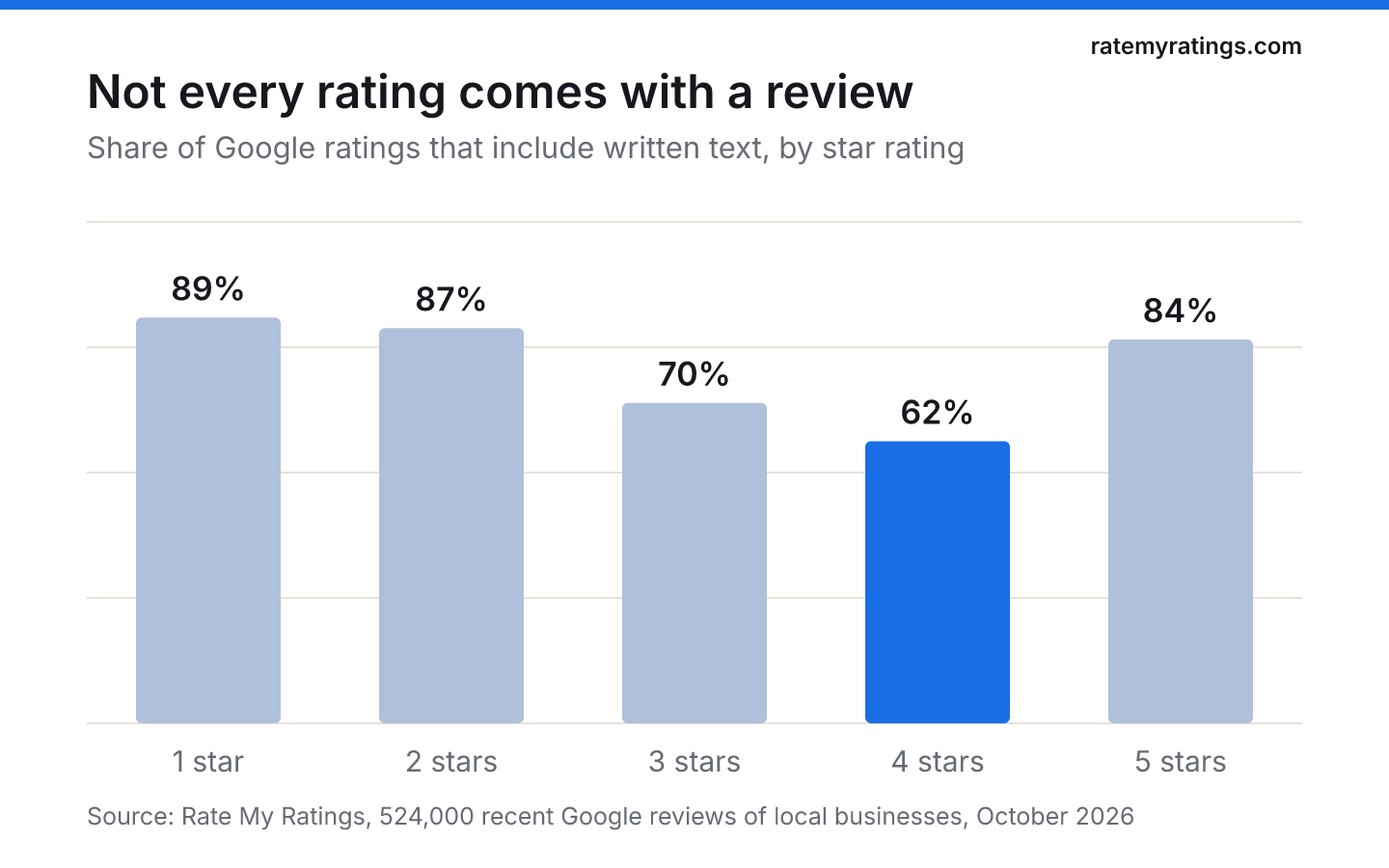
Three patterns stand out:
- Unhappy customers almost always explain themselves. 89% of one-star ratings come with text, and they are long: a median of 74 words.
- Four-star customers are the quietest. Only 62% of four-star ratings include text, and the median four-star review is just 24 words. These customers were satisfied, not moved.
- Five-star customers usually say something, briefly. 84% include text, with a median of 27 words. "Brilliant service, highly recommend" is typical.
Put together, it means the written side of a profile skews more negative than the star side. The stars are 87% five-star, but the long, detailed text on a typical profile disproportionately comes from the minority who were unhappy.
Which matters more to customers
Both, for different reasons. The star average is the filter; the text is the decider.
BrightLocal's 2026 Local Consumer Review Survey found that 92% of consumers care about star ratings, and 31% will only use a business rated 4.5 or higher. So the average decides whether you make the shortlist. But when the same survey asked what makes consumers trust a review, the top answers were about content: a review "backed up by other reviews with similar sentiment" (56%) and a positive written experience (46%), ahead of a high star rating (42%).
In other words, a rating gets you considered, and reviews get you chosen. A profile of 200 star-only five-star ratings is less persuasive than one with 120 ratings and 80 specific accounts of what the business did well. Our guide on what customers look for in reviews goes into what those accounts need to contain.
Which matters more to Google
Google's guidance on local ranking says more reviews and positive ratings can help a business's local ranking, as part of what it calls prominence. It does not separate star-only ratings from written reviews in that statement.
Text likely does more than stars in two indirect ways. First, the words in reviews can help Google understand what a business does and match it to searches; a review mentioning "emergency appointment" or "boiler repair" describes the service in customers' own language. Second, the topic filters Google shows above reviews are drawn from review text, so a profile without much text has little for readers to filter on. Google has not published weights for any of this, so treat it as informed inference rather than a rule. Our guides on how many Google reviews you need to rank and how Google sorts reviews cover what is known.
Are star-only ratings less trustworthy?
Not inherently. Plenty of genuine customers tap five stars on the way out of the door and never write anything. But star-only ratings are also the cheapest kind of fake, because they take seconds and leave nothing to check. A run of star-only five-star ratings from brand-new accounts in a short window is one of the patterns careful readers, and Google's filters, look at. In our data, 16% of reviews come from accounts that have only ever reviewed once, and those accounts lean towards one and five stars. Neither fact proves anything on its own, which is why written reviews carry more weight with readers: a specific account of a visit is much harder to invent convincingly. Our guide on how to spot fake Google reviews covers the signals.
A third thing called a Google rating: store ratings
There is one more source of confusion. If you sell online, you may see stars next to your Google Ads or shopping listings. These are store ratings, a separate system described in Google's help page on store ratings. They come from Google Customer Reviews and approved third-party review sites, they are about the online buying experience, and most merchants need around 100 eligible reviews from the past two years before a rating appears. Text ads only show a store rating of 3.5 or above.
Store ratings and Business Profile ratings both show as stars, but they are different numbers from different sources. A local business without an online shop only needs to think about its Business Profile.
What this means for your business
Ask for a few words, not just stars
When you ask for a review, ask for a sentence about what you helped with: "Would you mind mentioning what we did for you?" It turns a would-be star-only rating into a useful review, and it shifts the written side of your profile towards the experiences of satisfied customers. Our guide on how to ask for Google reviews has wording you can use.
Pay particular attention to four-star customers
They are the least likely to write anything, and the least likely to get a reply: in our data, 45% of four-star reviews receive an owner reply against 54% of five-star ones. A short, personal thank-you to a four-star reviewer costs little.
Reply to star-only ratings sparingly
You can reply to a star-only rating, but there is little to respond to. A brief thank-you on recent five-star ratings is fine. For a star-only one-star rating, a short invitation to get in touch is worth posting, because readers will see it.
Read your average in context
What counts as a good average depends on how many ratings sit behind it and on your category. In the 46,800 local businesses we track, the median rating is 4.8, but 70% of businesses with fewer than ten ratings sit at a perfect 5.0 and only 1% of those with more than a thousand do. Our guide to what a good Google rating is breaks this down by category.
If you want to see how your rating, review count and the substance of your reviews compare with every competitor nearby, a Rate My Ratings market report reads all of their public reviews for you.
The short version
A Google rating is the star score; a Google review is the written account that can come with it. Both count towards your average, but only reviews tell people what happened. In our data, 17% of Google ratings have no text, four-star customers write least, and unhappy customers write most. Ratings get you onto the shortlist; reviews win the decision. So when you ask customers for feedback, ask them for a few words, not just stars.
Frequently asked questions
- Can you leave a Google rating without writing a review?
Yes. Google lets people give a business a star rating with no text, and it counts towards the business's average rating. In our analysis of 524,000 recent Google reviews, 17% were star-only ratings. They are quick to leave, which helps volume, but they tell other customers nothing about what happened.
- Is the Google star rating a simple average?
The rating on a Business Profile is presented as the average of customers' star ratings, shown to one decimal place. Google does not publish a detailed formula, and removed reviews drop out of it. It is safest to treat it as an average of the visible ratings, and to remember that a small number of reviews makes it swing easily.
- What are Google store ratings?
Store ratings are a separate Google system for online shops. They appear in Google Ads and shopping results, are gathered from Google Customer Reviews and approved third-party review sites, and are about the online buying experience. They are not the star rating on a local Business Profile, although both show as stars.

Rate My RatingsNewsletter
What reviews say about local markets, in your inbox.
New articles and findings from the blog, as they're published.
Check your inbox.
If this address isn't subscribed yet, we've sent it a link to confirm. Nothing is sent until you click it.
That didn't go through. Check the email address and try again.
Hold on a moment, then subscribe again.