Do Google Reviews Really Bring in More Sales?
Yes, but not in the way most owners expect. Reviews raise sales by getting you found, getting you chosen and letting customers trust you enough to pay. Here is the evidence, and where it stops.

Do Google reviews increase sales? Yes, for most local businesses they do, but not because a review makes someone buy. Reviews work in three steps: they help you appear in local search, they help you get picked from the handful of businesses a customer compares, and they give a stranger enough confidence to book, call or walk in. Lose any of those steps and the reviews do far less.
We read the reviews of whole local markets for a living: the Google ratings of 46,800 businesses across 130 markets in the UK and Australia, and more than half a million recent reviews. This article sets out what the research says, what our own data adds, and how to tell whether reviews are earning their keep in your business.
Do Google reviews increase sales? What the research shows
The most cited evidence comes from a Harvard Business School study by Michael Luca, which used Yelp data for Seattle restaurants. It found that a one-star increase in rating led to a 5 to 9 percent increase in revenue, and that the effect was driven by independent restaurants. Ratings made no measurable difference to chain restaurants, whose customers already know what they will get.
That split matters for every small business owner. Reviews are a substitute for reputation. A national brand has decades of advertising doing the job; a single dental practice or a family garage has only what strangers have written about it.
The second strand of evidence is about the decision to buy. The Spiegel Research Center at Northwestern University found that a product with five reviews was 270% more likely to be bought than one with none, with the benefit of each extra review shrinking quickly after the first few. The same study found that purchase likelihood peaked for ratings between 4.0 and 4.7, not at a perfect 5.0.
Then there is reach. In BrightLocal's 2026 Local Consumer Review Survey, 97% of consumers said they read reviews when choosing a local business, and 31% said they would only use a business rated 4.5 or higher. When almost every buyer reads reviews first, reviews are part of the shop window whether you manage them or not.
How reviews turn into sales
Step one: being found
Google is explicit that reviews feed local ranking. Its own guidance on how local results are ranked names relevance, distance and prominence, and says that "more reviews and positive ratings can help your business's local ranking". A business that does not appear in the map results for "vet near me" never gets the chance to be chosen. We look at how much that matters in how many Google reviews you need to rank higher.
Step two: being chosen
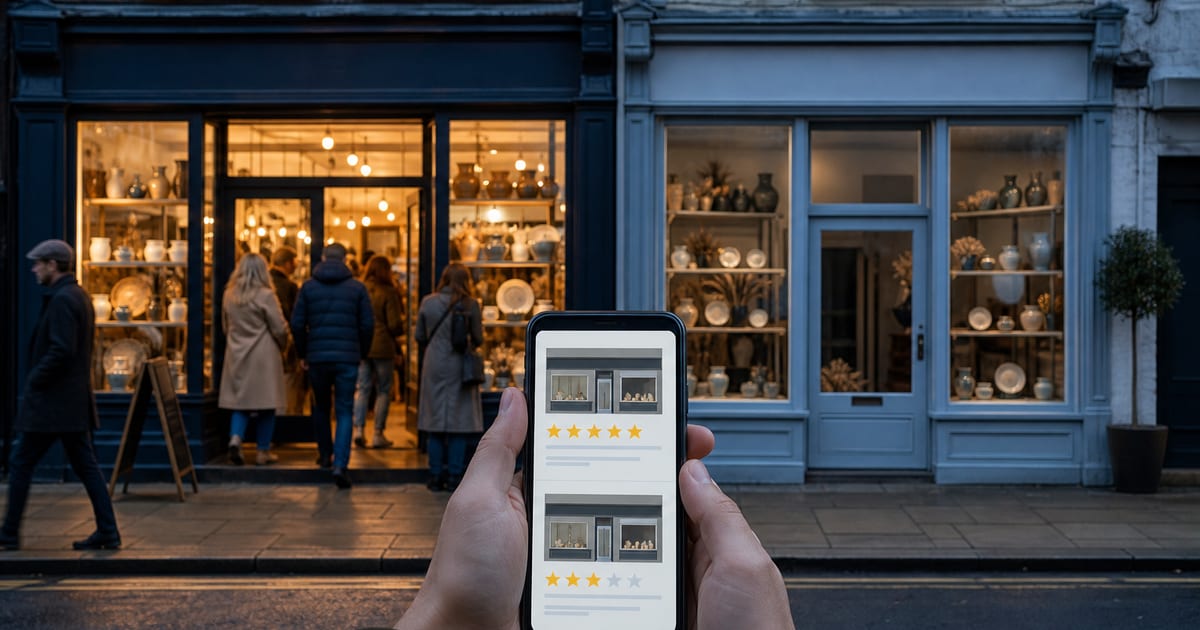
Once you appear, you are one of three or four names on a phone screen. The customer compares star ratings, review counts and the first few lines of the most recent reviews, usually in under a minute. This is where a rating gap between you and the business next to you becomes lost calls.
Step three: being trusted enough to pay
Reviews also change what a customer is willing to commit to. Booking a wedding venue, handing over a pet for surgery or letting a roofer up a ladder are high-trust decisions. Detailed reviews that describe the experience reduce the risk the customer feels, which is why they matter most in categories where a bad choice is expensive.
This is also where reviews can protect your prices. A customer who has read twenty accounts of a dentist explaining every step clearly is less likely to shop around on price than one choosing between two unknowns. Reviews do not only win the first booking; they make the next quote easier to accept.
What our data adds: the rating alone rarely sets you apart
Here is the part most advice misses. In the markets we track, the median Google rating is 4.8, and 74% of businesses are rated 4.5 or higher. Only 9% sit below 4.0.
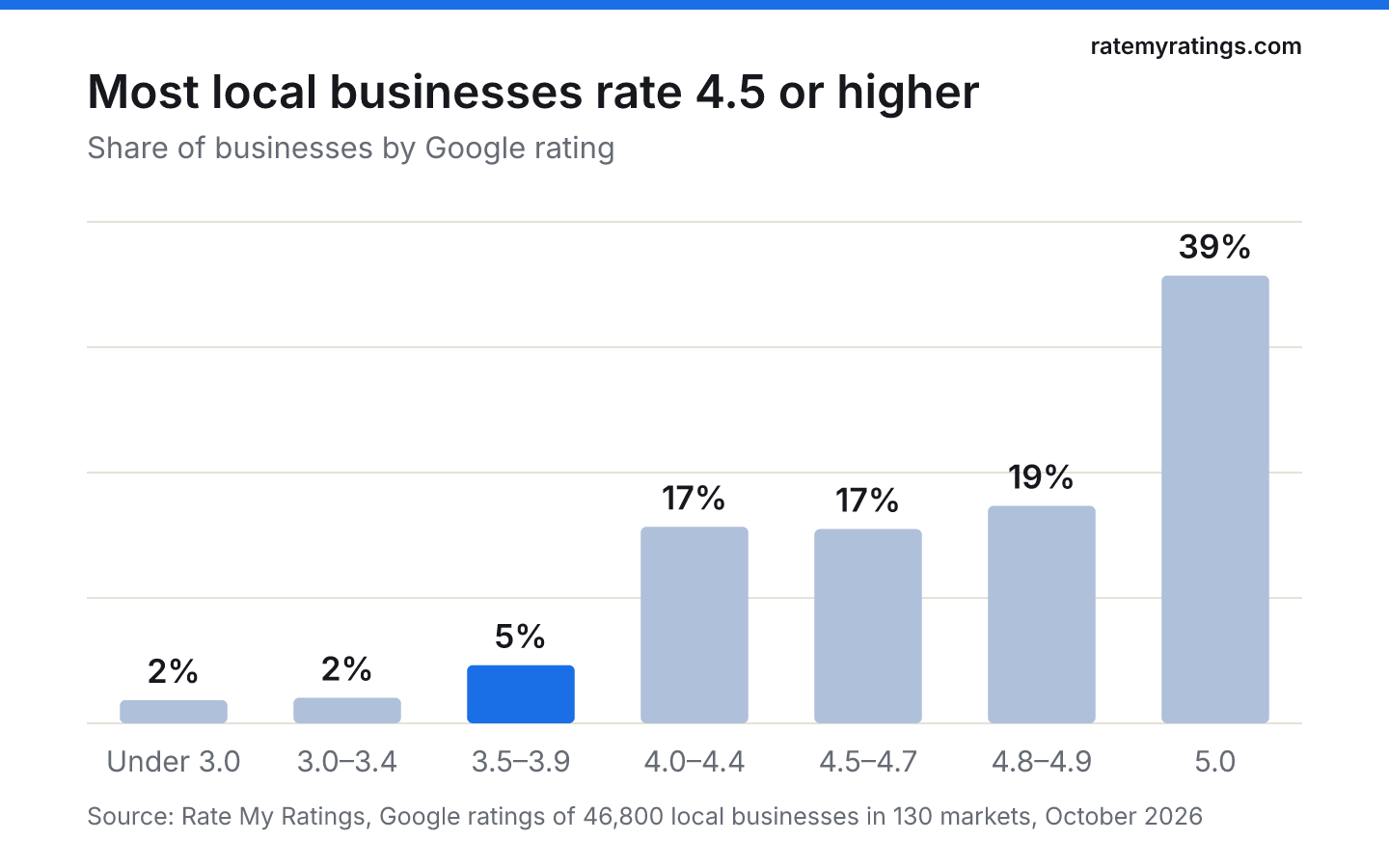
When nearly everyone has four and a half stars or more, a high rating stops being an advantage and becomes the entry ticket. What separates businesses in the same street is:
- Review count. A 4.8 from 300 reviews reads very differently from a 5.0 from six. In our data, 70% of businesses with fewer than ten reviews have a perfect 5.0, against just 1% of those with more than a thousand. Customers have learned to discount perfect scores on small numbers.
- Recency. BrightLocal's survey found 74% of consumers look for reviews written in the last three months. A strong rating built on reviews from two years ago looks like a business that has gone quiet.
- Content. Five-star reviews in our data talk about people: 41% mention friendly or helpful staff and 23% mention professionalism or expertise. Those specifics are what persuade the next customer.
What counts as "plenty" also depends on the trade. The median vet practice in our data has 154 Google reviews and the median wedding venue 165, while the median electrician has seven and the median roofer six. A roofer with 40 recent, detailed reviews stands out in a way a vet with 40 does not. Before you set a target, look at what the businesses around you have, not at a national average.
So, do Google reviews increase sales once you are already at 4.7? Mostly through volume, freshness and detail, not through the extra tenth of a star. Our piece on what a good Google rating is shows how the bar differs by category.
When reviews do not move sales
Reviews are not a lever that works everywhere. They make little difference when:
- You are a known chain. Luca's finding again: customers choose the brand, not the branch.
- Demand is not the constraint. A physiotherapist with a six-week waiting list will not earn more from more reviews, though they may be able to charge more or choose better-fitting clients.
- Customers do not choose online. Some trades still win most work through repeat customers and word of mouth from people who never check Google.
- The service itself is the problem. Reviews amplify reality. If customers keep writing about late appointments or surprise fees, more reviews will spread that message faster.
How to tell if reviews are working for you
You do not need an attribution model. Four simple checks will tell you most of what you need:
- Watch your Google Business Profile performance. Calls, direction requests and website clicks from your profile are the closest thing to a sales signal that Google gives you. Compare the same months year on year.
- Ask new customers how they found you. Add one question to your booking form or intake call. "Google reviews" as an answer is direct evidence.
- Compare yourself with the three businesses that appear next to you. If they have three times your review count and more recent reviews, that gap is likely costing you enquiries.
- Track enquiries after a push. If you start asking every customer for a review, note your enquiry numbers for the following three to six months. Our guide to how long Google reviews take to work sets realistic expectations.
If you want to put a number on it, our piece on the ROI of review management walks through a simple calculation. And if you want to see how your whole local market compares, a Rate My Ratings market report reads every competitor's reviews for you.
The short version
- Reviews raise sales by helping you get found, get chosen and get trusted.
- The strongest evidence is for independent businesses; chains benefit far less.
- With 74% of local businesses already at 4.5 stars or more, the advantage now comes from review count, recency and detail rather than the rating alone.
- Measure the effect through profile calls and clicks, a "how did you find us" question and a comparison with your nearest competitors.
- Keep the flow of reviews steady with a simple routine, as set out in how to get more Google reviews.
Frequently asked questions
- Do Google reviews really increase sales?
For most independent local businesses, yes. Research on restaurant ratings found a one-star rise linked to 5 to 9 percent more revenue for independents, and Google says more reviews and positive ratings can help local ranking. The effect is weaker for chains and for businesses that are already fully booked.
- How many Google reviews does a business need before they help sales?
The first handful matter most. Research on online purchases found that five reviews made a product far more likely to be bought than none, with smaller gains after that. Locally, aim to match or beat the review count of the businesses that appear next to you in map results.
- Is a 5.0 rating better for sales than 4.8?
Not necessarily. Buyers trust ratings between about 4.0 and 4.7 more than a perfect score, which can look too good to be true. In our data, 70% of businesses with under ten reviews have a 5.0, so a perfect score on few reviews carries little weight.
- How can I measure whether reviews bring in customers?
Track calls, direction requests and website clicks in your Google Business Profile performance view, ask new customers how they found you, and compare enquiries in the months after you start asking for reviews with the same months a year earlier.

Rate My RatingsNewsletter
What reviews say about local markets, in your inbox.
New articles and findings from the blog, as they're published.
Check your inbox.
If this address isn't subscribed yet, we've sent it a link to confirm. Nothing is sent until you click it.
That didn't go through. Check the email address and try again.
Hold on a moment, then subscribe again.