
Do Keywords in Google Reviews Help Your Local SEO?
Google never mentions the words inside reviews, and local search experts rank review keywords 36th of 187 map factors. What they do, why scripting them breaks Google's policy, and what works instead.
Review keywords help your local SEO a little, and mostly indirectly. Google says local results depend on relevance, distance and prominence, and that more reviews and positive ratings can help a business rank, but it says nothing about the words inside reviews. Local search specialists rank keywords in Google reviews 36th of 187 factors for map results, far below your rating, your review count and how recent your reviews are.
What review keywords clearly do is help the reader. The words customers choose can appear as snippets under your listing and as topic filters on your profile, and they tell the next customer what you are good at. This guide covers what Google says, what practitioners believe, why you must not script customers' words, and how to get naturally descriptive reviews instead.
What does Google say about review keywords?
Google's help page on how to improve your local ranking names three factors. Relevance is how well a profile matches the search. Distance is how far the business is from the searcher. Prominence is how well known the business is, and Google says it draws partly on how many reviews you have: "more reviews and positive ratings can help your business's local ranking".
The page does not mention keywords in reviews at all. It also says there is no way to request or pay for a better local ranking. So any claim that review keywords move rankings is an inference by practitioners, not a rule Google has published.
The inference is reasonable. Relevance is about matching what you offer to what people search for, and review text is one place Google could read that. But "Google could" is not "Google does, and by this much", and the difference matters when someone sells you a scheme to get keywords into your reviews.
What local SEO practitioners believe
The best summary of practitioner opinion is Whitespark's 2026 Local Search Ranking Factors survey, published in November 2025, which asks local search specialists to rank 187 factors. Here is where the review factors sit for the map pack:
| Review factor (Whitespark's wording, shortened) | Rank of 187 |
|---|---|
| High numerical Google ratings (4 to 5) | 6 |
| Quantity of Google reviews with text | 9 |
| Recency of reviews | 11 |
| Sustained influx of reviews over time | 14 |
| Keywords in Google reviews | 36 |
| Positive sentiment in review text | 42 |
| Quantity of reviews with photos | 43 |
| Keywords in owner responses to reviews | 182 |
The experts think review keywords matter somewhat, but far less than having plenty of recent, well-rated reviews with text. They put keywords in your own replies near the bottom of the whole list. For visibility in AI search, the same survey ranks keywords in Google reviews 53rd. Treat all of it as informed opinion: the survey records what specialists believe from their client work, not what Google has confirmed.
Where the words in your reviews do show up
The clearest effect of review wording is on what searchers see, not on where you rank.
- Snippets in local results. Google sometimes adds a short line under a business in the map pack explaining why it appeared, often a phrase from a review that matches the search. Practitioners call these justifications, and BrightLocal's guide to justifications describes the review type as pulled from reviews left on Google.
- Topic chips on your profile. The short phrases above your reviews, which filter the reviews that mention them, come from what reviewers write. Our guide on how Google sorts reviews explains how they work and why you cannot choose them.
- What the reader learns. A review that names the job, the problem and how it was solved tells the next customer far more than two words of praise.
That last point is the strongest case for descriptive reviews. Left alone, customers write mostly about people: in 524,000 recent Google reviews we analysed, 41% of five-star reviews mention friendly, helpful or kind staff, and 23% praise someone as professional or knowledgeable. Remind them of the job, and the service itself has a better chance of being mentioned.
Why you must not script customers' words
This is where much advice goes wrong. Google's prohibited and restricted content policy for Maps has a section on rating manipulation that is specific about review requests. It says that when soliciting reviews, merchants should not require or pressure customers to review while on the premises, "nor should they request that specific content be included". It also rules out merchants asking staff to collect reviews that include specific content, including content that identifies a staff member.
Some practitioner guides still suggest encouraging reviewers to use your preferred keywords. Google's policy says the opposite, and Google's policy is what decides whether reviews stay up.
There is a practical risk too. Reviews that share the same phrases look scripted, and similar wording is one of the patterns that draws attention from Google's filters. Our article on Google review velocity covers which patterns get reviews held or removed. A run of reviews that all say "emergency plumber in Leeds, highly recommend" is exactly that pattern.
How to get naturally descriptive reviews
You can make detailed reviews more likely without telling anyone what to write. Remind customers what you did, then leave the words to them.
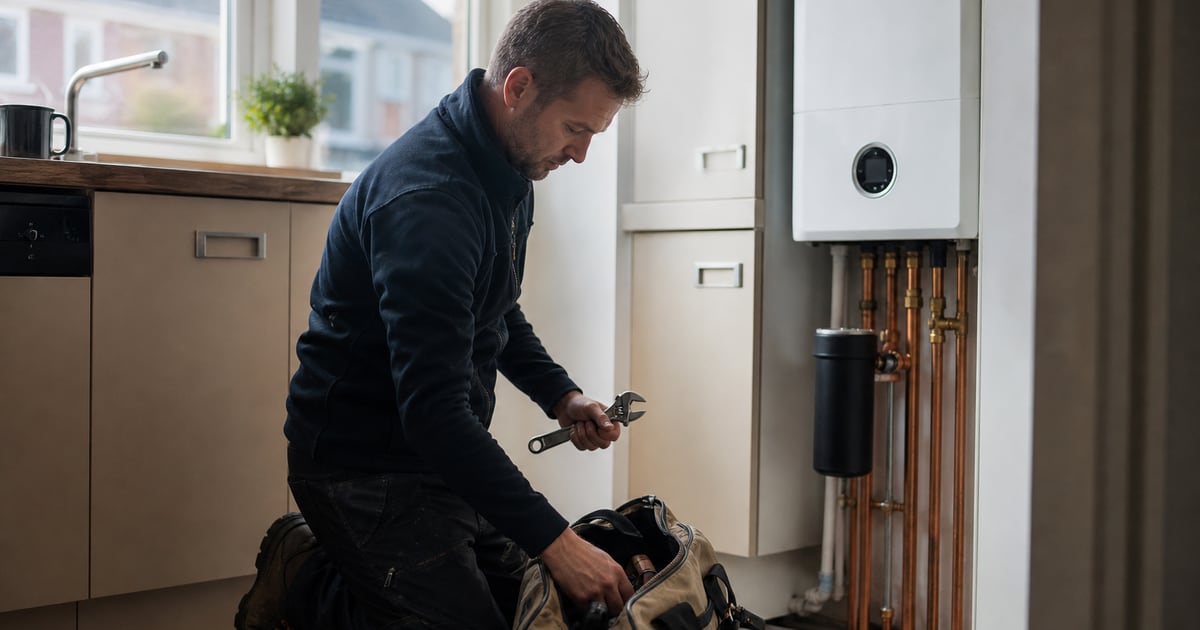
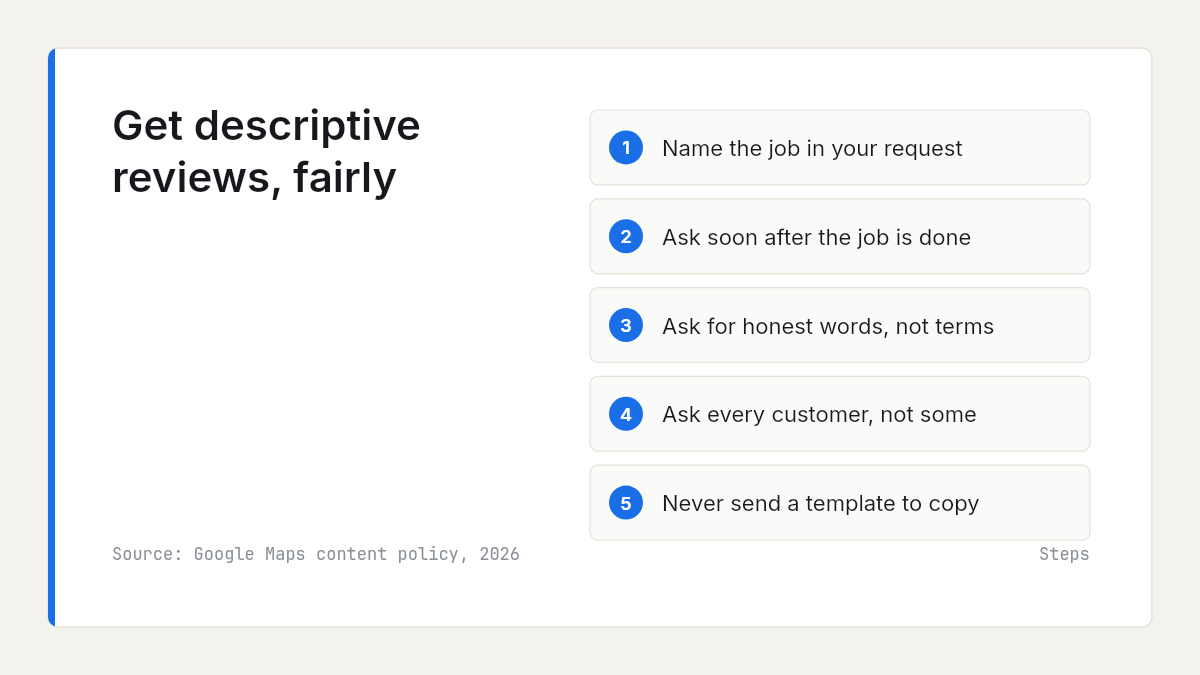
- Name the job in your request. "Thanks for having us fit your new boiler on Tuesday" reminds the customer what happened without suggesting a word of the review.
- Ask soon after the job. Details fade within days, and a fresh memory produces a more specific review.
- Ask for honesty, not content. "We would value an honest review" is fine. "Please mention our boiler servicing" is not.
- Ask every customer. Asking only the ones you expect to be happy breaks the same policy.
- Never send a template to copy, not even as "inspiration".
Here is how common request wording measures up. Our guide to what not to say when asking for a review has more phrases to drop.
| Request wording | Within Google's policy? |
|---|---|
| "Thanks for choosing us for your loft conversion. Would you leave us an honest review?" | Yes |
| "Could you mention the loft conversion and our Harrogate office?" | No: it requests specific content |
| "Please mention our receptionist by name" | No: content that identifies a staff member |
| "Here is a sample review you can adapt" | No: it scripts the review |
| "Five stars would really help us" | No: it tries to influence the rating |
Replying with service words, without stuffing
Your reply is a place to be specific, not to repeat search terms. Google's tips for writing review replies say to keep replies short and simple and to "be a friend, not a salesperson". Whitespark's experts rank keywords in owner responses 182nd of 187, so a reply that lists every service and town you cover gains nothing and reads like an advert to the next customer.
Name the job where it helps the reader: "Glad the new boiler is keeping the house warm, and thanks for making room for us on a busy morning." That is specific, short and written for a person. Our guide on how to respond to positive reviews has more examples.
What matters more than review keywords
If review keywords sit 36th, the factors above them deserve your time first. For relevance, your primary category and services carry far more weight than any review wording: see how to choose Google Business Profile categories. For prominence, review count, rating and recency come first, and our guide on how many Google reviews you need to rank gives benchmarks by trade.
Distance cannot be fixed with words at all. If a rival with fewer, plainer reviews still outranks you, the reason is usually elsewhere, and why a competitor with fewer reviews ranks higher works through the usual causes.
To see what customers actually say about every business near you, a Rate My Ratings market report shows each competitor's rating, review count and share of positive reviews, and the themes customers praise or complain about across the market.
The short version
- Google's local ranking guidance names relevance, distance and prominence, and never mentions review keywords.
- Local search experts rank keywords in Google reviews 36th of 187 map pack factors, well behind rating, review count and recency.
- Review wording shows up as snippets and topic filters, and helps the next customer decide.
- Google's policy says businesses should not ask customers to include specific content, so never script a review.
- Remind customers what job you did, ask every one of them for an honest review, and keep your replies short and human.
Frequently asked questions
- Should I ask customers to mention keywords in their Google review?
No. Google's Maps content policy says businesses asking for reviews should not request that specific content be included, and it does not allow staff to collect reviews that name them. You can remind a customer which job you did when you ask, then leave the wording of an honest review entirely to them.
- Do keywords in my review replies help my ranking?
There is no evidence that they do. Google's local ranking guidance does not mention them, and the specialists in Whitespark's 2026 survey ranked keywords in owner responses 182nd of 187 map pack factors. Write replies for the next customer instead: short, specific and polite, without lists of services or towns.
- Do review keywords matter for AI search?
A little, on expert opinion. Whitespark's 2026 survey ranks keywords in Google reviews 53rd for visibility in AI search, behind factors such as a high Google rating and reviews on trusted third-party sites. Google has published nothing on review wording, so the safe advice is unchanged: many genuine, detailed reviews, never scripted ones.
- Can I edit a customer's Google review to add more detail?
No. Only the person who wrote a review can edit it. A business can reply publicly and can flag a review that breaks Google's policies, but it cannot change the wording. If a customer offers to update a review after you have resolved a problem, let them write the update themselves without suggesting words.

Rate My RatingsNewsletter
What reviews say about local markets, in your inbox.
New articles and findings from the blog, as they're published.
Check your inbox.
If this address isn't subscribed yet, we've sent it a link to confirm. Nothing is sent until you click it.
That didn't go through. Check the email address and try again.
Hold on a moment, then subscribe again.