
How Should You Respond to Positive Google Reviews?
Thank the customer, mention one specific detail and add one line for the next reader. How to respond to positive reviews on Google, with ten example replies, what to avoid and a weekly routine.

To respond to positive reviews well, thank the customer, mention one specific detail from what they wrote and add one line that helps the next reader, all in two to four sentences. A short, personal reply shows future customers that real people run the business, tells the reviewer their words were read, and gives your team credit in public.
Most businesses do one of two things with five-star reviews: paste the same line under every one, or leave them unanswered. This guide covers why replies to praise matter, how often UK businesses actually reply, a three-part structure, ten example replies, what to leave out, how to handle four-star reviews and a ten-minute weekly routine.
Why respond to positive reviews at all?
A reply to a five-star review has three readers.
- The next customer. Your reply sits under the review for everyone who opens your profile. A specific, warm reply tells them someone is paying attention; a pasted one tells them nobody is.
- The reviewer. Google's help page on managing customer reviews says the person who wrote the review is notified when you reply. A customer who took the time to praise you hears back.
- Your team. A reply that names what went well, or credits the person who did it, is public recognition that costs nothing.
Customers notice. In BrightLocal's 2026 Local Consumer Review Survey of US consumers, 89% said they expect owners to respond to reviews, and 80% said they were likely to use a business that responds to all of its reviews. Only 45% said the same of a business that responds only to positive ones.
So replying to praise is half the job. A profile that thanks every five-star customer and ignores every complaint reads worse than one that answers both. Our guide on how to respond to negative Google reviews covers the other half.
Google itself is more relaxed. Its tips for writing review replies say you do not need to thank every reviewer publicly, and suggest replying when you have new or relevant information to share. That is a useful test: a reply should add something, even if it is only one specific detail.
How often do businesses reply to five-star reviews?
Across 524,000 recent Google reviews of local businesses in the UK and Australia, 54% of five-star reviews have a reply from the business. Four-star reviews are answered less often, at 45%, even though they come from customers who were happy.
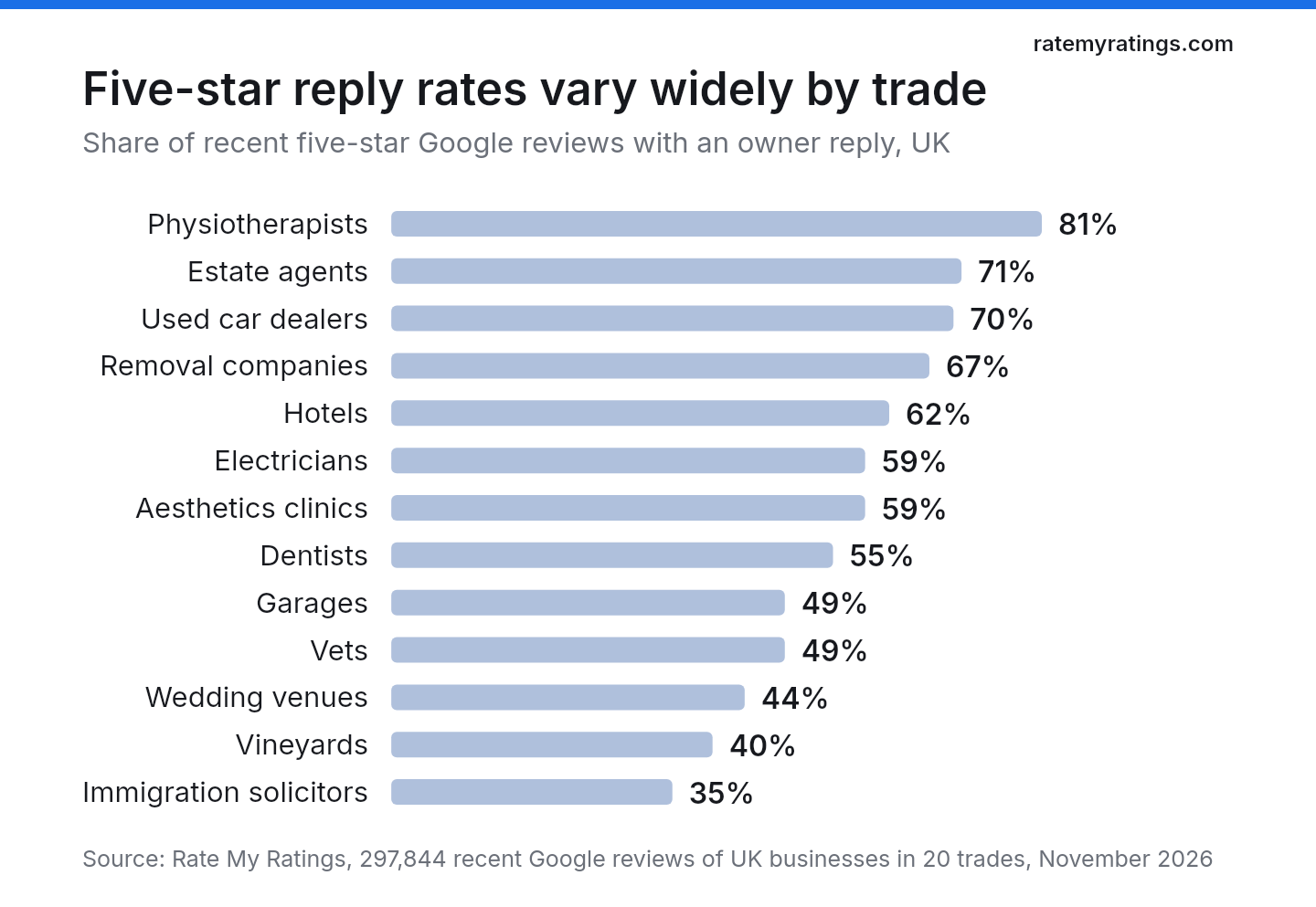
The rate varies a lot by trade. In our UK data, physiotherapists reply to 81% of their recent five-star reviews, while immigration solicitors reply to 35%.
One honest caveat: replying does not raise your star rating by itself. In our wider data, businesses that reply to most reviews do not have higher ratings than those that never reply (a median of 4.7 against 4.9). What replies change is how the rating reads, and whether a happy customer feels heard. Our article on the ROI of review management looks at where the return actually comes from.
A simple structure: thank, one detail, one forward line
A good reply to a positive review has three parts and rarely needs more than 50 words.
| Part | What it does | Example |
|---|---|---|
| Thank them | Shows a person read it | "Thank you for taking the time to write this." |
| One specific detail | Proves it is not a template, and tells readers what you do well | "We're glad the heating was back on before the cold snap." |
| One forward line | Credits the team, or tells the next reader something useful | "I'll pass your note to the engineer who came out." |
Sign it with a first name or initials, as Google's own tips recommend. Use the reviewer's first name only if it appears on the review, and never add details they did not mention themselves.
Ten examples to respond to positive reviews
These are starting points. Change the details until each reply could only have been written to that customer.
- Garage: "Thank you for this. We're glad we could get the car through its MOT on the same day, and I'll let the workshop know you noticed. [Name], service manager"
- Electrician: "Thanks for the review. Tracing that tripping fault took a while, so it's good to hear the explanation made sense. Any questions about the new consumer unit, just call."
- Café: "Thank you. The cinnamon buns are baked fresh every morning, so the kitchen will be pleased they won you over. Hope to see you again soon."
- Restaurant: "Thank you for choosing us for your anniversary. The team loved hearing the evening went well, and we'll pass your compliments to the kitchen."
- Wedding venue: "Congratulations again. It was a pleasure to host your day, and we've shared your thanks with the events team who set up the barn."
- Estate agent: "Thank you for the review. Selling in a slow market takes patience on both sides, and we're glad the weekly updates helped. Enjoy the new home."
- Dental practice: "Thank you for your kind words about the team. We'll share them at our next practice meeting."
- Barber: "Cheers for the review. Glad the fade came out the way you wanted, and [name] will be pleased you asked for him again."
- Accountant: "Thank you. Getting a first self-assessment return in on time is a relief, and we're glad we could make the process clear. Speak again next year."
- Removal company: "Thank you for the review. Three floors and no lift is never easy, so the crew will be glad to hear everything arrived in one piece."
Notice what the dental reply leaves out: no treatment, no appointment, nothing that confirms someone is a patient. Health and care businesses have extra rules, covered in our guide to how healthcare practices should respond to patient reviews.
What to leave out
- Copy and paste. BrightLocal's survey found generic or templated replies put off 50% of consumers. If every reply reads "Thanks for the five stars", readers stop believing any of them.
- Keyword stuffing. Replies crammed with "best electrician in town" read as spam to people. Google's guide to how local results are ranked says more reviews and positive ratings can help your local ranking, and that helpful replies can help you stand out. It does not say keywords in replies help you rank.
- Sales pitches. Google's tips put it plainly: be a friend, not a salesperson. A discount code in a reply can also look like a reward for the review, and Google's policies prohibit offering incentives for reviews.
- Personal details. Never add anything the reviewer did not share: what they bought, when they came, who they came with. Google's tips say never share a reviewer's private information.
How to handle four-star reviews
Four-star reviews are the most neglected. In our data, four-star customers write the least of any star level, and their reviews are answered less often than five-star ones (45% against 54%).
Treat a four-star review as a good review with a hint in it. Thank them, and if they mention what held back the fifth star, acknowledge it in one sentence and say what you have done:
Thank you for the review, and for the honest note about parking. We've added directions to the nearest car park to our booking confirmation, so the next visit should be easier.
Do not ask them to raise their rating. That turns a thank-you into pressure. If a four-star rating comes with no text at all, keep the reply to a single line; our guide to Google reviews vs Google ratings explains why star-only ratings tell readers so little.
A weekly routine to respond to positive reviews
Replying to praise works best as a habit, not a catch-up session every few months.
- Turn on review notifications in your Business Profile so new reviews reach a named person.
- Set aside ten minutes on the same day each week, and answer the week's positive reviews, oldest first.
- Write each reply fresh, using the three-part structure. Keep a short list of phrases you like, not whole replies.
- Pass any review that names a member of staff to that person the same day.
- Once a month, note what customers praise most often. Those are the strengths to mention on your website and when you ask for reviews.
Google checks replies against its content policies before they appear. That usually takes up to ten minutes but can take up to 30 days, so do not post the same reply twice if it does not show straight away. Replying also tells future customers that reviews get read, which is one of the best ways to encourage customers to leave reviews.
To see which strengths customers praise across your whole market, not just on your own profile, a Rate My Ratings market report shows every business's Google rating, review count and share of positive reviews, plus the themes customers praise and complain about.
The short version
- Respond to positive reviews in two to four sentences: thank them, mention one specific detail, add one forward line.
- In our data, 54% of five-star reviews get a reply, but only 45% of four-star ones.
- Leave out templates, keywords, sales pitches and anything the reviewer did not share.
- Treat four-star reviews as good reviews with a hint, and never ask for the fifth star.
- Reply weekly, and pass named praise to the person who earned it.
Frequently asked questions
- Should you reply to every positive Google review?
Not necessarily. Google's own tips say you do not need to thank every reviewer publicly, and suggest replying when you have something relevant to add. In practice, a short, specific reply to most positive reviews is worth the time, because customers read replies as a sign the business pays attention. Prioritise detailed reviews, four-star reviews and any that name staff.
- How long should a reply to a positive review be?
Two to four sentences, or roughly 20 to 50 words. Thank the customer, mention one detail from their review and add one line that credits the team or helps the next reader. Google's tips warn that long replies can overwhelm customers, and a short reply that is clearly personal does more than a long one that is not.
- Do replies to positive reviews help local SEO?
Google does not say they do. Its guidance on local results says more reviews and positive ratings can help your local ranking, and that positive reviews and helpful replies can help your business stand out. Write replies for readers, not search engines: stuffing them with keywords looks like spam to the customers who read them.
- Is it OK to use the same reply for every five-star review?
It is allowed, but it works against you. BrightLocal's 2026 survey of US consumers found that generic or templated replies put off half of them. A reply that mentions one specific detail takes a minute longer and reads as genuine. Keep a short list of phrases you like, then write each reply around what the customer actually said.

Rate My RatingsNewsletter
What reviews say about local markets, in your inbox.
New articles and findings from the blog, as they're published.
Check your inbox.
If this address isn't subscribed yet, we've sent it a link to confirm. Nothing is sent until you click it.
That didn't go through. Check the email address and try again.
Hold on a moment, then subscribe again.