
How Long Should Google Reviews Stay Visible?
Google reviews do not expire. They stay until their author, Google or a penalty removes them. But most readers only trust recent reviews, so the real question is how long a review stays useful.
Google reviews do not expire. A review stays on a Business Profile indefinitely, until its author edits or deletes it, the reviewer's account is closed, Google removes it for breaking its policies, or the profile is removed. So the literal answer to how long do Google reviews last is "as long as nobody removes them". The more useful answer is that a review's influence fades much faster than the review itself: most customers only trust reviews from the last few months.
That distinction shapes what a business should do. You cannot delete old reviews, good or bad, and you should not want to. What you can control is whether your newest reviews are recent enough to be believed.
How long do Google reviews last on a profile?
There is no time limit. Google's help page on reviews describes the ways a review can change or disappear, and age is not one of them. A review written when a café opened ten years ago can still be on its profile today.
Reviews do disappear for other reasons:
| Why a review disappears | Who causes it | Can it come back? |
|---|---|---|
| The reviewer deletes it | Reviewer | Only if they post again |
| The reviewer's Google account is closed | Reviewer | No |
| Google removes it for a policy breach | No; Google says it does not reinstate these | |
| The review is filtered as suspicious | Sometimes, if the filter is later reversed | |
| The profile is removed, suspended or merged | Google or owner | Depends on the case |
| A UK business is penalised for fake reviews | All reviews can be deleted for six months or more |
That last row is new. Under undertakings Google gave the Competition and Markets Authority in January 2025, UK businesses that repeatedly engage in fake review activity can have all their reviews deleted for six months or more, and first offenders get a warning on their profile and lose the ability to receive new reviews.
Edits reset the date
One quirk catches people out. When a reviewer edits a review, Google shows the date of the latest edit as its post date. An old complaint that the customer updates after you have put things right will reappear among your newest reviews, which is good news. So will an old five-star review that someone downgrades.
How long a review stays useful
Here the answer is much shorter. BrightLocal's 2026 Local Consumer Review Survey found:
- 74% of consumers look for reviews written in the last three months;
- 32% look for reviews from the last two weeks, up from 20% the year before;
- 18% are only swayed by reviews from the last week.
A review from two years ago still counts towards your average rating, but many readers mentally discount it. It describes a business that may have changed owner, staff, prices or premises since.
Google applies a similar logic in a different product. Its store ratings for online shops are built from reviews collected over the past 24 months, so older feedback simply drops out of the score. Business Profile reviews do not work that way, but the principle that recent experience matters most is the same.
Why small profiles feel this most
How quickly your profile looks stale depends on how many reviews you get. Review counts are very uneven. Across the 46,800 local businesses we track in the UK and Australia, a quarter have eight or fewer Google reviews in total, the median is 41, and only the top tenth have more than 542.
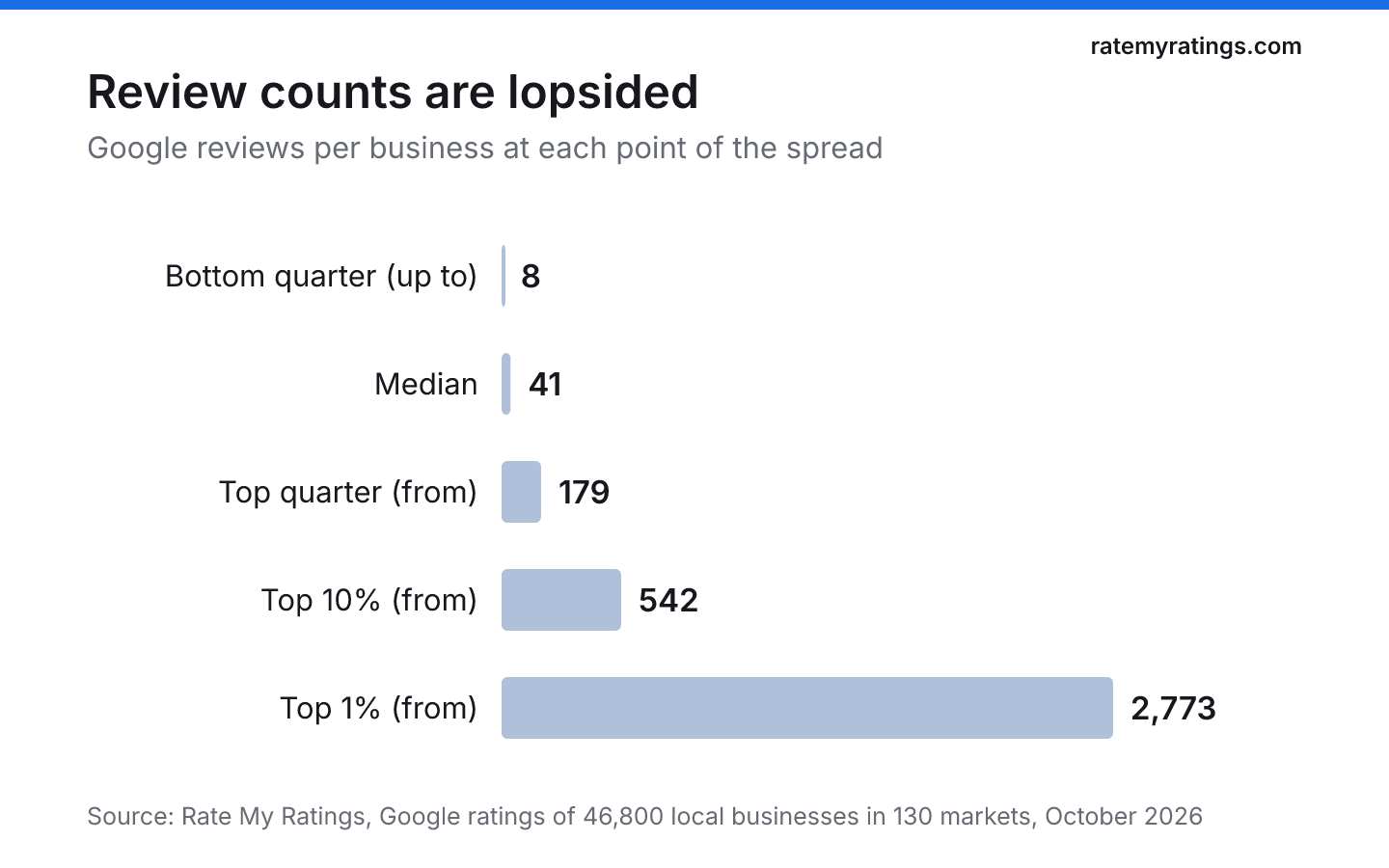
A busy restaurant or vet practice gets new reviews every week, so its first screen of reviews is always current. A roofer or accountant with a handful of reviews may have nothing newer than last year. In our data the median electrician has seven Google reviews and the median roofer six. For trades like these, a few recent reviews do more for credibility than any number of old ones.
Should old reviews stay visible?
Yes, and for two reasons.
History builds trust. Years of consistent reviews tell readers a business has been around and has kept its standards. Long-established businesses with steady reviews are harder to fake than a profile that appeared last month with forty five-star ratings.
Removing criticism would be misleading. On your own website, the rules are now explicit in the UK. Under the Digital Markets, Competition and Consumers Act 2024, publishing reviews in a misleading way is a banned practice, and legal commentary on the Act notes that this covers suppressing negative reviews and relying on outdated reviews that no longer reflect what you sell. If your website shows a review feed, keep it current and complete rather than curated.
What to do about old negative reviews
You cannot remove an old review because it is old, but you can change how it reads:
- Reply if you have not already. A short reply that says what has changed since ("We've moved to online booking since your visit, which has ended the phone queue you describe") turns an old complaint into evidence of improvement.
- Do not reply to dozens at once. A burst of replies to years-old reviews in one evening looks like a clean-up rather than care. Work through them over a few weeks.
- Report only genuine policy breaches. Google will not remove a review for being out of date. Our guide on removing a false Google review covers what it will take down.
- Bury it the honest way. The best answer to an old bad review is a steady flow of new genuine ones, which push it down the Newest view and dilute its effect on your average.
What to do about old positive reviews
Glowing reviews from years ago are worth keeping, but do not lean on them:
- If you quote reviews on your website or in brochures, prefer recent ones and show their dates.
- If the business has changed significantly (new owner, new premises, new service), do not present old reviews as if they describe the current one.
- If your average rating rests on a burst of reviews from your opening year, expect it to drift as newer, more varied reviews arrive. In our data, the median rating falls from 5.0 for businesses with fewer than ten reviews to 4.4 for businesses with more than a thousand. A slow drift down from a perfect score is normal, not a crisis.
Moves, rebrands and new owners
Reviews belong to the Business Profile, not to the person who runs it. When a business changes hands, the new owner usually takes over the existing profile and inherits every review on it, including complaints about the previous management. When a business moves premises, updating the address on the existing profile keeps its reviews; creating a fresh profile at the new address starts from zero and can leave a duplicate listing behind.
If the business has genuinely changed, say so in replies to old reviews that no longer apply, and in your profile description. Do not try to start a new profile to escape old reviews: duplicate listings confuse customers and Google alike, and a clean slate with no history is less convincing than an honest record with recent improvement on top.
Keep your newest review recent
The practical goal is simple: make sure your most recent review is never more than a few weeks old. For most local businesses that means asking every customer, consistently, at the right moment. Our guides on the best time to ask for a review and getting more Google reviews cover how to build that habit without nagging, and our guide to how Google sorts reviews explains what readers see first.
To see how recent and how numerous your competitors' reviews are, a Rate My Ratings market report reads the public reviews of every business in your category and area.
The short version
Google reviews last indefinitely. They only disappear if the author deletes or edits them, the account closes, Google removes them for a policy breach or as a penalty, or the profile goes. Their usefulness fades much faster: three-quarters of consumers look for reviews from the last three months. Keep old reviews, reply to old complaints that you have since fixed, and focus on keeping your newest review recent.
Frequently asked questions
- Do Google reviews expire after a certain time?
No. There is no expiry date on Google reviews. A review stays on a Business Profile until its author edits or deletes it, the reviewer's account is closed, Google removes it for breaking its policies, or the profile itself is removed or merged. A ten-year-old review can still be visible today.
- Can a business remove old Google reviews?
No. Owners cannot delete reviews of any age. They can reply to them, which is worth doing when an old complaint has since been fixed, and they can report reviews that break Google's policies. Age alone is not a reason Google will remove a review.
- Why did an old Google review suddenly appear as new?
Because the reviewer edited it. Google shows the date of the latest edit as the review's post date, so an old review updated after a business put things right, or one changed from five stars to three, appears among the newest reviews again.
- How recent do reviews need to be for customers to trust them?
Recent. BrightLocal's 2026 survey found 74% of consumers look for reviews written in the last three months, and 32% look for reviews from the last two weeks. A business whose newest review is a year old looks inactive, whatever its average rating.

Rate My RatingsNewsletter
What reviews say about local markets, in your inbox.
New articles and findings from the blog, as they're published.
Check your inbox.
If this address isn't subscribed yet, we've sent it a link to confirm. Nothing is sent until you click it.
That didn't go through. Check the email address and try again.
Hold on a moment, then subscribe again.