What Should a Review Request Email Say?
Thank you, what you did, one review link and a real name, in under 80 words, sent within a day. Six templates, the one reminder, and how UK direct marketing rules apply.

A review request email should say four things in under 80 words: thank you, what you did for the customer, one link to leave a review, and who it is from. Send it within a day of the service, from a named person, under a plain subject line, with one reminder at most and a way to opt out.
Most requests fail by doing too much: three review sites, a newsletter footer, a discount code, a paragraph about the business. This guide breaks a good review request email into its parts, gives six templates for different kinds of business, and explains where it sits under the UK rules on direct marketing and data protection.
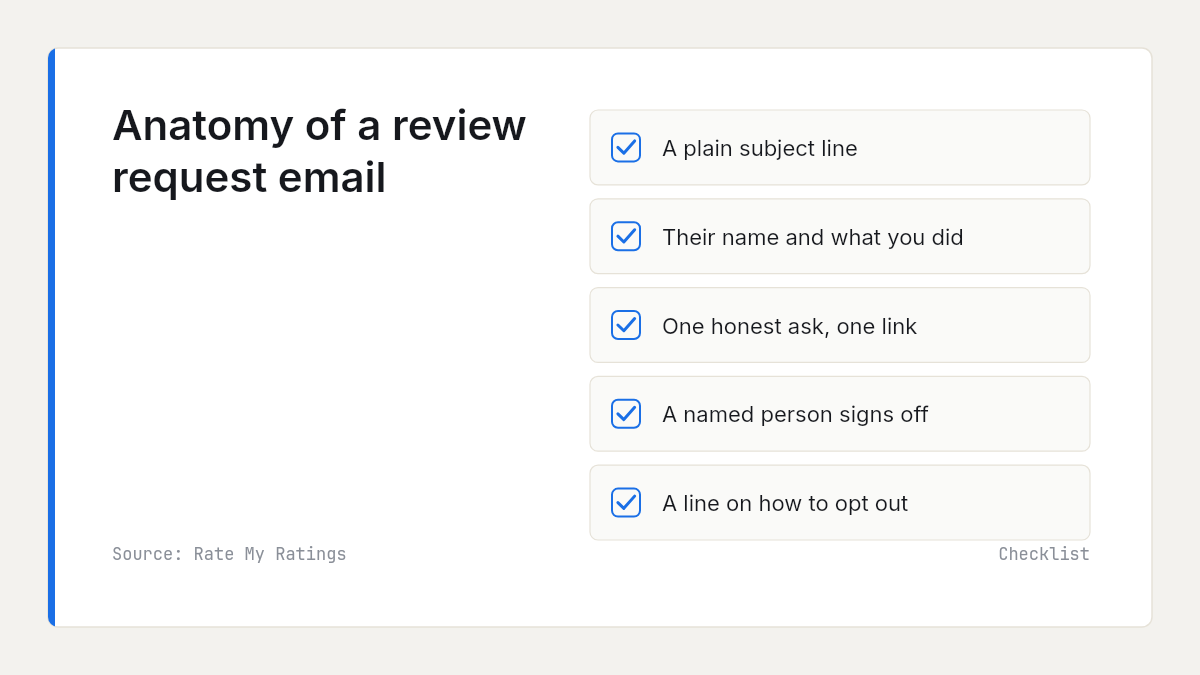
The anatomy of a good request
| Part | What to write | Why |
|---|---|---|
| Subject line | A plain question or statement, under about eight words | It is read on a phone lock screen |
| Greeting | Their first name | A name shows a person sent it, not a system |
| Thank-you | One line naming what you did | Reminds them which visit you mean |
| The ask | One sentence that welcomes any honest view | Asking for an honest review keeps it within the rules |
| The link | One link to one review site | Every extra choice loses people |
| Sign-off | A real name and role | People reply to people |
| Footer | One line on how to stop these emails | Needed if the email counts as marketing |
Keep the whole email short enough to read without scrolling. In the 524,000 recent Google reviews we track across the UK and Australia, a five-star review runs to a median of 27 words, so the request does not need to be longer than the review you hope for.
Subject lines that sound like a person
The subject line has one job: to make the email look like it came from someone the customer met. Avoid anything that looks like a campaign, such as capital letters, exclamation marks or a subject that is only your business name.
- How did we do, {first name}?
- Your boiler service on Tuesday
- Thank you from {staff name} at {business}
- A quick favour after your visit
- How is the new kitchen?
Use one subject line for each type of customer, then change one thing at a time if you want to compare.
Six review request email templates
Swap the braces for your own details. Each template has one link: your Google review link, which our guide to creating a Google review link shows you how to get and test.
A trade job
Subject: How is everything since Tuesday?
Hi {first name}, thanks for having us in to {job}. I hope it is all working as it should. If you have a minute, an honest review on Google helps other people nearby choose a tradesperson: {link}. Any problems, reply to this email and I will sort it. {name}, {business}
A clinic appointment
Subject: Thank you for visiting {practice}
Hi {first name}, thank you for coming in today. If you would like to share how your visit went, you can leave a review on Google here: {link}. Best wishes, {name}, practice manager
Keep clinical details out of the email itself. The patient decides what, if anything, to say about their own care.
A salon or barber
Subject: Loving the new cut?
Hi {first name}, it was lovely to see you today. If you have a moment, {stylist} and the team would be grateful for an honest Google review: {link}. See you next time, {name}
An accountant
Subject: Your return is filed
Hi {first name}, your return went to HMRC today and the confirmation is attached. If you have two minutes, an honest review on Google helps other small businesses find an accountant they can trust: {link}. Thank you for working with us this year. {name}
A restaurant booking
Subject: Thank you for dining with us
Hi {first name}, thank you for joining us on {day}. If you have a moment, we would value an honest review on Google: {link}. It helps a small, independent kitchen more than you might think. {name}, {restaurant}
An online order from a local shop
Subject: Has your order arrived safely?
Hi {first name}, your order should be with you now. Once you have had a chance to try it, an honest review on Google helps people nearby find us: {link}. Anything wrong, just reply. {name}, {shop}
When to send it, and the one reminder
Send the first email within a day of the service, or once the customer has seen the result: after the first heavy rain for a roofer, once the return is filed for an accountant, after the parcel arrives for a shop. Our guide to the best time to ask for a review has the detail by business type.
Then send one reminder, three to five days later, to people who have not reviewed, and stop. Keep it shorter than the first email and send it as a reply in the same thread, so it reads as a nudge rather than a campaign. If you also send requests by text, do not send both: pick the channel the customer used with you. Our guide to asking for a review by text covers the shorter version.
Is a review request email direct marketing?
The official guidance does not answer this by name, so it is a judgement. This section is general information, not legal advice.
The Information Commissioner's Office explains in its guidance on identifying direct marketing that contacting people to conduct genuine market research is not direct marketing, and that neutral messages sent purely for administrative or customer service purposes are service messages. It also says that adding promotional material makes a message direct marketing, and warns against "sugging": selling under the guise of research.
A review request sits between the two. It asks for feedback, but a public review also helps you win new customers. The cautious approach is to treat it as marketing and follow the email rules in the Privacy and Electronic Communications Regulations (PECR). For most businesses that means the soft opt-in, which the ICO's guidance on the PECR email marketing rules sets out:
- You got the email address while selling, or negotiating to sell, a product or service to that person.
- You gave them a chance to opt out when you collected it.
- You give them a chance to opt out in every message after that.
- You only contact them about your own similar products and services.
The ICO adds that an opt-out in an order confirmation alone is not enough at the point of collection. Under UK GDPR, say in your privacy information that you may ask customers for feedback, and stop contacting anyone who asks you to. Never use addresses you bought or collected for another purpose.
What the email must never say
The UK fake reviews rules are clear that asking is fine. The Competition and Markets Authority's fake reviews guidance says that merely emailing customers generally to ask if they wish to provide a review is not prohibited. Trouble starts with what you add.
- An incentive. Google's tips for getting more reviews say offering free or discounted goods or services in exchange for reviews is strictly prohibited.
- A filter. "Happy? Review us on Google. Not happy? Reply to us instead" is review gating. Google's content policy bans selectively soliciting positive reviews.
- A star rating or a script. Asking for five stars, or suggesting what to write, tries to decide the review for the customer.
Our guides to what not to say when asking for a review and to review incentives in the UK go further.
Reply to what comes back
Every review your email produces deserves a short, specific reply, which shows the next customer that someone reads them. Our guide to responding to positive reviews has examples. The email is one part of the habit; for asking in person, see how to ask for Google reviews.
To see how your review count and rating compare with every competitor nearby, a Rate My Ratings market report shows each business's rating, review count and share of positive reviews, and the themes customers praise or complain about across the market.
The short version
- Four parts, under 80 words: thank you, what you did, one link, a named sender.
- A plain subject line that sounds like a person, not a campaign.
- Send within a day of the result, remind once, then stop.
- Treat the review request email as marketing to be safe: soft opt-in, and an opt-out line in every message.
- No incentives, no filters, no star ratings, no scripts.
Frequently asked questions
- How soon should I send a review request email?
Within a day of the service, or as soon as the customer has seen the result, such as after a parcel arrives or a tax return is filed. Send it during working hours, then one reminder three to five days later to anyone who has not reviewed, and stop there.
- Do I need consent to email customers asking for a review?
Not always, but the safe course is to treat a review request as marketing under PECR. If you collected the address while selling to the customer, offered an opt-out then, and include an opt-out in every email, the soft opt-in usually covers it. This is general information, not legal advice; the ICO's guidance is the official source.
- What is a good subject line for a review request?
One that sounds like a person wrote it: a short question or a reference to the visit, such as 'How did we do, Sam?' or 'Your boiler service on Tuesday'. Avoid capital letters, exclamation marks and anything that looks like a campaign, because customers decide from the lock screen whether to open it.
- Can I email customers from last year asking for a review?
Yes, if you have a lawful basis to contact them and you ask everyone in the period, not only the customers you think were happy. Their reviews must still describe a genuine experience, so keep the window sensible, usually the past 12 to 18 months, and send in small batches.

Rate My RatingsNewsletter
What reviews say about local markets, in your inbox.
New articles and findings from the blog, as they're published.
Check your inbox.
If this address isn't subscribed yet, we've sent it a link to confirm. Nothing is sent until you click it.
That didn't go through. Check the email address and try again.
Hold on a moment, then subscribe again.