
Can You Offer Customers an Incentive for a Review in the UK?
UK law allows a disclosed incentive for a genuine review, but Google and Trustpilot ban review incentives outright. Where prize draws, staff bonuses and refunds stand, and what works instead.

Under UK law you can offer customers an incentive for a review only if the reward is made clear to readers and the review still reflects the customer's genuine experience. Under Google's and Trustpilot's rules you cannot offer one at all. Since those platforms are where most of your reviews appear, the practical answer for a small business is no: review incentives such as discounts, freebies and prize draws will get Google reviews removed, and if they are hidden they also break the law.
This guide sets out the three sets of rules side by side, the grey areas owners ask about most (prize draws, staff bonuses, thank-you gifts and refunds after a complaint), and what works instead. It is a summary, not legal advice.
What UK law says about review incentives
Since 6 April 2025, the Digital Markets, Competition and Consumers Act 2024 has banned submitting or commissioning a review that conceals the fact it was incentivised. In the Act, commissioning "includes incentivising by any means" (Schedule 20, paragraph 13).
The CMA's fake reviews guidance lists what can count as an incentive: money, commissions, discounts or vouchers, free products, free stays, loans or leases on better terms than the public gets, and invitations to events. It also says a business may incentivise reviews if two conditions are met:
- readers are told the review was incentivised, usually with a prominent label such as marking it as an advert; and
- the review still reflects the reviewer's genuine experience.
Two limits matter. The CMA says that where a website does not allow incentivised reviews, submitting one there is likely to be misleading. And a reward tied to the outcome fails the second condition: the guidance's examples of unlawful commissioning include offering a customer a free or discounted product in exchange for a five-star review that does not reflect their experience, and offering a refund or gift card to someone who removes the criticism from their review.
Google's rules: no review incentives at all
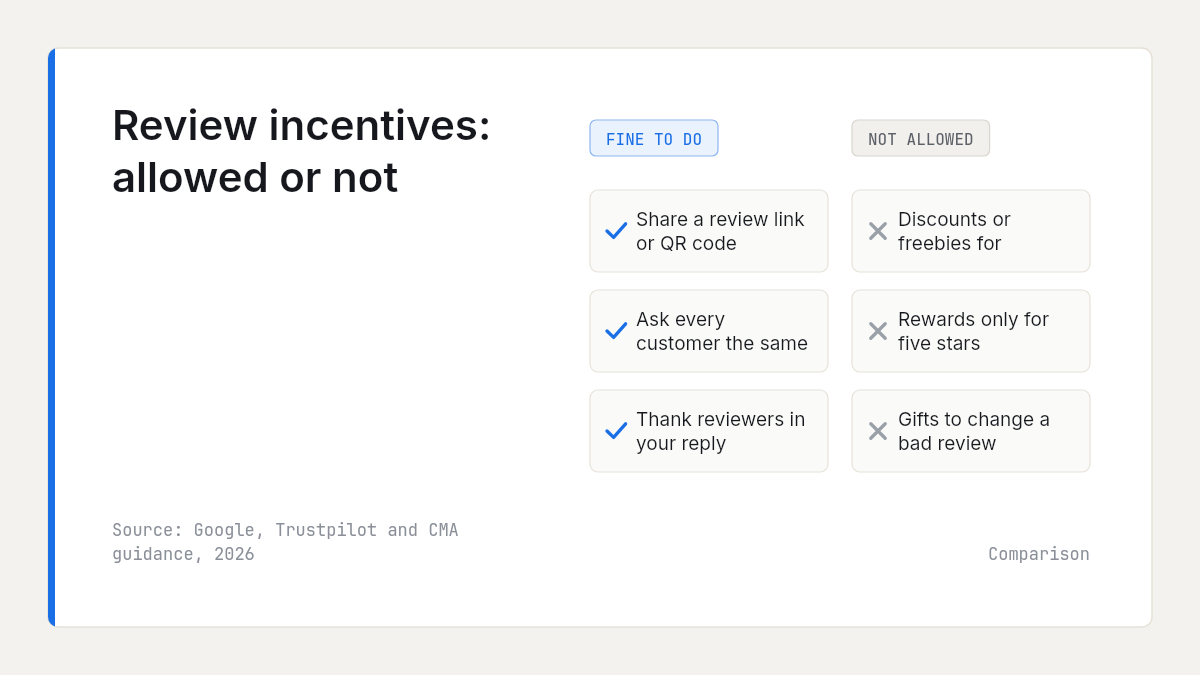
Google's content policy is stricter than the law. It treats reviews "paid for, directly or in kind" as fake engagement and says businesses must not offer incentives such as payment, discounts, or free goods and services. Its Business Profile help adds that offering incentives for customers to post reviews, change them or remove negative ones is strictly prohibited.
Disclosure does not help on Google: a labelled incentivised review is still against the policy, and it can be removed. Under the commitments Google gave the CMA in January 2025, UK consumers can also flag reviews linked to a payment or reward for a positive review.
Trustpilot's rules
Trustpilot's guidelines for businesses say plainly that it does not allow incentivised reviews. Its examples include discounts, promo codes, prize draw entries, refunds and freebies, for writing a review or for editing one. It also bans picking and choosing which customers to invite.
Review incentives at a glance
| Incentive | UK law | Trustpilot | |
|---|---|---|---|
| Discount or voucher for leaving a review | Only if disclosed and genuine | Banned | Banned |
| Free product or service for a review | Only if disclosed and genuine | Banned | Banned |
| Reward only for a five-star review | Unlawful in the CMA's examples | Banned | Banned |
| Refund or gift to change a negative review | Unlawful in the CMA's examples | Banned | Banned |
| Prize draw entry for reviewing | Unlikely to count, says the CMA | Treat as banned | Banned |
Prize draws, staff bonuses and thank-yous: the grey areas
Prize draws. The CMA's guidance says a chance to win something that does not guarantee the reviewer a benefit, such as entry into a prize draw, is unlikely to amount to commissioning under the Act. That is a statement about UK law only. Trustpilot names prize draw entries as a banned incentive, and Google bans rewards for reviews in money or in kind, so a "review us and win" draw is still off limits on both.
Staff bonuses. The Act does not address paying staff per review collected, but Google's policy bans businesses from asking staff to collect a set number of reviews. Targets also push staff to ask only the happy customers or to press people at the till. Reward what staff can control, asking every customer politely, rather than the count. Our guide to getting staff to ask for reviews covers how.
Thank-you gifts. Thanking a customer in your public reply is fine. A gift promised in advance, or one that every reviewer is known to receive, is an incentive.
Refunds after a complaint. Refunding or putting things right is good service. Making it depend on the customer changing or deleting their review is not: the CMA lists that as unlawful, and also warns against making dispute resolution conditional on a customer not leaving a negative review.
Discounts for everyone. A discount code on every receipt, with no link to reviewing, is ordinary marketing. The problem starts when the review unlocks it.
Why review incentives backfire
Incentives solve a problem most businesses do not have. In the 524,000 recent Google reviews we analysed across 130 local markets in the UK and Australia, 87% were five-star. Pleased customers already give five stars; what they lack is a reminder and an easy link.
Incentivised reviews can also arrive in a rush after a promotion, the kind of unusual pattern Google's systems watch for, and when they are removed the rating and the count fall with them. Our guide to review velocity explains which patterns attract filters. US rules share the core principle: the FTC tells marketers that an incentive must never be conditioned, explicitly or implicitly, on the review being positive.
If you have offered review incentives before
Plenty of businesses ran "review us for 10% off" offers before the rules tightened. If yours did, tidy up now:
- Withdraw the offer everywhere it appears: receipts, table cards, follow-up emails, your website and staff scripts.
- Do not contact past reviewers with new offers to edit or remove their reviews, which would be a fresh incentive.
- Expect some of those reviews to disappear if Google's systems identify them, and resist the urge to replace them in a hurry.
- Switch to one neutral request sent to every customer, so the gap fills with reviews nobody can question.
What to do instead of review incentives
- Make it one tap. Use the review link or QR code from your Business Profile, as Google's help suggests.
- Ask everyone, the same way. Asking only the customers you expect to be happy is its own problem, covered in our guide to review gating.
- Ask at the right moment, when the job is done and the customer is pleased, and send the link the same day.
- Thank reviewers publicly in your replies, good and bad.
- Fix what people complain about, so the next review is better on its own.
Our guides on how to encourage customers to leave reviews and what not to say when asking for a review have wording you can use. If someone offers to boost your reviews for a fee, read should you pay for review services first, and for the wider law, see whether fake reviews are illegal in the UK.
Once reviews come in steadily, a Rate My Ratings market report shows how your rating, review count and share of positive reviews compare with every competitor in your category and area, and which themes customers raise across the market.
The short version
- UK law allows review incentives only when they are disclosed and the review is still genuine; rewards for five stars or for changing a bad review are unlawful in the CMA's examples.
- Google and Trustpilot ban review incentives outright, disclosed or not.
- Prize draws are unlikely to count as commissioning under UK law, but they still break platform rules.
- You do not need incentives: 87% of recent Google reviews in our data are already five-star. Ask everyone, make it easy and thank people publicly.
Frequently asked questions
- Can I offer a discount for a Google review?
No. Google's policy says businesses must not offer incentives such as payment, discounts or free goods or services for reviews, and reviews posted because of one can be removed. UK law allows an incentivised review only when the incentive is disclosed and the review is genuine, but because Google bans them outright, a discount for a Google review is off limits.
- Is a prize draw for reviews allowed in the UK?
Under UK consumer law, the CMA's guidance says a prize draw entry that does not guarantee the reviewer a benefit is unlikely to amount to commissioning a review. Platform rules are stricter: Trustpilot names prize draw entries as a banned incentive, and Google bans rewards for reviews in money or in kind. So a review-and-win draw is still best avoided.
- Can I pay my staff a bonus for getting reviews?
It is risky. Google's policy bans businesses from asking staff to collect a set number of reviews, and targets push staff to ask only happy customers or to pressure people at the till, which breaks other rules. Reward staff for asking every customer politely and for the service customers praise, rather than for the number of reviews that arrive.
- Can I offer a refund if a customer removes a bad review?
No. Offering a refund, gift card or discount in return for changing or deleting a negative review is one of the CMA's examples of unlawfully commissioning a review, and Google treats incentives to change or remove reviews as fake engagement. You can refund or put things right as normal service, but it must not depend on what the customer does with their review.

Rate My RatingsNewsletter
What reviews say about local markets, in your inbox.
New articles and findings from the blog, as they're published.
Check your inbox.
If this address isn't subscribed yet, we've sent it a link to confirm. Nothing is sent until you click it.
That didn't go through. Check the email address and try again.
Hold on a moment, then subscribe again.