Can You Make Money by Writing Google Reviews?
Offers to earn money writing Google reviews are everywhere. Here is why paid reviews break Google's rules and the law, how the scams work, and the honest ways to get paid for your opinions.

No, not legitimately. Nobody can lawfully pay you to write Google reviews: paid reviews break Google's policies, and in the UK, the US and Australia writing reviews for money is against consumer law. Most offers to get paid to write Google reviews are either illegal review farms or outright scams that end with you losing money.
That does not mean there is no way to earn from your opinions. Below we explain why paid Google reviews are off limits, how the "review job" scams work, and the legitimate alternatives that do pay, from user research panels to mystery shopping.
Why you cannot get paid to write Google reviews
Google's prohibited and restricted content policy is blunt. Reviews must reflect a genuine experience, and reviews or ratings "that have been paid for, directly or in kind" count as fake engagement and are removed. Businesses may not offer money, discounts or free goods in exchange for a review, and the same policy bars reviews written from a conflict of interest, such as by a business's own staff or its competitors.
The law now goes further than Google's rules:
- UK. The Digital Markets, Competition and Consumers Act 2024 lists fake reviews among the practices banned in all circumstances. It covers writing a review that "purports to be, but is not, based on a person's genuine experience", commissioning one, and hiding that a review was incentivised. These provisions came into force on 6 April 2025.
- US. In August 2024 the Federal Trade Commission announced a final rule banning the sale and purchase of fake reviews, and payments for reviews conditioned on a positive or negative sentiment, with civil penalties for knowing violators.
- Australia. The Australian Consumer Law treats fake or misleading reviews as misleading conduct, and the ACCC's guidance on online reviews says businesses must not write or arrange fake reviews.
So if someone offers to pay you per Google review, they are asking you to help them break the law. Even if you are never pursued, Google routinely deletes paid reviews and can restrict the accounts that post them.
How "get paid to review" scams actually work
Most people who search for ways to get paid to write Google reviews have seen an advert or received a message: "Earn £100 a day rating local businesses from home." These are usually task scams, and they have grown fast. The FTC says reports of these gamified job scams went from none in 2020 to about 20,000 in the first half of 2024 alone.
The pattern is predictable:
- An unexpected message on WhatsApp, Telegram, text or social media offers easy online work.
- Simple tasks follow: rate a product, review a business, like a video.
- Small real payments (often a few pounds or dollars) arrive to build your trust.
- A deposit request comes next, usually in cryptocurrency, to "unlock" better-paid tasks or withdraw your balance.
- The money vanishes. The earnings on your dashboard were never real.
The FTC's own advice on task scams is worth remembering: never pay anyone to get paid, and do not trust anyone who says they will pay you to give a positive rating or like things online. No honest company does that.
How paid reviews show up in the data
From the outside, bought reviews leave traces. In the 524,000 recent Google reviews of local businesses we analysed in the UK and Australia, 16% were written by accounts that had only ever posted one review. That share is highest at the extremes: 17% of five-star reviews and 13% of one-star reviews, compared with 6% of three-star reviews.
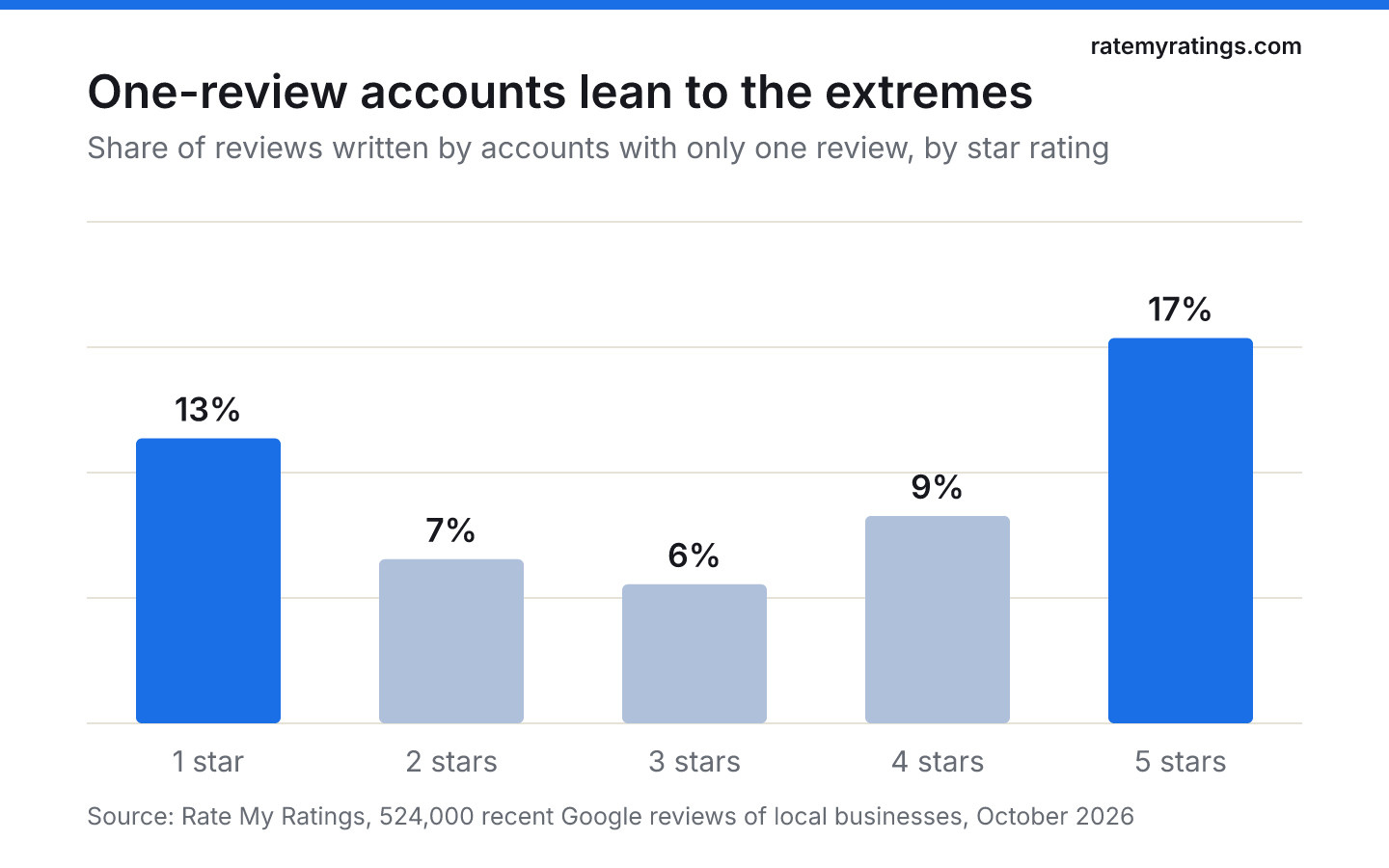
Most one-review accounts are perfectly genuine customers. But it is exactly the kind of account a review farm creates, and Google's systems look at account history when they decide whether to publish a review. Our guide to spotting fake Google reviews covers the other signs.
What about Google Local Guides?
Google does reward people who contribute to Maps, through its Local Guides programme. You earn points for reviews, photos, answers and edits, climb levels and get a badge next to your name. It is free to join and genuinely useful if you enjoy reviewing.
But it is not a way to make money. Google does not pay Local Guides for contributions, and the benefits it has offered over the years have been perks and early access rather than income. It is a hobby with recognition, not a side job. For a sense of scale: 27% of the recent reviews in our data were written by Local Guides, which shows how much of Google's review content comes from unpaid enthusiasts.
Legitimate ways to get paid for your opinions
If what you want is side income from giving feedback, these are the honest routes. None of them involve posting public reviews in exchange for money.
User research and usability testing
Companies pay people to try websites, apps and products and say what they think, usually on a video call or a recorded screen session. The feedback stays private, which is exactly why it can be paid. Rates vary by platform and study, and there is no guarantee of regular work.
Market research panels and paid surveys
Research agencies pay small amounts for completing surveys. It is legitimate but low paying, and best treated as pocket money rather than income. Our guide to market research versus customer surveys explains what these studies are for.
Mystery shopping
Retailers, restaurants and service businesses hire mystery shoppers to visit and report on the experience. The FTC notes that legitimate mystery shopping exists but is usually occasional work with costs reimbursed and a small fee, and that paying any upfront fee to become a mystery shopper is always a scam. The report goes to the business, not onto Google.
Product testing with disclosure
Some brands send free products in exchange for an honest review on their own site or a retailer's, clearly labelled as received free. The disclosure is what keeps it legal. Writing an unlabelled review on Google in return for a free product is not allowed.
Writing about products and places
Freelance writing for blogs, local guides and magazines pays for opinions published under a byline, with the commercial relationship clear. It takes skill and pitching, but it is the honest version of "getting paid to review".
If you have already been approached
- Do not pay anything, even if you have received small payments so far.
- Stop replying and block the contact.
- Report it. In the US, use ReportFraud.ftc.gov. In the UK, report scam websites to the National Cyber Security Centre and, if you have lost money, to your bank straight away.
- Delete any reviews you posted for payment. They break Google's policies and mislead other people.
Why this matters for businesses too
If you run a business, the same rules apply from the other side. Paying for reviews, offering a discount for a five-star rating or asking staff to review you can get reviews removed, trigger a warning on your profile and, in the UK, break consumer law. Our guides on whether to pay for review services and how to ask for Google reviews cover what is allowed.
The short version
- You cannot legitimately get paid to write Google reviews. It breaks Google's rules and UK, US and Australian law.
- "Get paid to review" offers are usually task scams that end with a request for your money.
- Google Local Guides earns points and badges, not money.
- If you want paid feedback work, look at user research, survey panels, mystery shopping and disclosed product testing.
- Never pay to get paid.
Frequently asked questions
- Is it illegal to get paid for Google reviews?
Writing reviews in exchange for payment breaks Google's policies everywhere, and in many countries it breaks consumer law too. In the UK, the Digital Markets, Competition and Consumers Act 2024 bans fake and undisclosed incentivised reviews. In the US, the FTC's 2024 rule bans buying and selling fake reviews. Australian Consumer Law treats fake reviews as misleading conduct.
- Does Google pay Local Guides?
No. Local Guides earn points, levels and a badge for contributing reviews, photos and edits to Google Maps, and Google has offered occasional perks over the years, but contributions are not paid. It is a recognition programme for enthusiasts rather than a source of income.
- Are 'rate products from home' jobs real?
Almost never. Unsolicited offers to earn money by rating products, reviewing businesses or liking videos are usually task scams. They pay small amounts at first to build trust, then ask you to deposit money, often in cryptocurrency, to unlock more tasks or withdraw earnings. The FTC's advice is simple: never pay anyone to get paid.
- What are legitimate ways to get paid for my opinion?
User research and usability testing, market research survey panels, mystery shopping and disclosed product testing are all legitimate. What they share is that the feedback is private or clearly labelled, rather than posted as an independent public review. Expect modest, irregular earnings, and walk away from anything that asks you to pay a fee first.

Rate My RatingsNewsletter
What reviews say about local markets, in your inbox.
New articles and findings from the blog, as they're published.
Check your inbox.
If this address isn't subscribed yet, we've sent it a link to confirm. Nothing is sent until you click it.
That didn't go through. Check the email address and try again.
Hold on a moment, then subscribe again.