How Do You Check If a Website Is Legit Before Black Friday?
Most fake shops fail a five-minute check: who runs the site, how old its web address is, what buyers say on sites it does not control, and how you pay. Here is the order to do it in before Black Friday.
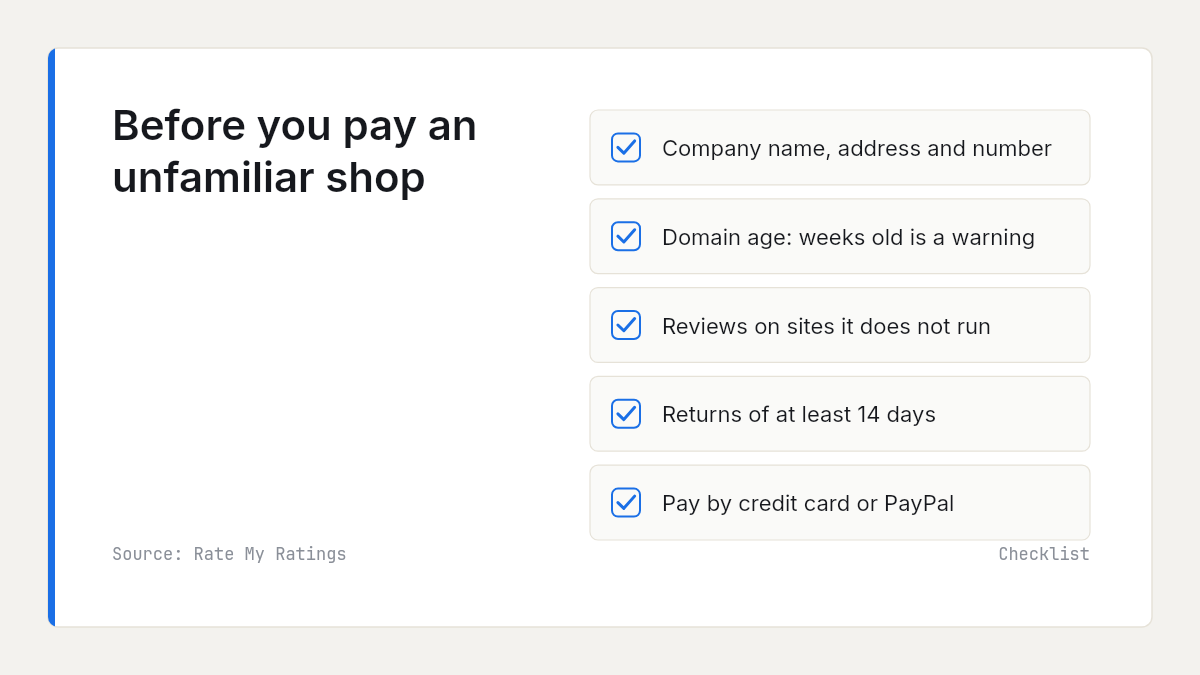
To check if a website is legit, confirm who runs it (a company name, address and number you can look up), how long its web address has existed, what buyers say about it on sites it does not control, and whether it lets you pay in a way you can reclaim. Those four checks take about five minutes and catch most fake shops.
Black Friday falls on 27 November this year, and the rush of deals, adverts and unfamiliar shops before Christmas is exactly the mix fake shops rely on. This guide is about online shops, especially ones you find through a social media advert or a search for a bargain. For local businesses and trades, our guide to checking if a business is legit covers registers and accreditations. If you have already paid a shop you now doubt, skip to the last section.
Why fake shops are worth five minutes
A purchase scam is the simplest fraud there is: you pay for something that never arrives, or that arrives as a cheap copy. According to UK Finance's annual fraud report, purchase scams made up 71% of authorised push payment scam cases in 2025 (the scams in which victims send the money themselves), and losses rose 20% to £118.1 million. UK Finance says purchase fraud often starts on marketplace sites.
The amounts are often small, which is part of the trick. A £40 jacket at 70% off does not feel like a risk worth checking. It is exactly the one worth checking.
How to check if a website is legit in five minutes
Work through these in order. The first few take seconds, and any one of them can be enough reason to walk away.
| Check | Good sign | Warning sign |
|---|---|---|
| Web address | Spelled correctly, matches the brand | Brand name plus "outlet" or "sale", or an odd ending |
| Company details | Full company name, postal address, company number | A contact form only, or a free email address |
| Domain age | Registered for years | Registered a few weeks ago |
| Prices | In line with other shops | Almost everything at 60% to 80% off |
| Reviews elsewhere | Months or years of mixed reviews | None, or a sudden burst of glowing ones |
| Returns policy | At least 14 days, with a UK address | Missing, vague, or returns to an overseas address at your cost |
| Payment | Card and PayPal accepted | Bank transfer or cryptocurrency only |
Who is behind the website?
Scroll to the footer and open the terms and conditions or the "About" page. A real shop tells you who you are buying from: a trading name, a postal address and, for a limited company, a company number. Look the number up on Companies House and make sure the name, address and status match what the site says.
Then look hard at the address bar. Copycat shops borrow a real brand's name, logo and photos and put them on a look-alike address: an extra word such as "outlet" or "official-sale", a swapped letter, or an unusual ending. Type the brand's address yourself, or reach it from a search, rather than trusting the link in an advert.
The padlock beside the address only means the connection is encrypted. Fake shops have padlocks too.
How old is the web address?
Fake shops tend to be short-lived, so a young address is one of the quickest warning signs. A free domain lookup such as ICANN Lookup shows when a .com or similar address was first registered, and Nominet's lookup does the same for .uk addresses. A shop selling designer goods at clearance prices from an address registered last month deserves real suspicion.
An old domain is not proof of honesty, though. Expired addresses can be bought and reused, so treat age as one signal among several.
Prices, adverts and pressure
The price is the bait. Be wary of:
- Discounts across the whole shop. Real retailers cut some lines heavily; fake shops often cut everything.
- Social media adverts for a shop you have never heard of, especially ones using a famous brand's images.
- Countdown timers and "only 2 left" banners on every product.
- Payment by bank transfer only, sometimes with an extra discount for paying that way.
None of these proves a shop is fake. Together, they describe most of the ones that are.
Read reviews of the shop on sites it does not control
Reviews on the shop's own pages are chosen and displayed by the shop. Search its name with "reviews" and "scam", and read what buyers say on sites it does not run, such as Google and Trustpilot. Our guide to why people trust Google reviews explains where that trust is deserved and where to look harder.
Read the pattern, not the score:
- When the reviews arrived. Dozens of five-star reviews in one week, starting just after the domain was registered, point to bought reviews.
- Who wrote them. Open a few reviewer profiles. In the 524,000 recent Google reviews we analysed across 130 local markets in the UK and Australia, 16% came from accounts with only one review, so one-review accounts are normal. A page where nearly all the praise comes from them is not.
- What they say. Real buyers mention delivery times, sizes, packaging and returns. Fake reviews praise "amazing quality" without a detail a buyer would remember.
- What the one-star reviews say. "Never arrived", "no reply to emails" and "the parcel came from abroad" are the reviews that matter most.
Our guide on how to spot fake Google reviews covers ten signs in more depth. Many glowing reviews on fake shops are bought from people recruited through "get paid to review" offers, which are often scams themselves, as we explain in can you make money writing Google reviews. Writing or buying fake reviews has been illegal in the UK since April 2025; our guide to whether fake reviews are illegal covers the law.
Use a website checker, but do not stop there
Get Safe Online's free Check a Website tool, run with the fraud prevention service Cifas and ScamAdviser, gives a web address a trust score in seconds, drawing on more than 40 data sources and reports of malicious websites. It is a useful first filter, not a verdict. A shop set up this week may not have been reported yet, so a reasonable score does not replace the checks above.
Pay in a way you can get back
How you pay decides what happens if the parcel never comes.
- Credit card. Under section 75 of the Consumer Credit Act, the card provider can be jointly responsible when a single item costs more than £100 and no more than £30,000, as Citizens Advice explains.
- Debit card. You can ask your bank for a chargeback, whatever you paid.
- PayPal. You can open a dispute within 180 days of paying. Section 75 usually does not apply when you pay through a wallet like PayPal.
- Bank transfer. Avoid it with any shop you do not know. Money sent this way is much harder to recover.
Read the returns policy too. When you buy online from a UK business, you normally have 14 days after delivery to cancel under the Consumer Contracts Regulations. A shop with no returns policy, or one that offers less than that, is a reason to stop.
If you have already paid a shop you now doubt
- Call your bank or card provider straight away, on the number on the back of your card. The sooner they know, the better the chance of stopping or reclaiming the payment.
- Report it to Report Fraud, the national fraud reporting service for England, Wales and Northern Ireland, which replaced Action Fraud, at reportfraud.police.uk or on 0300 123 2040. In Scotland, call Police Scotland on 101. Your bank may ask for the crime reference number.
- Report the website to the National Cyber Security Centre, which can work with hosting companies to remove malicious sites.
- Leave a factual review on Google or Trustpilot so the next buyer finds it. Our guide to reporting fake reviews covers what to do if the shop's own reviews look bought.
For local businesses, reviews are also the best public record of how a market treats its customers. Our market reports show each business's Google rating, review count and share of positive reviews in a category and area, and the themes customers praise or complain about across the market.
What to do this week
- Bookmark the shops you plan to buy from, and reach them from your bookmarks rather than from adverts.
- Look up the domain age of any unfamiliar shop and run it through Get Safe Online's checker before you pay.
- Read its reviews on Google or Trustpilot sorted by newest, and read the one-star reviews first.
- Use a credit card for anything over £100, and never pay an unfamiliar shop by bank transfer.
- Save your bank's fraud number and reportfraud.police.uk somewhere you can find them quickly.
Frequently asked questions
- How can I tell if a shopping website is fake?
Check four things before you pay: whether the site names a real company with an address and number you can verify, how recently its domain was registered, what buyers say about it on Google or Trustpilot rather than on its own pages, and whether it accepts card or PayPal. A new domain, prices far below everyone else's and bank transfer only together form the classic pattern.
- Does a padlock mean a website is safe?
No. The padlock shows that the connection between your browser and the site is encrypted, so other people cannot read what you send. It says nothing about who runs the site or whether they will deliver what you order. Fake shops use padlocks as routinely as real ones, so check the company details, domain age, independent reviews and payment options as well.
- What should I do if I have paid a fake website?
Call your bank or card provider straight away on the number on your card. Then report it to Report Fraud at reportfraud.police.uk or on 0300 123 2040 if you are in England, Wales or Northern Ireland, or to Police Scotland on 101. Report the website to the National Cyber Security Centre as well, and keep emails, screenshots and receipts.
- Are the reviews on a shop's own website reliable?
Treat them with caution. The shop chooses which reviews appear on its own pages and how they are displayed, and copycat sites sometimes copy reviews from the real brand. Read what buyers say on sites the shop does not control, such as Google and Trustpilot, and look at when the reviews arrived and who wrote them, not only the star average.

Rate My RatingsNewsletter
What reviews say about local markets, in your inbox.
New articles and findings from the blog, as they're published.
Check your inbox.
If this address isn't subscribed yet, we've sent it a link to confirm. Nothing is sent until you click it.
That didn't go through. Check the email address and try again.
Hold on a moment, then subscribe again.