Is It Illegal to Post Fake Reviews in the UK?
Yes. Since 6 April 2025, UK law has banned fake reviews, hidden incentives and cherry-picked review displays, with CMA fines of up to 10% of global turnover. What that means for an ordinary small business.
Are fake reviews illegal? UK law says yes. Since 6 April 2025, the Digital Markets, Competition and Consumers Act 2024 has banned businesses, and anyone acting for them, from writing or commissioning fake reviews, hiding that a review was incentivised, or publishing reviews in a misleading way. The Competition and Markets Authority (CMA) can now fine a business up to 10% of its global turnover without first going to court.
This guide explains what the ban covers, what it means for an ordinary small business (staff and family reviews, review swaps, buying reviews, incentives and the reviews on your own website), where people who write fake reviews stand, and what enforcement has looked like so far. It is a plain-English summary, not legal advice; the CMA's guidance is the official source.
Are fake reviews illegal? UK law in plain terms
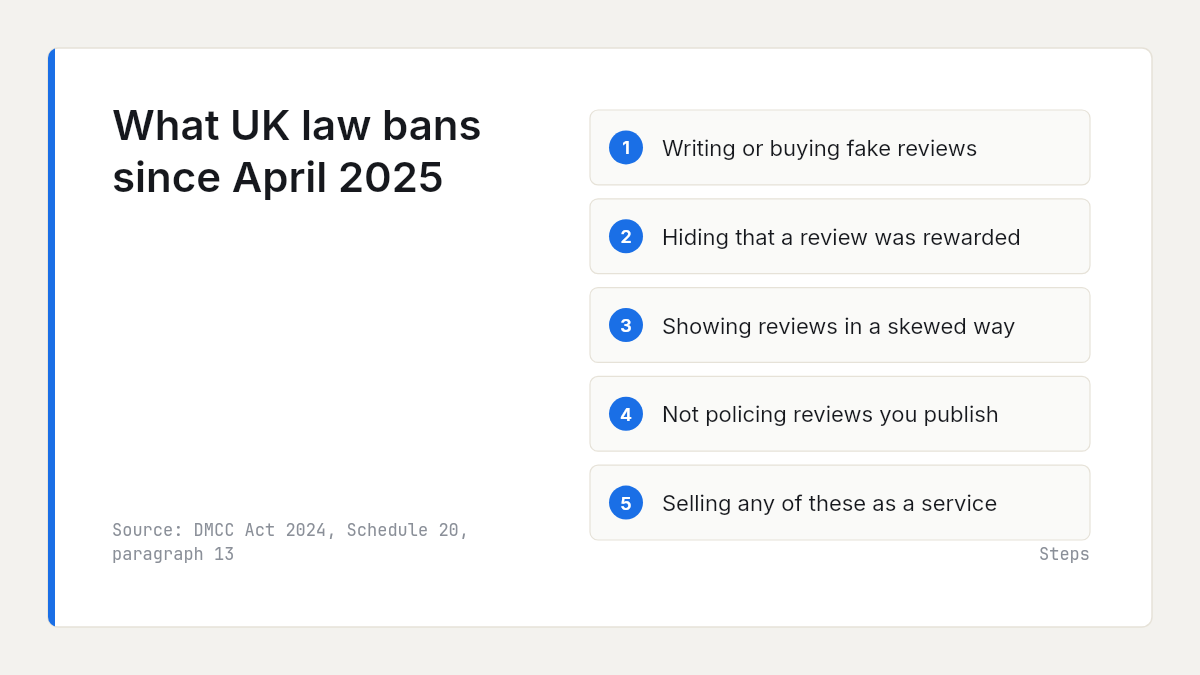
The rules sit in paragraph 13 of Schedule 20 to the Act, the list of commercial practices that are unfair in all circumstances. These practices are automatically unfair: nobody has to show that a customer was actually misled.
| Banned practice | What it means in practice |
|---|---|
| Submitting or commissioning a fake review | Writing a review of your own business, or getting someone else to, when it is not based on a genuine experience |
| Concealed incentivised reviews | A review written in return for something, with that fact hidden from readers |
| Publishing reviews in a misleading way | Hiding or removing negative reviews, giving positive ones more prominence, or leaving out how a review came about |
| Publishing without reasonable steps | Showing reviews without proportionate steps to prevent and remove fake or misleading ones |
| Offering any of these as a service | Selling fake reviews, or services that help others get them published |
"Commissioning" includes incentivising someone by any means, so you do not need to hand over cash to be caught.
What counts as a fake review?
The Act defines a fake review as one that "purports to be, but is not, based on a person's genuine experience". That covers fake praise and fake criticism alike, in any form: written reviews, star ratings, videos and images.
The CMA's fake reviews guidance (CMA208), published in April 2025, fills in the detail:
- A review is not fake just because the business disagrees with it, as long as it reflects the reviewer's genuine experience.
- A review can be genuine even if the reviewer did not pay, for example someone reviewing a gift a friend bought them.
- Reviews generated by software such as bots, made to look as if they come from individual customers, are fake.
- Offering a customer a refund or a gift card to remove the criticism from their review counts as commissioning a review that no longer reflects their experience.
What the law means for a small business
Most owners will never buy a batch of reviews. The everyday risks are smaller and easier to slip into.
- Staff and family reviews. The CMA's examples of commissioning include asking a member of staff to write a review, and its guidance treats hiding that a reviewer is an employee or shareholder as misleading. Do not ask staff, family or friends to review the business.
- Review swaps. Agreeing to review another business if it reviews yours is an exchange, and commissioning covers incentives "by any means". Treat swaps as banned.
- Buying reviews or ratings. An agency promising a better rating through reviews it supplies is offering exactly what the Act bans, and the business that hires it is commissioning them. Our guide to paying for review services shows how to tell legitimate software from the rest.
- Incentives. UK law allows an incentivised review only if the incentive is made clear and the review is still genuine. Google bans incentives outright, so in practice do not offer them. Our guide to review incentives covers the grey areas.
- Reviews on your own website. If you show reviews, a rating or a testimonial feed, the misleading-publication rules apply to you. The CMA lists suppressing genuine negative reviews and encouraging only satisfied customers to review as ways of cherry-picking. Our guide to why Google reviews can look hidden shows how this looks from the customer's side.
- The duty to police reviews you publish. A business that publishes reviews, even only from its own customers, needs a clear policy on fake reviews and proportionate steps to prevent and remove them. The CMA says a lack of resources is no excuse, although what is reasonable for a small trader differs from what is expected of a large review platform.
Who enforces it, and what are the penalties?
The CMA can now enforce consumer law directly. Under its direct consumer enforcement powers, a business that breaks the rules can be fined up to 10% of its global turnover or £300,000, whichever is greater, and can be directed to compensate consumers. Trading Standards enforces consumer law too, and the CMA notes that some fake review schemes may also break other laws, such as the Fraud Act 2006.
Platforms add their own penalties. Under undertakings Google gave the CMA in January 2025, UK businesses caught boosting their ratings with fake reviews get a warning on their Google profile and have their reviews switched off, and people who repeatedly post fake reviews for UK businesses are banned from posting. Google's own content policy removes reviews that are not based on a real experience or that were paid for, directly or in kind.
Making fake reviews illegal: UK enforcement so far
Before opening formal cases, the CMA reviewed more than 100 review publishers and sent advisory letters to 54 firms, and it says 90% made changes. In March 2026 it opened investigations into five businesses: a car sales platform, a review service provider, a funeral services firm, a food delivery platform and a food producer selling through delivery apps. The concerns range from one-star reviews being left out of ratings, to staff being asked to write positive reviews, to discounts for five-star reviews that were not disclosed.
The CMA stresses that it has reached no conclusions on whether any of them broke the law, and in October 2026 it said it expected to give a further update in the coming months. The pattern is still telling: the first cases are about everyday practices like the ones above, not only about review farms.
What about people who write fake reviews?
The ban applies to commercial practices: businesses, and anyone acting on their behalf. The CMA's guidance names professional reviewers, influencers, marketing companies and individuals acting for traders. Someone paid to write reviews is caught, and so is the business that paid them. Our article on whether you can get paid to write Google reviews explains why those offers are usually scams anyway.
A private individual who writes a spiteful fake review with no commercial motive is less clearly covered by these rules. That review still breaks Google's policy and can be removed, and if it is false and damaging, the business may have a claim in defamation. Our guide on how to remove a false Google review covers both routes.
How to stay on the right side of the law
- Ask every customer for a review in the same way, with no reward and no hint about what to write.
- Never write, edit or arrange reviews of your own business, and do not let staff, family or friends do it.
- Do not swap reviews with other businesses or join review exchange groups.
- If you show reviews on your website, show them fairly, label hand-picked quotes as selected testimonials and link to your full Google profile.
- If you publish reviews yourself, write a short policy on fake and incentivised reviews and check new reviews against it.
- Check what any review vendor actually does before you sign.
If you find fakes about your own business, or a rival boosting itself with them, our guides on how to spot fake Google reviews and where to report fake reviews cover the next steps.
If you want to see how your genuine reviews compare with your competitors', a Rate My Ratings market report shows every business's rating, review count and share of positive reviews in your category and area, and the themes customers raise across the market.
The short version
- Fake reviews have been illegal in the UK since 6 April 2025, under Schedule 20 to the Digital Markets, Competition and Consumers Act 2024.
- The ban covers writing or commissioning fake reviews, hiding incentives, publishing reviews misleadingly and failing to police the reviews you publish.
- For a small business, the real risks are staff and family reviews, swaps, undisclosed incentives and cherry-picked testimonials.
- The CMA can fine up to 10% of global turnover, and opened its first review investigations in March 2026. This is a summary, not legal advice.
Frequently asked questions
- Is it illegal to write a fake review of your own business?
Yes. Since 6 April 2025, writing a review of your own business that is not based on a genuine customer experience, or getting someone else to write one, has been a banned practice under the Digital Markets, Competition and Consumers Act 2024. The CMA can fine a business up to 10% of its global turnover. Reviews from staff, family or friends carry the same risk.
- Can my staff leave Google reviews for my business?
They should not. The CMA treats asking staff to write reviews as commissioning them, and hiding that a reviewer works for the business can make reviews misleading. Google's policy also removes reviews written from a conflict of interest, including current or former employment. Staff can ask customers for reviews, as long as everyone is asked and managers do not set review targets.
- What is the fine for fake reviews in the UK?
The CMA can fine a business up to 10% of its global turnover or £300,000, whichever is greater, for breaking consumer law, and can direct it to compensate consumers. Google adds its own penalties for UK businesses caught with fake reviews: a warning on the profile and reviews switched off. As of autumn 2026, the CMA's first review cases were still being investigated.
- Is it illegal to delete bad reviews from my own website?
It can be. If you publish reviews on your website, removing or not publishing genuine negative reviews while showing positive ones is named in the law as publishing reviews in a misleading way. You should remove reviews you find to be fake, under a clear published policy. If you only show selected quotes, label them as selected testimonials and link to your full Google profile.

Rate My RatingsNewsletter
What reviews say about local markets, in your inbox.
New articles and findings from the blog, as they're published.
Check your inbox.
If this address isn't subscribed yet, we've sent it a link to confirm. Nothing is sent until you click it.
That didn't go through. Check the email address and try again.
Hold on a moment, then subscribe again.