
How Much Is a Single Google Review Worth to Your Business?
One more review is worth most when you have few. How to estimate the value of a Google review in pounds from your enquiries, win rate and job value, with two worked examples.

The value of a Google review depends mostly on how many you already have. For a business with seven reviews, one more changes how many customers will consider it at all; for a business with 200, one more barely moves the star average and is worth most as proof that the business is still busy. You can put a rough figure in pounds on it with numbers you already know: enquiries from Google, the share you win, your average job value and a cautious guess at how much more reviews lift enquiries.
This guide explains the three ways a review earns money, what the research says one star is worth, and a simple spreadsheet you can fill in, with worked examples for an electrician with seven reviews and a vet practice with 217.
What is the value of a Google review made of?
A review earns money in three ways, and how much each matters depends on the size of your profile.
- It gets you considered. Many customers set a minimum before they look closely. In BrightLocal's 2026 Local Consumer Review Survey of 1,002 US consumers, 47% said they would not use a business with fewer than 20 reviews, and only 9% would use one with five or fewer. UK habits may differ, but the direction is clear.
- It helps you get chosen. Reviews lower the risk of picking the wrong business. The Spiegel Research Center at Northwestern University found that a product with five reviews was 270% more likely to be bought than one with none, and that extra reviews added less after the first five.
- It helps you get found. Google says in its guidance on how local results are ranked that more reviews and positive ratings can help a business's local ranking. It does not say by how much.
For most small businesses the first two, both about conversion, are larger and easier to measure than the third, so the spreadsheet below uses them.
Why the first reviews are worth the most
Studies of review volume find diminishing returns: the jump from none to five is large, from five to 20 smaller, and from 200 to 201 close to nothing. The UK businesses we track show how unevenly that falls across trades.
| Trade | Median Google reviews | Share with fewer than 10 | Share with 100 or more |
|---|---|---|---|
| Electricians | 7 | 58% | 6% |
| Accountants | 7 | 57% | 5% |
| Roofers | 7 | 57% | 6% |
| Garages | 35 | 27% | 22% |
| Dentists | 104 | 21% | 50% |
| Vets | 217 | 4% | 78% |
| Restaurants (London) | 361 | 8% | 76% |
Half of the 4,005 electricians in our UK data have seven reviews or fewer. For them, the eighth, ninth and tenth reviews bring them closer to the counts customers say they want to see. For a vet practice with 217 reviews, just as typical of its trade, one more changes almost nothing a customer can see. Our guide to a realistic review goal for a new business sets out the counts for more trades.
What one review does to your star average
Your Google rating is the average of every star rating on your profile, so the weight of one new review is one divided by your new total. Here is what a single review does to a business rated exactly 4.4, at different review counts.
| Reviews before | Rating before | After one five-star | After one one-star |
|---|---|---|---|
| 5 | 4.4 | 4.5 | 3.8 |
| 10 | 4.4 | 4.5 | 4.1 |
| 25 | 4.4 | 4.4 | 4.3 |
| 50 | 4.4 | 4.4 | 4.3 |
| 200 | 4.4 | 4.4 | 4.4 |
Below about 25 reviews, one review can change the number customers see; above about 50 it rarely does. And a bad review costs more than a good one adds, because a one-star rating sits 3.4 stars below a 4.4 average while a five-star sits only 0.6 above it. We look at that side in what one bad review really costs. Larger moves are slow: from 4.2 with 50 reviews to 4.5 takes about 30 more five-star reviews.
What the research says one star is worth
The best-known studies are not about UK local businesses, so treat them as a guide to scale, not a forecast.
| Study | Setting | Finding |
|---|---|---|
| Luca, Harvard Business School (2011) | Seattle restaurants on Yelp | One more star linked to 5% to 9% more revenue for independents, none for chains |
| Anderson, Cornell (2012) | Hotel bookings on Travelocity | One more point of review score raised the odds of a booking by 14.2%; each extra review by 0.2% |
Michael Luca matched Yelp ratings with the revenue of Seattle restaurants and found that a one-star increase was linked to a 5 to 9 percent rise in revenue, driven by independent restaurants. Chris Anderson's Cornell report on hotel performance is useful because it prices a single review: in Travelocity's booking data, each additional review raised a hotel's odds of being booked by about 0.2%.
Take Luca's range at face value for an independent restaurant turning over £500,000 a year. Moving from 4.2 to 4.5 is 0.3 of a star, worth 1.5% to 2.7% of revenue, or £7,500 to £13,500 a year. That takes about 30 five-star reviews, so each one is worth roughly £250 to £450 of extra revenue a year while the rating holds. It assumes Google ratings in a UK town move diners as Yelp ratings did in Seattle, which nobody has measured. Our article on whether Google reviews increase sales covers the wider evidence.
A simple spreadsheet for the value of a Google review
For most trades there is no study to borrow, so build the estimate from your own numbers. Six cells are enough.
| Cell | Input | Where to find it |
|---|---|---|
| A | Enquiries a month that come through Google | Your enquiry log, or calls and messages in the profile's performance report |
| B | Share of enquiries that become paid work | Your quotes and bookings |
| C | Average job value, £ | Your invoices |
| D | Gross margin | Your accounts |
| E | Extra enquiries once you reach a target review count | A cautious guess, such as 5% or 10% |
| F | Reviews needed to reach the target | Target count minus current count |
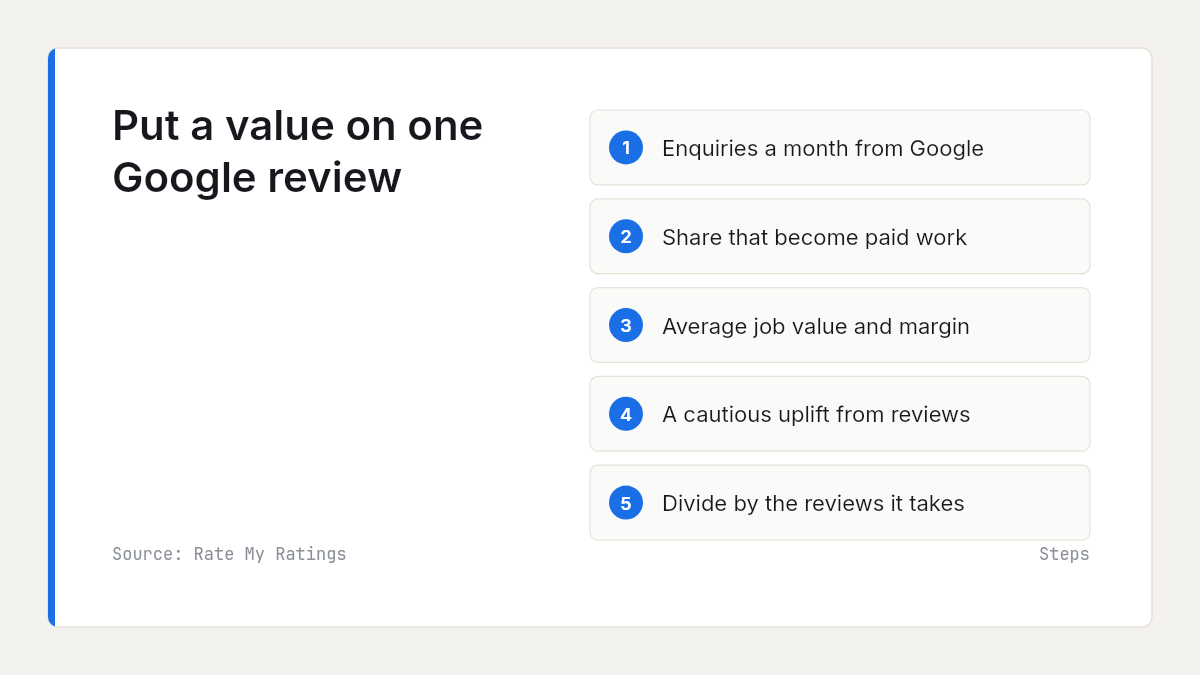
Then extra profit a year is A × E × B × C × D × 12, and the value of one review is that figure divided by F. Keep E modest. The 270% figure from online shopping compares product pages with no reviews at all, and a local business with seven reviews already has some proof. Run the sheet at 5% and at 10% and treat the gap as your range.
Worked example: an electrician with seven reviews
Say an electrician gets 25 enquiries a month through Google, wins 40% of them, has an average job of £350 and a gross margin of 45%. The target is 20 reviews, which takes 13 more. If reaching 20 brings 10% more enquiries:
- Extra enquiries: 25 × 10% = 2.5 a month.
- Extra jobs: 2.5 × 40% = one a month.
- Extra revenue: £350 a month, or £4,200 a year.
- Extra gross profit: £4,200 × 45% = £1,890 a year.
- Value of one review: £1,890 ÷ 13 = about £145 of profit a year.
At a 5% uplift the figure halves, to about £73 a review. Asking costs a text message, so even the cautious figure is a good return. Our Google review benchmarks for electricians show where 20 reviews would put you in your trade.
Worked example: a vet practice with 217 reviews
Now take a vet practice rated 4.6 with 217 reviews, which is typical in our UK data. One more five-star review lifts its average by about 0.002 stars, which no customer will ever see. Counted one at a time, the value of a Google review here is close to nothing.
The value sits in the flow instead. In the same BrightLocal survey, 74% of consumers said they seek reviews written in the last three months. A practice whose newest review is from the summer looks quieter than one reviewed last week, whatever its total. So for an established business, value the habit rather than the review: what would you lose if new reviews stopped for six months? That question belongs with the ROI of review management, which prices the staff time as well.
What the model leaves out
- Thresholds. If you sit at 3.9, the review that lifts you to 4.0 can be worth far more than the average, because many customers filter below four stars. See what a 3.5 star rating costs compared with 4.5.
- The businesses beside you. Twenty reviews stand out among rivals with five and disappear among rivals with 60. What counts as a good Google rating depends on them too.
- Ranking. Google does not publish how much reviews move local ranking, so the sheet leaves it out. Any gain there is extra.
To set a target against real competitors rather than a guess, a Rate My Ratings market report shows the rating, review count and share of positive reviews of every business in your category and area.
The short version
- The value of a Google review is highest for small profiles: half of the UK electricians we track have seven reviews or fewer, and each new one moves them towards the counts customers look for.
- On a large profile, one review barely changes the average; the value lies in a steady flow of recent ones.
- Studies put a full star at 5% to 9% of revenue for independent restaurants and price a single hotel review at about 0.2% higher odds of a booking.
- Estimate your own figure from enquiries, win rate, job value, margin and a cautious uplift, then divide by the reviews it takes.
Frequently asked questions
- How much is one Google review worth?
It depends on how many you already have and what a job is worth to you. Multiply your monthly Google enquiries by a cautious uplift, your win rate, job value, margin and 12, then divide by the reviews needed to reach your target. For a small trade business with seven reviews, that can come to well over £100 of profit a year per review.
- Do more Google reviews mean more customers?
Usually, up to a point. Research on online shopping found five reviews made a purchase 270% more likely than none, with smaller gains after that. Google says more reviews and positive ratings can help local ranking. The effect is largest for businesses with few reviews and smallest for those that already have hundreds.
- How many Google reviews does a small business need?
Enough to match the businesses customers compare you with. In a 2026 US survey, 47% of consumers said they would not use a business with fewer than 20 reviews. In our UK data the median ranges from seven reviews for electricians, accountants and roofers to 217 for vets, so check your own trade.
- Is it worth paying for Google reviews?
No. Buying reviews breaks Google's policies, and in the UK writing or commissioning fake reviews is a banned practice under the Digital Markets, Competition and Consumers Act 2024. The value described here comes from genuine reviews by real customers, which you can grow by asking every customer at the right moment.

Rate My RatingsNewsletter
What reviews say about local markets, in your inbox.
New articles and findings from the blog, as they're published.
Check your inbox.
If this address isn't subscribed yet, we've sent it a link to confirm. Nothing is sent until you click it.
That didn't go through. Check the email address and try again.
Hold on a moment, then subscribe again.