Google Reviews for Estate Agents: UK Benchmarks From 800 Agents
The median UK estate agent we track has a 4.8 Google rating and 99 reviews, and communication drives both praise and complaints. Benchmarks from 802 agents, when to ask, and how to reply.

Google reviews for estate agents are plentiful and high: across the 802 estate agents we track in South West London, Hertfordshire, Leeds and Cambridge, the median Google rating is 4.8 and the median agent has 99 reviews. Nearly four in five (78%) are rated 4.5 or higher, so 4.5 is where an agent starts to look normal, not where it stands out.
Agents also reply to their reviews more than almost any other trade we track, and their customers write long reviews about one thing above all: communication. This guide sets out the UK benchmarks, what vendors, buyers, landlords and tenants praise and complain about, when to ask, how to reply without breaking a client's confidence, and the trust signals customers check before they instruct an agent.
Google reviews for estate agents: the UK benchmarks
These figures come from Google's own rating and review count for each agent, and from a sample of 15,255 recent reviews of the same agents.
| Measure | Estate agents we track |
|---|---|
| Median Google rating | 4.8 |
| Share with a perfect 5.0 | 22% |
| Share rated 4.5 or higher | 78% |
| Share rated below 4.0 | 8% |
| Median number of reviews | 99 |
| Reviews needed for the top quarter | 204 or more |
| Share with 100 or more reviews | 50% |
| Recent reviews with an owner reply | 71% |
Two things set estate agents apart. They have far more reviews than most local services: the median electrician or accountant we track has seven, while half of all agents have 100 or more and the busiest tenth have at least 383.
Perfect scores are also rarer than in most trades. Only 22% of agents hold a 5.0, against 66% of accountants, and among agents with 100 or more reviews just 9% do. The median for those busy agents is still 4.8. Our guide to the average Google rating by industry puts these figures beside every other trade.
What the benchmarks mean for one branch
Read your own profile against three lines.
- Your rating. A 4.8 puts you level with the median agent. Because 53% of agents are at 4.8 or above, a 4.7 already places you in the lower half, and anything under 4.5 puts you among the lowest 22%.
- Your review count. With 28 or fewer reviews you are in the bottom quarter. Around 100 is typical. With 204 or more you are in the top quarter, where the rating becomes hard to move by accident.
- How fragile your average is. A branch at 4.8 from 100 reviews that gets one one-star review falls to about 4.76. A new branch at 5.0 from ten reviews that gets the same review falls to about 4.6, below most of its competitors.
That last point is why a new or rebranded office should build volume first. With ten reviews, one unhappy client is a tenth of the record.
What vendors, buyers, landlords and tenants write about
An agent's reviews come from both sides of every deal: the vendors and landlords who pay the fees, and the buyers and tenants who deal with the branch without having chosen it. Our data does not record which side a reviewer was on, but the themes are clear. Google reviews for estate agents are long and specific: the median five-star review with text runs to 41 words, the median one- or two-star review to 90, and 95% of recent reviews have written text.
In five-star reviews, 44% say they would recommend the agent, 36% praise knowledge or expertise, 34% call the staff professional and 33% praise communication, such as being kept informed or having the process explained. That communication figure is the highest of the 20 trades we track. Only 3% mention price or value.
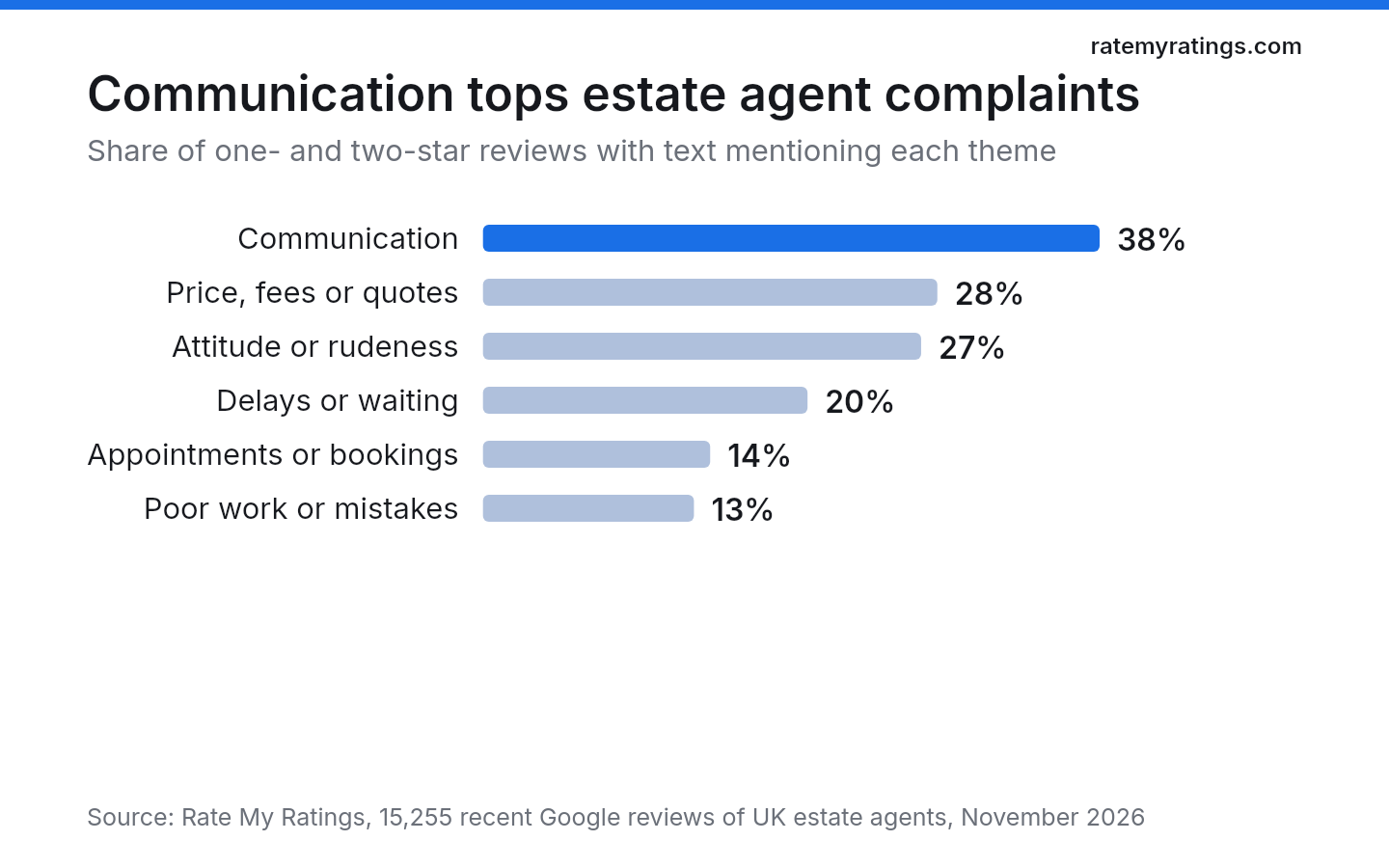
The complaints mirror the praise. Of the 786 one- and two-star reviews with text, 38% mention communication: no response, unanswered calls, having to chase for news. Price, fees or quotes come up in 28%, a rude or dismissive attitude in 27%, and delays in 20%.
A sale or a let means weeks of waiting on solicitors, lenders and the other party. Many of the delays customers describe are outside the agent's control; the silence while they wait is not. The practical lesson for a branch: a regular update to every vendor and landlord, even with nothing new to report, protects your reviews more than any request script. Our guide to what customers look for in reviews shows how readers weigh this kind of detail against the star rating.
When to ask for a review
The moment in an estate agent's job is the handover, when the keys change hands.
- Sales: at completion. Ask the vendor and the buyer on completion day or the day after, when relief is high and the details are fresh. Exchange is too early, because nobody has moved yet.
- Lettings: two to three weeks after move-in. By then the tenant has settled, the inventory is agreed and any early repair has been dealt with. Ask the landlord once the tenant is in and the first rent has reached them.
- Longer management. For a landlord on full management, a renewal or the end of a tenancy is a natural second moment.
Ask every client at the same stage, whether or not the sale was smooth. Google's policy on fake engagement bans selectively asking happy customers for reviews and offering incentives for them, and since April 2025 UK law has banned fake reviews and concealed incentivised reviews, as the CMA explains in its fake reviews guidance. A moving-in gift is fine; a gift in exchange for a review is not. For the time of day and the wording, see the best time to ask for a review.
How estate agents should reply to reviews
Estate agents already reply to 71% of recent reviews and to 68% of one- and two-star reviews. Of the 20 trades we track, only physiotherapists reply more often (81%). For most branches the question is not whether to reply but what to leave out.
Google posts approved replies publicly under the review and notifies the reviewer, according to its help page on replying to reviews. So treat everything about a client's sale or tenancy as private: the price, the offers, the other party, a mortgage, rent arrears or a deposit dispute. A reply that wins the argument by revealing a client's circumstances loses the next vendor's trust.
A good reply to a complaint about communication is short:
Thank you for telling us this. Updates should not depend on you chasing us, and I am sorry they did. I would like to understand what went wrong, so please call me at the branch. Branch Manager
Two points are specific to estate agency. When the reviewer was on the other side of the deal, such as a buyer unhappy with how an offer was handled, acknowledge the frustration without discussing your client's decisions. And for a serious complaint, point to your complaints procedure, which ends with your redress scheme. For structure and more examples, see how to respond to negative Google reviews, and how to respond to positive reviews without sounding templated.
Trust signals customers check
A vendor choosing between three agents reads the reviews, then checks that the agent is properly set up.
- A redress scheme. Anyone doing estate agency work in the UK must belong to an approved redress scheme, and there are two: The Property Ombudsman and Property Redress, as Business Companion's guidance for estate agents sets out. Letting agents and property managers in England have had to join one since 1 October 2014.
- A route for complaints. Under The Property Ombudsman's process, a customer complains to the agent first and can refer the complaint once they have the agent's final response, or after eight weeks. The service is free for consumers.
- Professional membership. Propertymark checks that its members belong to a redress scheme and hold professional indemnity insurance, and that members who handle client money have client money protection.
- Replies. A profile where every recent complaint has a calm reply reads as an agent that listens.
Customers who want a fuller check can follow our guide to checking whether a business is legit.
To see where your branch sits, our public reports on estate agents in South West London, Leeds and Cambridge show every agent's Google rating, review count and share of positive reviews, with the themes customers praise and complain about across each market. A market report gives the same view for your own area.
The short version
- The median estate agent we track has a 4.8 rating and 99 reviews; 78% are rated 4.5 or higher, and the top quarter have 204 reviews or more.
- Communication is what customers praise most specifically (33% of five-star reviews) and complain about most (38% of one- and two-star reviews).
- Ask every vendor and buyer at completion, and tenants a few weeks after move-in, and never offer anything in return.
- Reply to every review, but keep the price, the client's finances and the other party out of it.
Frequently asked questions
- What is a good Google rating for an estate agent?
Across the 802 UK estate agents we track, the median Google rating is 4.8 and 78% are rated 4.5 or higher. A 4.8 puts an agent level with the typical competitor, while anything below 4.5 places it among the lowest 22%. Only 9% of agents with 100 or more reviews hold a perfect 5.0, so a 4.8 on a large review count is a strong result.
- How many Google reviews does an estate agent need?
The median estate agent we track has 99 Google reviews, half have 100 or more, and the top quarter have 204 or more. A branch with 28 or fewer sits in the bottom quarter. Aim first for enough reviews that one unhappy client cannot pull your average below your competitors', then for the count of the agents that appear beside you in Google Maps.
- Should estate agents reply to every Google review?
Most already do: 71% of recent reviews of the agents we track have an owner reply, more than in any trade we track except physiotherapists. Reply to positive and negative reviews alike, briefly, and keep every detail of a client's sale or tenancy out of the public reply. Offer a phone call or a meeting for anything that needs facts.
- When should an estate agent ask for a Google review?
At the handover. Ask vendors and buyers on completion day or the day after, tenants two to three weeks after they move in, and landlords once the tenant is in and the first rent has arrived. Ask every client at the same stage, not only those whose sale went smoothly, and never offer a gift or discount in return for a review.
- How do I complain about an estate agent?
Complain to the agent first, in writing, using its complaints procedure. If you are unhappy with its final response, or eight weeks pass without one, you can take the complaint to the redress scheme the agent belongs to: The Property Ombudsman or Property Redress. The Property Ombudsman's service is free for consumers. A Google review is separate from this process.

Rate My RatingsNewsletter
What reviews say about local markets, in your inbox.
New articles and findings from the blog, as they're published.
Check your inbox.
If this address isn't subscribed yet, we've sent it a link to confirm. Nothing is sent until you click it.
That didn't go through. Check the email address and try again.
Hold on a moment, then subscribe again.