Google Reviews for Dentists: UK Benchmarks and the Rules on Replying
Most UK dental practices sit at 4.8 stars on about 100 Google reviews. Where your practice stands, what patients praise and complain about, and how to reply within the GDC's confidentiality rules.

Google reviews for dentists in the UK cluster high. Across the 972 dental practices we track in nine UK markets, the median Google rating is 4.8, four in five practices are rated 4.5 or higher, and the typical practice has 104 reviews. A practice below 4.5, or well short of 100 reviews, sits behind most of the practices a patient will compare it with.
This guide sets out the benchmarks, what patients praise and complain about, when in a course of treatment to ask for a review, and how to reply within the General Dental Council's rules on confidentiality. Our dental data covers practices in Greater Manchester, Birmingham, Harley Street, Ealing and south-west London.
Google reviews for dentists: the UK benchmarks
Each figure below uses the practice's own Google rating and review count, as Google showed them in November 2026.
| Benchmark | UK dental practices |
|---|---|
| Median Google rating | 4.8 |
| Rated a perfect 5.0 | 29% |
| Rated 4.5 or higher | 80% |
| Rated below 4.0 | 8.5% |
| Median number of reviews | 104 |
| Reviews needed for the top quarter | 229 or more |
| Recent reviews with an owner reply | 54% |
Two things stand out. Dental practices collect far more reviews than most appointment-based businesses: half have more than 100, and the busiest tenth have 432 or more. And ratings are more spread out than in physiotherapy or aesthetics: 29% of practices have a perfect 5.0, 31% sit at 4.8 or 4.9, 20% at 4.5 to 4.7, and 8.5% are below 4.0.
Our figures do not record whether a practice is NHS, private or mixed, so they cannot show whether patients rate the two differently. For how dentists compare with other trades, see the average Google rating by industry.
What the numbers mean for one practice
Review count changes what a rating means. Of the practices with fewer than 10 reviews, 70% show a perfect 5.0; of those with 100 or more, only 13% do, and their median rating is still 4.8. So a 4.8 on 200 reviews is what an established, well-run practice looks like, and a 5.0 on six reviews tells patients very little.
The larger your count, the slower your rating moves. A practice at 4.6 with 80 reviews needs about 80 more five-star reviews to reach 4.8. Google shows the rating to one decimal place, so the exact number depends on rounding, but the point holds: recovery after a bad patch takes a steady flow of reviews, not one good month.
When you read Google reviews for dentists near you, the fairest comparison is not a national figure but the practices that appear beside you in Google Maps for the searches that bring you patients, such as an emergency appointment or teeth straightening in your town.
What patients praise and complain about
Most of what patients write is praise. Of 44,788 recent Google reviews of UK dental practices in our data, 92% are five-star and 4% are one-star. Five-star reviews are short, a median of 27 words, and personal: 44% mention friendly, kind or welcoming staff, 35% say they would recommend the practice, 30% praise a dentist as knowledgeable, experienced or thorough, and 27% use the word professional. Only 2% mention price or value.
Complaints are almost three times as long, a median of 75 words. Of the 1,747 one- and two-star reviews with text, these are the share that mention each theme (a review can mention several):
- Booking and appointments: 57%. Any mention of appointments, cancelling, rescheduling or reception.
- Price, fees or quotes: 29%. Words such as cost, expensive, quote, invoice or fee.
- Staff attitude: 27%. Words such as rude, dismissive, unprofessional or patronising.
- Waiting or delays: 21%. Running late, long waits, or slow to be seen.
- Communication: 13%, and quality of treatment: 7%.
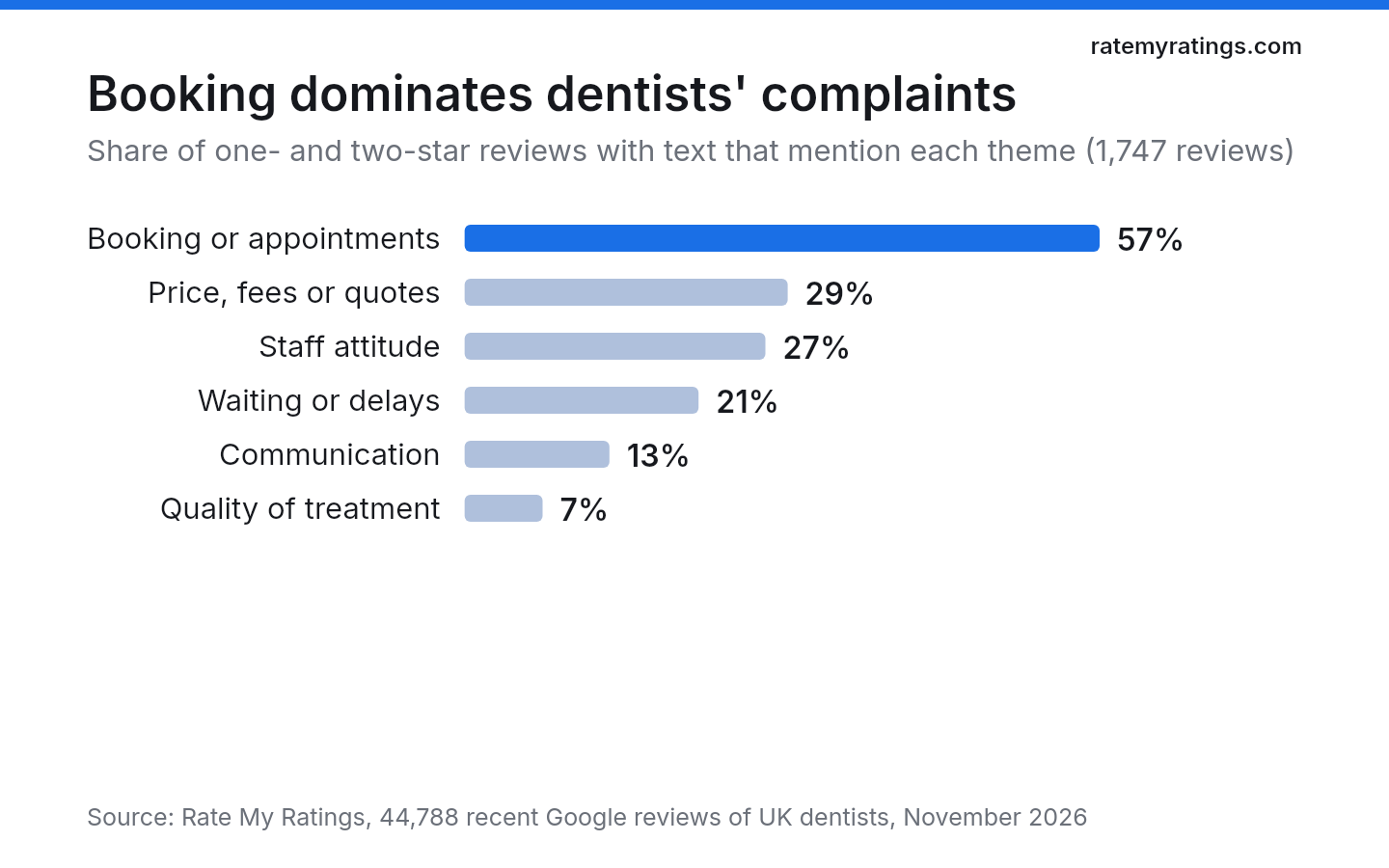
The booking theme is broad, because almost every dental review mentions an appointment, but the pattern is clear: the experience around the chair loses more stars than the treatment in the chair. Reception, cancellations and conversations about fees are where to look first. Our guide to what customers look for in reviews explains why readers weigh these details so heavily.
When to ask patients for a review
Ask when a course of treatment is complete, not in the middle of it. Mid-course, neither you nor the patient knows the result. Good moments are the fit of a final crown or denture, the end of orthodontic treatment, a hygiene visit, or the first check-up of a nervous patient that went well.
- Ask in person at the desk, as the patient books their next recall: one sentence, no script.
- Follow up the same day by text or email with a direct link that opens the review box. Our guide to creating a Google review link and QR code shows how.
- Ask every patient at that stage, not only the ones who seemed pleased. Google's prohibited content policy bars businesses from selectively soliciting positive reviews or discouraging negative ones.
- Offer nothing in return. The same policy treats reviews posted because of an incentive as rating manipulation, so a discount on the next hygiene visit is out. Staff and their families should not review the practice either.
How to reply to dental reviews without breaching confidentiality
A reply on Google is public, and the reviewer is notified when you post it, according to Google's help page on replying to reviews. Treat it as social media for the purposes of your professional duties.
The GDC's guidance on using social media quotes standard 4.2.3 of the Standards for the Dental Team: no information or comments about patients on social networking sites. It asks dental professionals not to publish anything that could identify a patient without their explicit consent, and warns that several pieces of information together can identify someone even when none does alone.
In practice that means a reply should never confirm that the reviewer is a patient, or mention their treatment, dates, the clinician they saw, fees or anything from their notes, even when the review itself gives those details. A patient posting a review has not given you explicit consent to discuss their care in public.
That caution may explain a gap in our data: practices replied to 55% of five-star reviews but only 42% of one- and two-star reviews. A confidential reply is possible, and it helps the next reader. For a complaint:
Thank you for taking the time to write. We are sorry to read that your experience fell short of what you expected. We cannot discuss anyone's care online, but our practice manager would like to talk this through. Please call the practice and ask for them.
For praise, thank the reviewer and pass it on to the team, without adding anything about the treatment. Our guides on how to respond to negative Google reviews and how healthcare practices should respond to patient reviews have more wording.
Where patients review and complain now
The NHS website took its ratings and reviews service offline at the end of June 2025, as Care Opinion reported at the time. That leaves one fewer official place for patients to rate a practice in public, and more of that feedback on Google.
Complaints should still go through your own procedure first. For private treatment that a practice cannot resolve, the Dental Complaints Service offers free, impartial help and is funded by the GDC. Price matters here too: the Competition and Markets Authority opened a market study into private dental services on 5 March 2026, with findings due by 4 March 2027. With 29% of complaints in our data mentioning price, fees or quotes, a clear written estimate before treatment is cheap insurance.
Trust signals patients check besides reviews
- The GDC register. Patients can search the GDC's online register by name or town to confirm that a dentist, hygienist, therapist or dental nurse is registered. Make sure every clinician's name on your website matches it.
- Inspection reports. In England, dental practices register with the Care Quality Commission, which publishes an inspection report for each practice it has inspected.
- Clear fees. NHS charges in England are set nationally in three bands; private fees are set by each practice, so publish them.
- Recent reviews with replies. A steady flow of new reviews, each answered calmly, reads as a practice that is open and listening.
To see where your practice stands locally, our reports on dentists in Greater Manchester and dentists in Birmingham are public. A Rate My Ratings market report shows every practice's Google rating, review count and share of positive reviews in a category and area, and the themes patients praise or complain about across the market.
The short version
- Google reviews for dentists in the UK centre on 4.8 stars and 104 reviews; 80% of practices are at 4.5 or higher.
- Complaints are mostly about booking (57%), price (29%) and staff attitude (27%), not clinical results.
- Ask when treatment is complete, ask every patient at that stage, and offer nothing in return.
- Reply to every review without confirming the reviewer is a patient or mentioning their care.
- Back your reviews with a correct GDC register entry, your inspection report and clear fees.
Frequently asked questions
- What is a good Google rating for a dentist?
In our data on 972 UK dental practices, the median Google rating is 4.8 and 80% are rated 4.5 or higher, so 4.8 or above puts a practice level with most of its competitors. Only 8.5% of practices are below 4.0. Compare yourself with the practices beside you in Google Maps, and remember that a rating on few reviews carries less weight.
- How many Google reviews does a dental practice need?
The median UK dental practice in our data has 104 Google reviews, and the top quarter have 229 or more. A new practice cannot match that quickly, so aim first to pass 10 genuine reviews, then work towards the typical count for your area by asking every patient when a course of treatment is complete.
- Can a dentist reply to a Google review?
Yes, and it is worth doing, but the reply must not confirm that the reviewer is a patient or mention their treatment. The GDC's guidance says dental professionals must not post information or comments about patients on social media. Thank the reviewer, say you cannot discuss anyone's care online, and invite them to contact the practice manager directly.
- Can patients still review dentists on the NHS website?
No. The NHS website's ratings and reviews service was taken offline at the end of June 2025, according to Care Opinion, which reported the change. Patients can still post reviews on Google and other sites, and complaints should go to the practice first. For private treatment, the Dental Complaints Service offers free help.
- Can a dental practice offer a discount for a Google review?
No. Google's content policy treats reviews posted because a business offered an incentive as rating manipulation, and it bars businesses from asking only satisfied customers. Offer no discounts, prize draws or free treatment for reviews. Ask every patient at the same point in their care, and make leaving a review easy with a direct link.

Rate My RatingsNewsletter
What reviews say about local markets, in your inbox.
New articles and findings from the blog, as they're published.
Check your inbox.
If this address isn't subscribed yet, we've sent it a link to confirm. Nothing is sent until you click it.
That didn't go through. Check the email address and try again.
Hold on a moment, then subscribe again.