Does ChatGPT use Google reviews for local answers?
OpenAI has not said, and vendor claims clash. A platform-by-platform map of what each assistant reads, and where a UK business should collect reviews.
Does ChatGPT use Google reviews? Not as far as anyone can show. OpenAI has never said that ChatGPT reads Google reviews or Google Business Profile data, and no review licence between the two companies is on record. The one review deal on record is with Yelp. Google reviews feed Google's own assistants, such as Gemini, and they can reach ChatGPT only indirectly, when a page its search can read repeats them.
That matters because each assistant reads a different mix of sources. Below we take the platforms one at a time, separate what each has published from what vendors infer, and finish with a way to map the review sites that count in your own trade and town.
Does ChatGPT use Google reviews, according to OpenAI?
OpenAI has published nothing that describes a feed of Google reviews into ChatGPT, and no documentation on how it ranks local businesses. What it has said is general.
The OpenAI launch post for ChatGPT search (October 2024) says the model "leverages third-party search providers, as well as content provided directly by our partners", and that results can include any source that does not block its search crawler. That gives three routes in:
- Search providers. ChatGPT runs searches and reads the pages that come back.
- Partners. Content licensed directly to OpenAI, such as Yelp's (below).
- The open web. Any page that lets OpenAI's search crawler, OAI-SearchBot, read it.
Google's review pages are not among the named partners. If a ChatGPT answer echoes what your Google reviewers say, the likeliest explanation is that the same praise sits on a page it could read, such as your own testimonials page or a directory listing. That is our inference, not something OpenAI has confirmed.
The one review licence on record: Yelp
The only documented review source for ChatGPT's local answers is Yelp. In its Q2 2026 letter to shareholders, filed with the SEC, Yelp states that "Yelp ratings and reviews recently began powering ChatGPT's local experience in relevant categories" under a licensing agreement with OpenAI.
Search Engine Land's report on the Yelp and OpenAI deal, published in July 2026, gives the terms: Yelp licenses its reviews, ratings, photos, and business information; the deal is non-exclusive; it covers about 330 million cumulative reviews; and OpenAI, not Yelp, controls how the content appears. Coverage differs on when the deal began.
For a UK owner, read this with care: none of the coverage we read says whether the deal reaches UK businesses. Before acting on it, look up your business and three rivals on Yelp and count the reviews: if there are few, ChatGPT has little Yelp material about your market to draw on. Claiming your free Yelp listing and correcting its details costs little. Asking customers to review you on Yelp is rarely the best use of their goodwill.
What vendors claim, and why the claims clash
Companies that sell AI visibility tools have tried to work out ChatGPT's local sources by running large batches of prompts, and their answers do not agree:
- Local Falcon's review of ChatGPT's local data sources says it has no direct link to Google Business Profile and calls Bing Places a direct pipeline into its local data, alongside directories and websites.
- A May 2025 study, as Steady Demand describes it, put Foursquare at 60 to 70% in five cities. Steady Demand's own US test found it at 0.00% of citations.
- The same test found Yelp in 95.83% of the data behind ChatGPT's local business cards, but only 1.04% of citations.
None of these is backed by OpenAI, and they cannot all describe the same thing. Each rests on different categories, countries, and dates, ChatGPT can change its sources without notice, and each vendor has a product to sell. Treat any single figure as a snapshot of one test, not a rule.
Does Gemini use your Google Business Profile?
Gemini is the one assistant with documented access to Google's place data. Google says Grounding with Google Maps, released for developers on 17 October 2025, connects Gemini models to data on more than 250 million places, including addresses, opening hours, and user ratings, and that the model detects when a question has a geographical context.
That is the developer API, so it shows what Gemini can read rather than how the Gemini app ranks businesses. The practical step is the same either way: for Google's assistants, your Business Profile and its reviews are the most direct source you control. Google's search features are covered separately, in how to show up in Google AI Overviews and AI Mode and in what replaced Google Business Profile Q&A, which explains the review summaries searchers now see.
What do Copilot, Perplexity, and Siri read?
The other assistants each lean on a different base, and none has published a full list.
- Copilot. Microsoft's rewritten Bing Webmaster Guidelines, reported in February 2026, cover Copilot too, and eSEOspace quotes them as saying Bing and Copilot "rely on the same core crawling, indexing, and ranking foundation as traditional search". Microsoft has not documented how Bing Places listings feed Copilot answers; our guide to Bing Places for Business covers what is known.
- Perplexity. It announced an integration with Yelp and maps in March 2024 to improve searches for local restaurants and businesses, and it cites web pages as well.
- Siri and Apple Maps. They read the listing you manage in Apple Business (Business Connect until April 2026). Where Apple's ratings and reviews come from, and what a UK place card shows, is covered in our guide to getting your business on Apple Maps and Siri.
| Assistant | What the platform or a partner has published | What is not documented |
|---|---|---|
| ChatGPT | Search providers, partner content, open web; Yelp licence | How local businesses are chosen |
| Gemini | Maps grounding with places, hours, and ratings | How the Gemini app ranks businesses |
| Copilot | Same core crawling, indexing, and ranking as Bing | How Bing Places feeds answers |
| Perplexity | Yelp and maps integration for local searches | Current sources and weighting |
Do the assistants agree on which business to recommend?
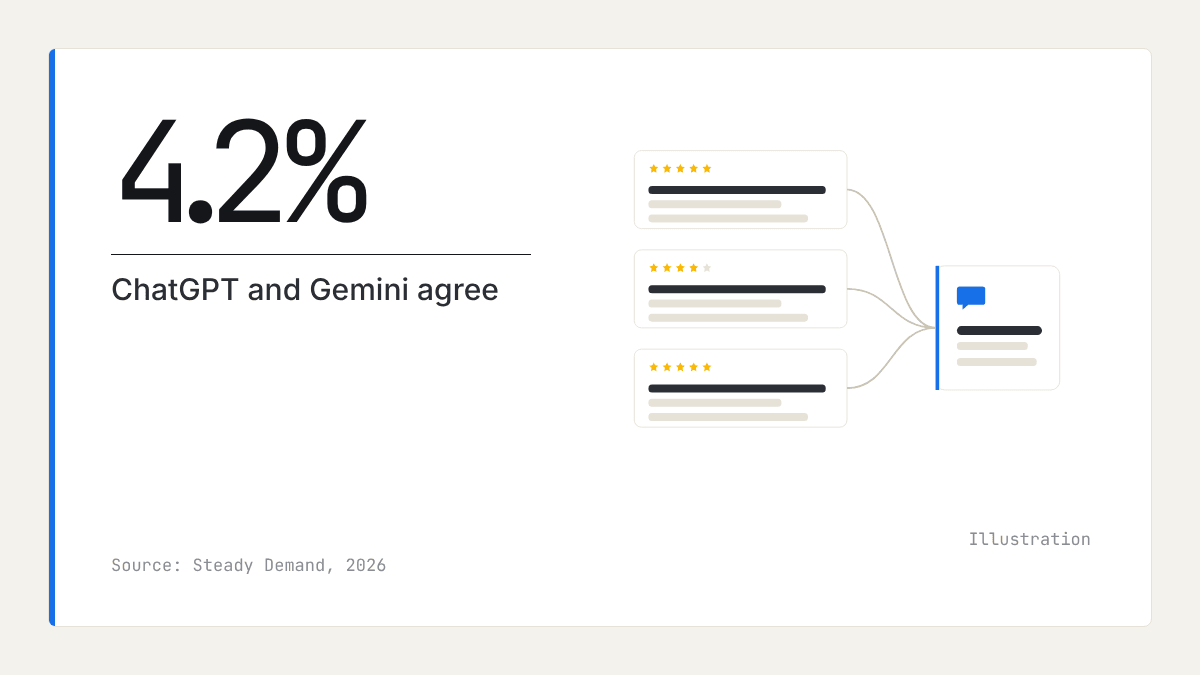
Rarely. Steady Demand's study of 1,487 local queries across US metros found ChatGPT and Gemini named the same top business in 4.2% of identical queries. Asked again, Gemini named the same top business about 7.9% of the time, against 90.2% for Google's local pack. It is US vendor data and UK figures may differ, but the direction is plain: AI visibility is not one score. Being first in ChatGPT tells you little about Gemini, and an assistant's answer is far less steady than the map pack.
To see how this plays out for you, run the same questions several times and record which sources each answer cites.
How to build your sector's review map
Because each assistant reads different sources, the useful question is not which platform matters most but which review sites matter in your trade and town. You can answer it in an hour.
- Search Google for your main service and town, for example "emergency plumber Leeds", and list every review site on page one.
- Ask ChatGPT, Gemini, Copilot, and Perplexity the same question and note every source each answer cites.
- For your three closest rivals, note which sites hold their reviews.
- Mark the sites that appear in both lists. Those are your sector's review sites.
The maps differ by trade. Take three hypothetical businesses in one town: a dental practice might find Google beside the NHS website and a booking platform; a garage might see Google, Trustpilot, and a trade directory; a restaurant might see Google, Tripadvisor, and a reservations site. For trades, Checkatrade deserves a look, since it has run an app inside ChatGPT since April 2026.
Keep Google as the base, because it feeds Google's own assistants; add the one sector site your customers use; and do not spread effort across ten platforms. A steady flow of reviews on two sites is easier to keep up than a trickle across many. The steps for acting on your map are in how to get recommended by ChatGPT as a local business.
Where reviews fit
Whichever assistant does the reading, public reviews are among the few inputs every platform can see. The specific words customers use, the service they bought, the area you covered, how quickly you came, and whether the price matched the quote, are what an assistant can match to a question and repeat in its answer, on whichever site they sit.
That makes what reviews say as important as how many there are. Our market reports show what the reviews across a whole local market say: ratings, review counts, share of positive reviews, and the themes customers praise or complain about, across a category and town. They do not show which assistant reads which source, or how any business ranks. For collecting and replying to reviews, see the guides on our blog.
What to do this week
- Check that your website's robots.txt does not block OAI-SearchBot, so pages that quote your reviews can be read by ChatGPT search.
- Claim or check your Yelp listing: name, address, phone number, hours, and category. No Yelp review drive is needed.
- Bring your Google Business Profile up to date, including hours, categories, and services, since Gemini reads Google's place data.
- Claim Bing Places and Apple Business if you have not already.
- Build the review map above for your main service and town, and choose your one sector site.
- Quote a few recent, genuine reviews as text on your service pages, so the words your customers use sit on a page any assistant can read. Do not add review markup to them: Google does not show stars for reviews a business publishes about itself.
Frequently asked questions
- Does ChatGPT read my Google reviews?
OpenAI has not said that ChatGPT reads Google reviews, and no licence between OpenAI and Google for review data is on record. Your Google reviews may still shape an answer indirectly if the same praise appears on a page ChatGPT's search can read, such as your own website. That route is an inference, not something OpenAI has confirmed.
- Does ChatGPT use Google or Bing for local results?
OpenAI says ChatGPT search uses third-party search providers, content from its partners, and any site that does not block its search crawler. It has published no documentation on how it chooses local businesses. Some vendors say it draws on Bing and on directories, but OpenAI has not confirmed which index it uses for local answers.
- Which review sites matter for AI assistants in the UK?
It depends on your trade, because each assistant reads a different mix of sources and each sector has its own review sites. Google is the base for most UK businesses, since it feeds Google's own assistants. Add the one sector site that appears when you search your service and town and when you ask the assistants, rather than spreading effort across many platforms.
- Does Gemini use my Google Business Profile?
Google says Gemini models can be grounded in Google Maps data, which covers more than 250 million places with addresses, opening hours, and user ratings. That shows what Gemini can read rather than how the Gemini app ranks businesses. Keeping your Business Profile accurate and your reviews current is the most direct way to be described correctly by Google's assistants.
- Where does Perplexity get local business information?
Perplexity announced in March 2024 that it had improved local searches through an integration with Yelp and maps. It also cites web pages it finds through search, so your website and the directories that list you can appear as sources. It has not published how it weighs those sources for local answers.

Rate My RatingsNewsletter
What reviews say about local markets, in your inbox.
New articles and findings from the blog, as they're published.
Check your inbox.
If this address isn't subscribed yet, we've sent it a link to confirm. Nothing is sent until you click it.
That didn't go through. Check the email address and try again.
Hold on a moment, then subscribe again.