Best Survey Questions to Understand Customer Pain Points
A pain point survey has two jobs: find what frustrates customers, then work out which frustrations matter most. The questions for each step, the four kinds of pain point to cover, and how to turn the answers into a fix list.

The best customer pain points questions do two jobs in order. First, open questions find the frustrations ("What is the most frustrating part of [the task]?"). Then closed questions measure them: how often each one happens, how much it matters and what customers do about it. A pain point that is frequent, severe and already costing customers money or time is the one to fix first.
This guide gives you the customer pain points questions for each step, organised by the four kinds of pain point most businesses run into, plus a survey you can send and a simple way to score the results.
What counts as a customer pain point
A pain point is a specific, recurring problem a customer has with getting something done, whether or not it involves you. It is different from a complaint. A complaint is a pain point a customer bothered to tell you about; most do not. That is why you have to ask.
It helps to sort pain points into four types, because each needs different questions:
| Type | What it looks like | Example |
|---|---|---|
| Money | Costs more than expected, or prices are unclear | "The quote doubled once they started." |
| Process | Too many steps, waiting, hard to book or change | "I had to call three times to move my appointment." |
| Communication | Not kept informed, slow replies, no one to ask | "Nobody told me the parts were delayed." |
| Outcome | The result was not what they needed | "It fixed the leak but not the damp." |
Where to start: what customers already complain about
Before writing a single question, read the complaints customers have already made in public. One- and two-star reviews are pain points written out in full, unprompted, usually within days of the experience. And unhappy customers write at length: in our data the median one-star review runs to 74 words, against 27 for a five-star one.
Across the 29,000 one- and two-star Google reviews with text in our dataset of 524,000 recent reviews of local businesses in the UK and Australia, the same themes keep coming back.
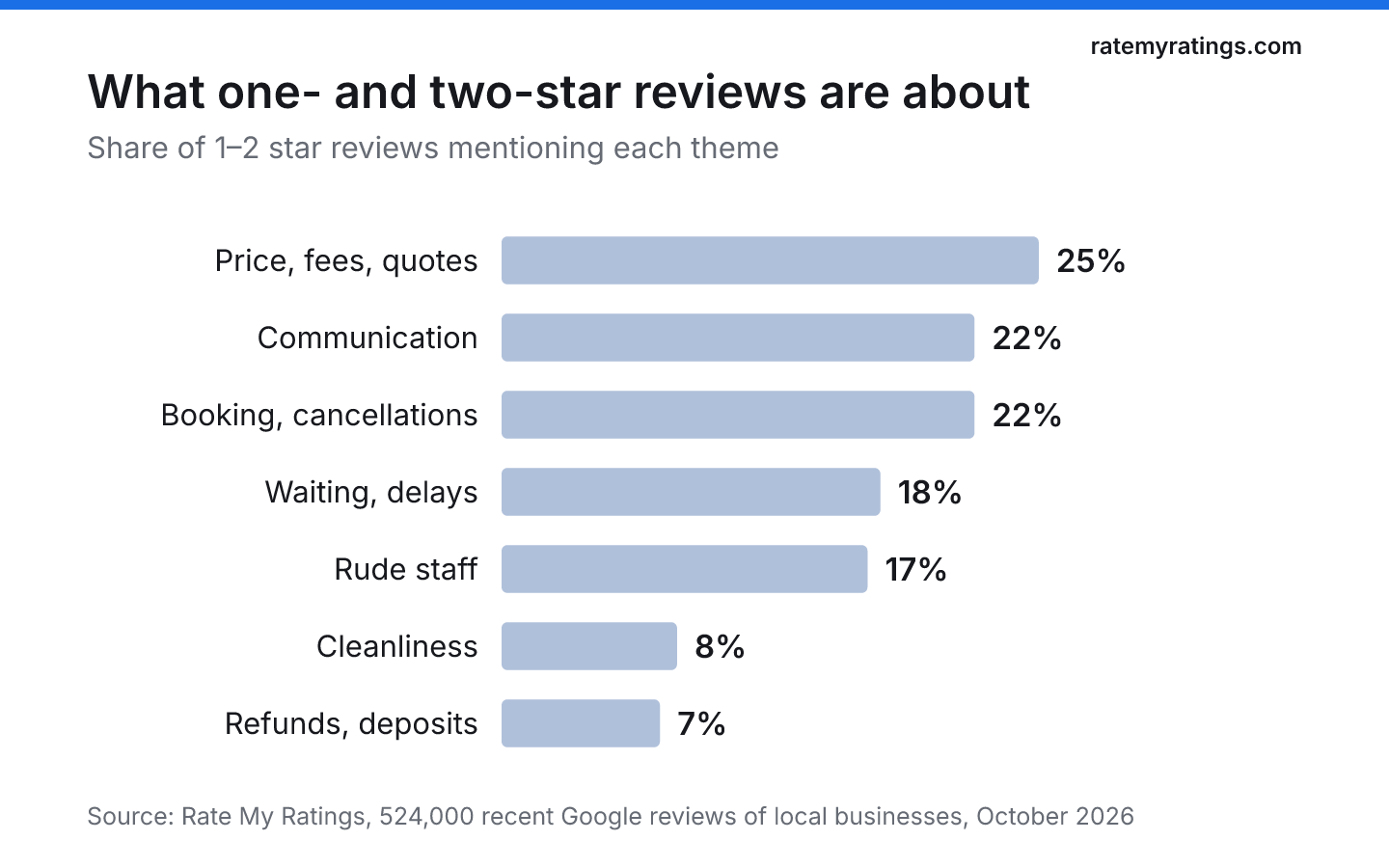
Price surprises lead at 25%, followed by communication and booking problems at 22% each, waiting at 18% and rude or unprofessional staff at 17%. Money, process and communication account for most of it. Use these themes as a starting list for your own survey, then let your customers tell you where you differ. Our guide to what customers look for in reviews goes further into what these complaints reveal.
Step 1: open questions to find pain points
Start with open questions, because a list of options can only find the pain points you already suspect. The Nielsen Norman Group's guide to open-ended questions puts it simply: open questions surface unexpected concerns, while closed questions rarely produce surprises. Use three or four of these:
- What is the most frustrating part of [getting your car serviced, planning a wedding, finding a dentist]?
- Think about the last time you [did the task]. What, if anything, went wrong?
- What takes longer than it should?
- What do you wish you had known before you started?
- Is there anything you have stopped doing, or avoid doing, because it is too much hassle?
- If you could change one thing about how [the task] works, what would it be?
Keep these questions about the task, not just about your business. Customers often feel the biggest pain before or after they deal with you, and that is where new services come from.
If you are at the very start, conversations will tell you more than a form. Our guide to questions that reveal what customers really want covers how to run them.
Step 2: closed questions to size each pain point
Once open answers (or a first round of interviews) give you a list of five to eight pain points, turn them into closed questions. Pew Research Center recommends exactly this order in its guide to writing survey questions: pilot with open questions, then build the answer options from what people actually said.
For each pain point, ask three things.
How often does it happen?
- How often does [pain point] happen to you? (never, rarely, sometimes, often, every time)
How much does it matter?
- When it happens, how much of a problem is it? (not a problem, minor, moderate, serious)
What does it cost?
- What do you usually do when it happens? (put up with it, complain, find a workaround, go elsewhere)
- Roughly how much time or money does it cost you each time?
Question 9 is the most revealing. "Go elsewhere" means you are losing customers to it. "Find a workaround" means they care enough to spend effort, which is a sign they would value a fix.
Which one matters most?
- Of these problems, which is the biggest for you? (pick one)
- Which is the second biggest?
Forcing a choice stops every pain point coming out as "moderately important". Keep the list to around five options; longer lists get skimmed.
Customer pain points questions by type
Use these to fill gaps once you know which types matter in your business.
Money
- Was the final price what you expected when you first enquired?
- At what point did you find out the full cost?
- Was anything charged that you did not expect?
Process
- How easy was it to book, change or cancel?
- How long did you wait at each stage, and was that what you expected?
- How many times did you have to contact us to get it sorted?
Communication
- Did you always know what was happening next?
- When you contacted us, how quickly did you hear back?
- Was there a point where you did not know who to ask?
Outcome
- Did the result solve the problem you came to us with?
- Is there anything you had to sort out yourself afterwards?
- What would have made the result better?
A pain point survey you can send
Help us fix what annoys you. Six questions, about three minutes.
- What is the most frustrating part of [the task], with us or anyone else?
- Think about your last visit. Did anything go wrong, or take longer than it should?
- How often do these happen to you? (never to every time, for each of: unexpected costs, waiting, hard to book or change, not being kept informed)
- Which of those is the biggest problem for you? (pick one)
- When it happens, what do you usually do? (put up with it, complain, work around it, go elsewhere)
- If you could change one thing about how we work, what would it be?
Replace the four options in question 3 with the pain points your open answers and reviews point to.
How to turn the answers into a fix list
- Group the open answers into themes. Tag each comment with one or two of: money, process, communication, outcome, plus a more specific label such as "quote changed" or "phone not answered".
- Score each pain point as frequency multiplied by severity. A problem that happens "often" and is "serious" beats one that is "serious" but rare.
- Check the cost. Move up anything where a meaningful share of customers say they go elsewhere.
- Compare with your reviews. If a pain point is high in the survey and also appears in your one- and two-star reviews, it is real and public. Fix it first.
- Tell customers what you changed. It turns a survey into a reason to come back, and it raises replies next time.
Our guide to using customer reviews to improve your business shows how to keep tracking the same themes after you fix them. To see how your pain points compare with those of competitors in your area, a Rate My Ratings report analyses every business's reviews in your market.
How this differs from a satisfaction survey
A satisfaction survey asks how well you did. A pain point survey asks what is hard, whether or not it is your fault. You need both, but they should not be the same form: mixing them makes customers rate you while listing problems, and the ratings drop for no useful reason. For the satisfaction side, see our guide to customer satisfaction survey questions, and for general survey design, our list of customer survey questions.
The short version
- Good customer pain points questions start open (what is frustrating, what went wrong) and then turn closed (how often, how serious, what it costs).
- Cover the four types: money, process, communication and outcome.
- Start from the complaints customers already make in reviews: price surprises, communication and booking lead in our data.
- Ask what customers do when it happens. "Go elsewhere" is the answer that should move a problem to the top of your list.
- Score frequency times severity, fix the top one, then tell customers you did.
Frequently asked questions
- What are examples of customer pain points?
Common examples are prices that turn out higher than quoted, long waits, difficulty booking or changing an appointment, not being kept informed and having to chase for a reply. In one- and two-star Google reviews of local businesses, price surprises appear in about a quarter, and communication and booking problems in about a fifth each.
- How do you identify customer pain points?
Read your negative reviews and complaints first, then ask open questions about the most frustrating part of the task and what went wrong last time. Once you have a list, use closed survey questions to measure how often each one happens, how serious it is and what customers do about it.
- What are the four types of customer pain points?
A practical way to group them is money (unexpected or unclear costs), process (waiting, too many steps, hard to book), communication (not kept informed, slow replies) and outcome (the result did not solve the problem). Covering all four in a survey stops you missing a whole category of frustration.
- Should pain point questions be open or closed?
Both, in that order. Open questions find pain points you did not know about. Closed questions then measure how common and serious each one is, so you can rank them. A survey that only offers a list of options can only confirm the problems you already suspected.

Rate My RatingsNewsletter
What reviews say about local markets, in your inbox.
New articles and findings from the blog, as they're published.
Check your inbox.
If this address isn't subscribed yet, we've sent it a link to confirm. Nothing is sent until you click it.
That didn't go through. Check the email address and try again.
Hold on a moment, then subscribe again.