
What Questions Matter Most in Customer Satisfaction Surveys?
Three numbers dominate customer satisfaction surveys: CSAT, Net Promoter Score and Customer Effort Score. Here is what each one measures, which to use when, and the follow-up question that makes any of them useful.
The customer satisfaction survey questions that matter most are one headline score and one open follow-up: a rating question you can track over time (CSAT, Net Promoter Score or Customer Effort Score) and "What is the main reason for your score?" The score tells you whether things are getting better or worse. The follow-up tells you why, and it is the only part you can act on.
Which score to use depends on what you want to know. This guide compares the three, gives the exact wording for each, and explains how to read the results without fooling yourself.
The three scores behind most satisfaction surveys
| Score | The question | Scale | What it measures | Best for |
|---|---|---|---|---|
| CSAT (customer satisfaction) | How satisfied were you with [the visit, the service, the order]? | 1 to 5 | How a specific experience went | A single visit, job or purchase |
| NPS (Net Promoter Score) | How likely are you to recommend us to a friend or colleague? | 0 to 10 | Overall loyalty and word of mouth | The relationship over time |
| CES (Customer Effort Score) | How easy was it to [get your problem sorted, book, return the item]? | 1 to 5 or 1 to 7 | Friction in a process | Bookings, support, complaints |
Most local businesses need one of them, not all three. Asking all three in one short survey makes customers answer the same feeling three times.
CSAT: how did this experience go?
CSAT is the simplest and the easiest to act on, because it is tied to one experience. Ask it straight after the thing you want to measure: the appointment, the delivery, the completed job.
Wording: "Overall, how satisfied were you with your visit today?" with five labelled options from very dissatisfied to very satisfied.
How to score it: the share of customers who choose the top two options (satisfied or very satisfied). That "top-two-box" figure is easier to explain than an average and less distorted by a few extreme answers.
NPS: would they put their name to you?
Net Promoter Score was introduced by Fred Reichheld of Bain & Company in a 2003 Harvard Business Review article, The One Number You Need to Grow. It asks how likely someone is to recommend you on a scale of 0 to 10.
According to Bain's own guide to calculating it, people who answer 9 or 10 are promoters, 7 or 8 are passives, and 0 to 6 are detractors. The score is the percentage of promoters minus the percentage of detractors, so it runs from -100 to +100.
NPS suits businesses where recommendation drives growth, which is most local services. A family choosing a vet, a couple choosing a wedding venue or a homeowner choosing a roofer usually asks someone first. Its weakness is that it is blunt: a 7 counts for nothing, and a small business with 40 replies will see the score jump around from month to month on a handful of answers.
CES: how hard did we make it?
Customer Effort Score comes from a 2010 Harvard Business Review article, Stop Trying to Delight Your Customers, by Matthew Dixon, Karen Freeman and Nicholas Toman. Their argument was that going above and beyond rarely wins loyalty, while making things easy does.
The original question asked how much effort the customer had to put in. Later versions ask how easy the interaction was. Jeff Sauro of MeasuringU, who has reviewed the evidence on CES, notes that it was validated on customer support interactions and that independent research found it predicted retention less well than satisfaction or NPS. Use it where it fits: measuring a process such as booking, complaints or returns, not the whole relationship.
The follow-up question that makes any score useful
A score without a reason is a thermometer reading with no diagnosis. Always follow the headline question with one open question:
- "What is the main reason for your score?"
- or, for anyone below the top score: "What would have made it a 10?" (or a 5)
The second version is especially good for the large group of customers who are happy but not delighted. In our data they are the least likely to explain themselves unprompted. Of 524,000 recent Google reviews we have collected, four-star ratings are the least likely to come with any written text (62%, against 89% for one-star ratings). Ask them directly and they will usually tell you exactly what was missing.
Customer satisfaction survey questions for the details
Once you have a score and a reason, add two or three questions about the parts of the experience you control. These are the customer satisfaction survey questions that point to specific fixes. Choose the ones that match your business:
- How satisfied were you with how quickly we responded to your enquiry?
- How clearly did we explain the cost before we started?
- Did the price match what you were expecting?
- How satisfied were you with the time you waited on the day?
- How satisfied were you with how our team treated you?
- How easy was it to book or change your appointment?
We chose these deliberately. In the one- and two-star Google reviews we have read, the most common complaints are about price surprises (25%), communication (22%), booking and cancellations (22%), waiting (18%) and rude staff (17%). Five-star reviews, by contrast, are mostly about people: 41% mention friendly or helpful staff. A satisfaction survey that asks about those areas is asking about the things that move ratings in the real world.
For broader question ideas beyond satisfaction, see our list of customer survey questions, and for digging into problems specifically, our guide to questions about customer pain points.
How to read your results without fooling yourself
Expect high scores, and look at the gaps
Satisfaction scores for local businesses bunch near the top. Across the Google ratings of 46,800 local businesses we track, the median is 4.8 stars and 74% of businesses rate 4.5 or higher. Your survey will look similar. A 4.6 average is not a triumph; it may be ordinary for your trade.
What counts as good also depends on the category. Physiotherapists and aesthetics clinics in our data are almost all rated 4.5 or above, while fewer than half of restaurants are.
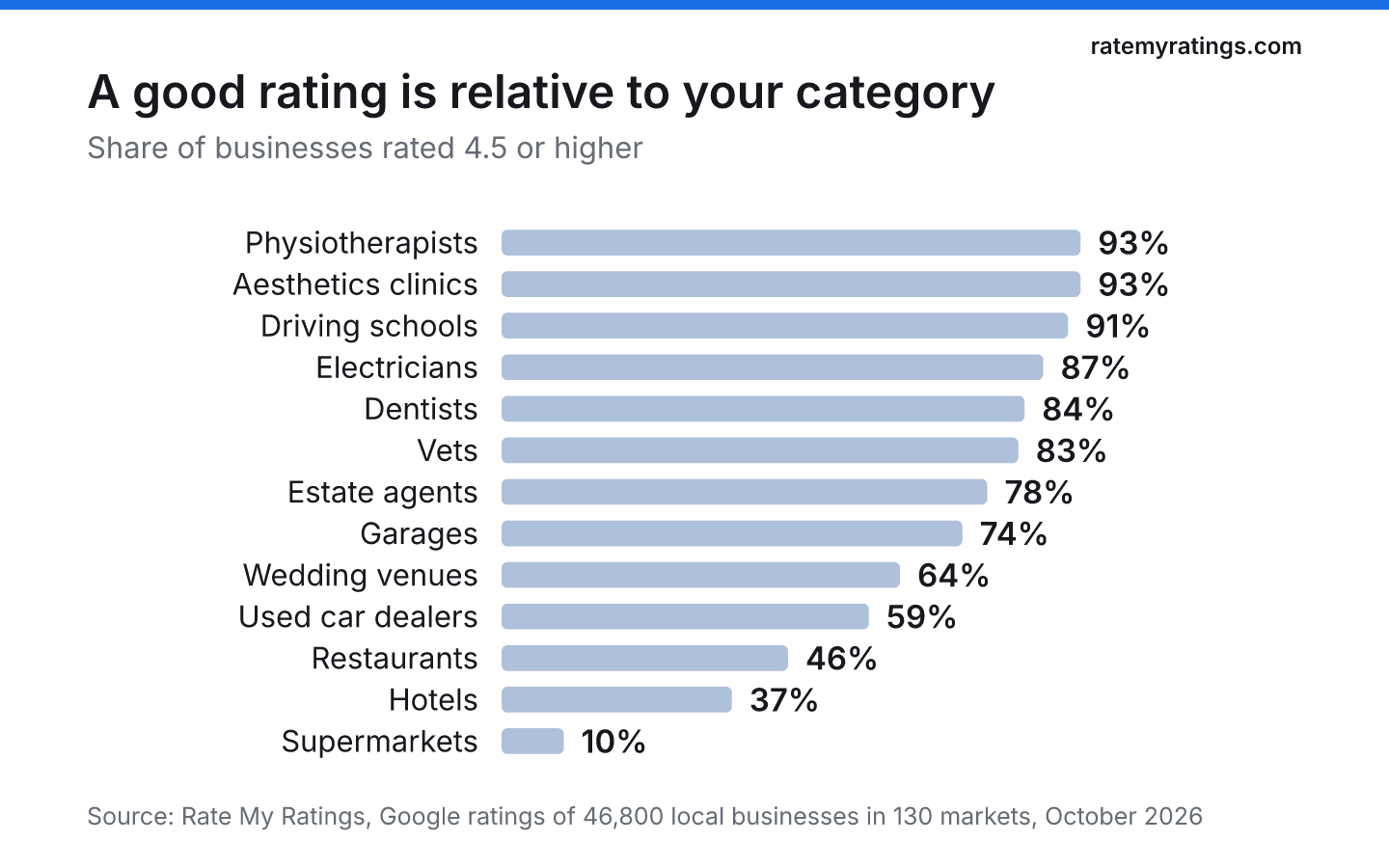
So benchmark against your own past results first, and against your category second. Generic "industry average" figures from survey software vendors mix very different businesses and rarely mean much for a single practice or shop.
Watch the trend, not the number
A single month's score is noisy, especially with fewer than 100 replies. Track a rolling three-month figure and look for movement after you change something.
Read every low score
With a small business's volumes you can read every detractor and every dissatisfied comment. Do it. Group them by theme (price, waiting, communication, staff) and count. The theme that appears most is your next fix.
Compare with your reviews
Your survey and your public reviews should tell roughly the same story. If your survey says customers are delighted with communication but your Google reviews complain about unanswered calls, one of them is reaching a different group of customers. Usually the survey is only going to the people who were easy to reach. Our guide to using customer reviews to improve your business shows how to read reviews alongside survey results, and a Rate My Ratings report does the same across your whole local market.
A satisfaction survey you can copy
- Overall, how satisfied were you with [your visit / our service]? (very dissatisfied to very satisfied)
- What is the main reason for your answer?
- How easy was it to book with us? (very difficult to very easy)
- Did the final price match what you expected? (yes / no, and if not, why?)
- How likely are you to recommend us to a friend or colleague? (0 to 10)
That is CSAT, its reason, one effort question, one question on the most common complaint we see in reviews, and NPS for the long-term trend. It takes about two minutes.
The short version
- The customer satisfaction survey questions that matter most are one score and one open "why".
- Use CSAT for a single experience, NPS for loyalty over time and CES for a specific process such as booking or complaints.
- Add two or three questions about the things customers actually complain about: price surprises, communication, booking and waiting.
- Expect high scores, compare against your own trend and your category, and read every low score.
- If you want to understand what customers want rather than how satisfied they are, a survey is the wrong tool: see questions that reveal what customers really want.
Frequently asked questions
- What is the difference between CSAT and NPS?
CSAT asks how satisfied a customer was with a specific experience, usually on a 1 to 5 scale, and is best measured straight after that experience. NPS asks how likely they are to recommend you on a 0 to 10 scale and measures the overall relationship. CSAT tells you how a visit went; NPS tells you whether customers would vouch for you.
- What is a good customer satisfaction score?
It depends on your category and how you calculate it. Local businesses tend to score high: the median Google rating across the 46,800 businesses we track is 4.8 stars. Compare your score with your own previous months first and with similar businesses second, and pay more attention to the reasons behind low scores than to the average.
- How do you calculate Net Promoter Score?
Ask customers how likely they are to recommend you on a scale of 0 to 10. Count those who answer 9 or 10 as promoters and those who answer 0 to 6 as detractors. Subtract the percentage of detractors from the percentage of promoters. Passives, who answer 7 or 8, count towards the total but not the score.
- Should a satisfaction survey use CSAT, NPS and CES together?
Usually not. In a short survey, asking all three makes customers rate the same feeling several times and adds little. Pick the one that fits your question: CSAT for an experience, NPS for loyalty, CES for a process. Then spend the remaining questions on the reason for the score and the specific things you can change.

Rate My RatingsNewsletter
What reviews say about local markets, in your inbox.
New articles and findings from the blog, as they're published.
Check your inbox.
If this address isn't subscribed yet, we've sent it a link to confirm. Nothing is sent until you click it.
That didn't go through. Check the email address and try again.
Hold on a moment, then subscribe again.