What Questions Should You Ask Customers in Surveys?
Good customer survey questions start from a decision you need to make. Here are the questions worth asking, how to word them so the answers mean something, and a short survey you can send this week.

The best customer survey questions are short, ask about one thing at a time and are tied to a decision you are actually going to make. For most small businesses that means five to ten questions: one or two ratings to measure, one open question to explain the rating, and a few specific questions about the part of the business you are thinking of changing. Everything else is noise that lowers your response rate.
This guide groups the customer survey questions worth asking by what they help you decide, shows how to word them so the answers can be trusted, and ends with a five-question survey you can copy.
Start with the decision, not the questions
Most surveys go wrong before the first question is written. Someone decides "we should survey our customers", opens a form builder and starts typing whatever they are curious about. The result is twenty questions, a handful of replies and a spreadsheet nobody acts on.
Turn it round. Write down the decision first, in one sentence:
- "Should we open on Saturdays?"
- "Is our pricing stopping people from booking a second appointment?"
- "Why do new customers come once and not return?"
Then ask only the questions whose answers would change that decision. If you cannot say what you would do differently depending on the answer, cut the question.
The customer survey questions worth asking
Below are the questions we would start from, grouped by what they tell you. Pick the group that matches your decision, take three or four questions from it, and add the one open question at the end of this list.
How customers found you and chose you
- How did you first hear about us?
- What were you looking for when you found us?
- Which other businesses did you consider?
- What made you choose us over them?
- Was there anything that nearly put you off booking or buying?
The last question is the most useful one here. It surfaces friction (a confusing website, a price you only learnt about late, a phone nobody answered) that customers who went elsewhere never tell you about.
The experience itself
- How easy was it to book, order or get hold of us? (very difficult to very easy)
- How would you rate [the specific thing: the treatment, the delivery, the food]?
- Did anything happen that you did not expect?
- Was the price what you expected when you arrived?
- If you could change one thing about your visit, what would it be?
Notice that question 7 names a specific part of the experience. "How was everything?" produces polite, empty answers. "How would you rate the explanation the vet gave you about the treatment?" produces something you can improve.
Loyalty and word of mouth
- How likely are you to use us again?
- How likely are you to recommend us to a friend or colleague? (0 to 10)
- What would make you more likely to come back?
Question 12 is the Net Promoter Score question. If you want to track satisfaction as a number over time, our guide to customer satisfaction survey questions explains when to use NPS, CSAT or effort scores, and which one fits a local business.
Products, services and gaps
- Which of our services have you used?
- Is there anything you wanted that we do not offer?
- Which of these would you be most interested in? (a short list of options you are genuinely considering)
- How often do you need [the service]?
About the customer (always last)
- Which area do you live in?
- Roughly how old are you? (bands, optional)
- Is this your first visit?
Keep demographic questions to the end and make them optional. Asked first, they feel intrusive and people abandon the survey before reaching the questions you care about.
The one open question every survey needs
- Is there anything else you would like to tell us?
It looks lazy. It is the question that most often produces the answer you did not think to ask about.
How to word customer survey questions so the answers mean something
The wording of a question changes the answer, sometimes dramatically. Pew Research Center, whose whole business is asking questions, publishes the rules it follows in its guide to writing survey questions. The ones that matter most for a small business survey:
- Ask about one thing at a time. "How satisfied were you with our staff and prices?" is two questions. A customer who loved the staff and hated the price has no honest answer. Split it.
- Avoid agree or disagree statements. People tend to agree with whatever is put to them, which Pew calls acquiescence bias. "The booking process was easy. Agree or disagree?" flatters you. "How easy or difficult was it to book?" does not.
- Open questions get different answers from closed ones. In one Pew poll, 58% chose the economy as the top issue when it appeared in a list, but only 35% named it unprompted. A list of options puts ideas in people's heads. Use open questions to discover, closed ones to count.
- Keep lists short. Pew suggests around four or five options for closed questions. Long lists get skimmed and the first options win.
- Mind the order. Earlier questions colour later ones. Ask the overall rating before the detailed questions, or the details will drag the overall score towards whatever was asked last.
Two more rules from our side. Never lead ("How much did you enjoy...?" assumes they did), and never offer an incentive that depends on a positive answer. A prize draw for everyone who replies is fine; a discount for a good score makes the whole survey worthless.
How many questions, and when to send them
Five to ten questions is the right length for almost every local business survey. Every extra question costs you replies, and customers answering on a phone between other things will abandon a long form.
Send it while the experience is fresh, ideally within a day or two. For a service with a natural end point (a completed job, a discharged pet, a delivered order), send it then. For a regular service such as a gym or a clinic, a short survey every few months works better than one after every visit.
If you are choosing a tool to send it with, we compare the options in the best platforms to collect customer feedback.
The answers you already have: reviews
Before you survey anyone, read what customers have already written without being asked. Online reviews are an unprompted survey with one rating question and one open question, and there are usually far more of them than you would ever get survey replies.
They also show the limits of a rating on its own. In the 524,000 recent Google reviews we have collected across local markets in the UK and Australia, 17% are a star rating with no text at all. Four-star ratings are the least likely to come with an explanation: only 62% include any words, against 89% of one-star ratings.
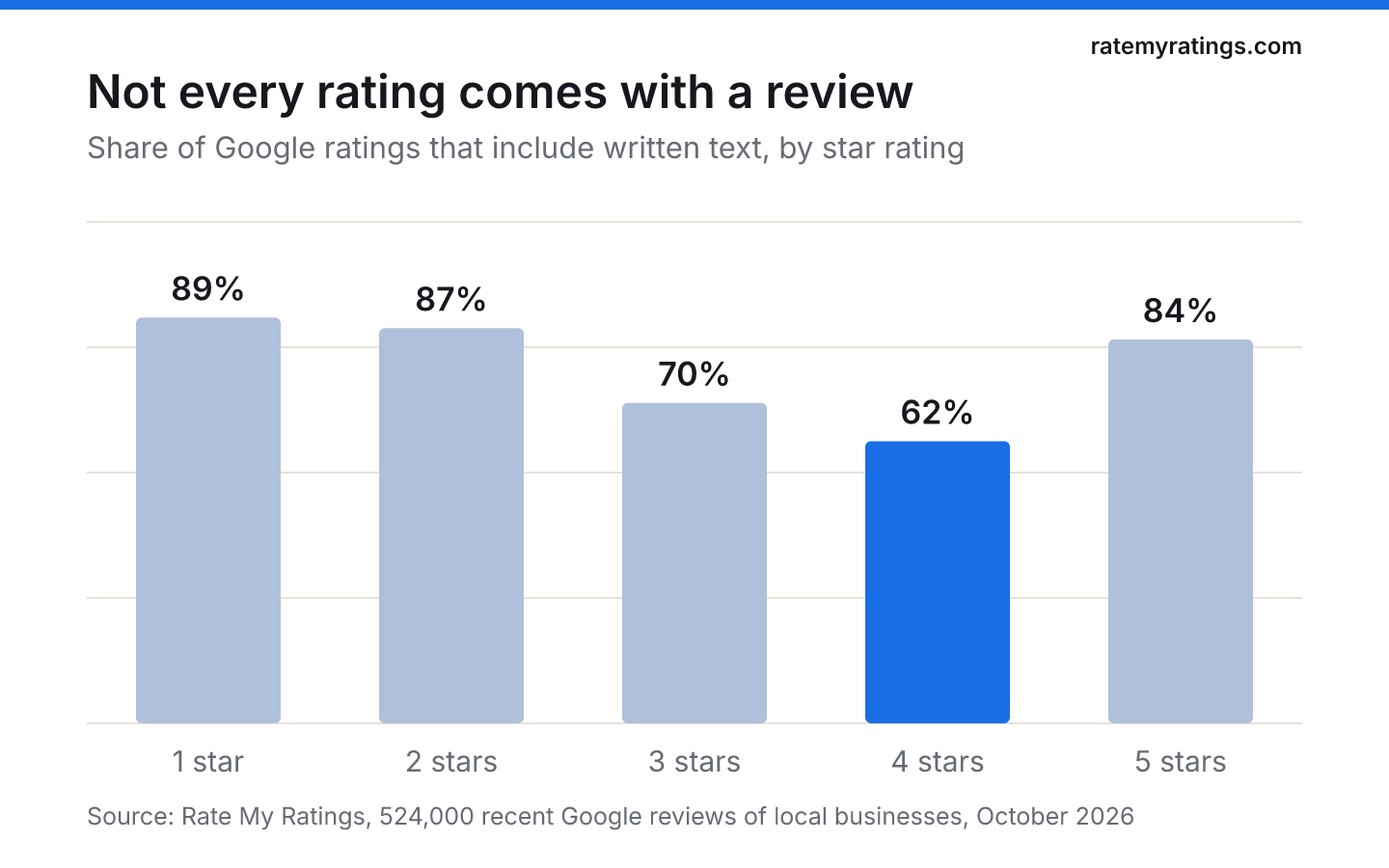
That is exactly the gap a survey can fill. Your four-star customers are satisfied but not delighted, and they rarely say why. A survey that asks "What would have made this a five?" reaches the group with the most to tell you and the least inclination to volunteer it.
Reviews of your competitors are just as useful. They tell you what customers in your area praise and complain about across the whole market, which helps you decide what to ask. Our guide to competitor analysis using Google reviews shows how to do this, and a Rate My Ratings market report reads every competitor's reviews for you.
A five-question survey you can send this week
Copy this, replace the brackets, and send it to your last fifty customers:
Thanks for choosing [business name]. Five quick questions, about two minutes.
- How would you rate your overall experience? (1 to 5)
- What is the main reason for your rating?
- How easy was it to book with us? (very difficult to very easy)
- If you could change one thing about your visit, what would it be?
- How likely are you to use us again? (very unlikely to very likely)
Question 1 gives you a number to track. Question 2 explains it. Questions 3 and 4 point at things you can fix. Question 5 tells you whether the fixes are worth making.
Common mistakes
- Asking what you will not act on. If you will never change your opening hours, do not ask about them.
- Surveying only happy customers. If the survey only goes to people who left a good review or bought again, you are measuring the people who already like you.
- Never closing the loop. Tell customers what you changed because of their answers. It is the single best way to get replies to the next survey.
- Treating a survey as research into the market. A survey of your customers tells you about your customers. It does not tell you why people choose a competitor. We explain the difference in market research vs customer surveys.
If you want to dig deeper than a survey can, conversations work better. Our guides to questions that reveal what customers really want and survey questions about customer pain points cover the follow-up.
The short version
- Write the decision down first, then ask only the customer survey questions that would change it.
- Keep it to five to ten questions: a rating, an open "why", and a few specific questions.
- Ask about one thing at a time, avoid agree or disagree statements, keep option lists to four or five, and put demographics last.
- Send it within a day or two of the experience, and never tie a reward to a positive answer.
- Read your reviews and your competitors' reviews first: they are the survey your market has already filled in.
Frequently asked questions
- How many questions should a customer survey have?
Five to ten is right for most small businesses. That is enough for an overall rating, an open question asking why, and a few specific questions about the decision you are making. Every extra question lowers the number of people who finish, especially on a phone, so cut anything whose answer would not change what you do.
- What is the most important question to ask customers?
An open question asking why they gave their rating. A score tells you whether something is wrong; only the customer's own words tell you what. If you can ask just one more question, ask what single thing they would change, which turns vague satisfaction into something you can fix.
- Should I offer an incentive for completing a survey?
A small incentive for everyone who completes it, such as entry into a prize draw, can raise response rates and is generally fine. Never make a reward depend on a positive answer or a good review. That biases every reply, and for online reviews Google's policies prohibit incentives altogether.
- When is the best time to send a customer survey?
Within a day or two of the experience, while customers still remember the details. For one-off services send it when the job is finished. For ongoing services such as a gym, clinic or subscription, a short survey every few months works better than asking after every visit.

Rate My RatingsNewsletter
What reviews say about local markets, in your inbox.
New articles and findings from the blog, as they're published.
Check your inbox.
If this address isn't subscribed yet, we've sent it a link to confirm. Nothing is sent until you click it.
That didn't go through. Check the email address and try again.
Hold on a moment, then subscribe again.