
Is Net Promoter Score Useful for a Small Business?
Net Promoter Score is useful for a small business only as a slow trend with a follow-up question. With 30 replies it can swing by 28 points by chance. How to calculate it, read it and know when to ask something simpler.

Net Promoter Score is useful for a small business as a slow-moving trend with a "why" question attached, and of little use as a monthly number to chase. With 30 replies, a score of 30 could really sit anywhere between about 2 and 58, so most of the movement a small business sees from one month to the next is chance.
This guide explains where the score comes from, how to calculate it with a worked example, how far small samples swing it, why it is not the same thing as your Google rating, and when a simpler question does the job better. For how NPS compares with CSAT and Customer Effort Score, with the wording of each, see our guide to customer satisfaction survey questions.
What is Net Promoter Score?
Net Promoter Score (NPS) is built on one question: "How likely are you to recommend us to a friend or colleague?", answered on a scale from 0 to 10. Fred Reichheld of Bain & Company introduced it in a December 2003 Harvard Business Review article, The One Number You Need to Grow. The name is a service mark of Bain & Company, NICE Systems and Reichheld, but anyone can ask the question.
Bain's own guide to measuring it sorts every answer into one of three groups:
| Group | Score given | How to read the group |
|---|---|---|
| Promoters | 9 or 10 | Enthusiastic: likely to recommend you and come back |
| Passives | 7 or 8 | Satisfied but not attached; a better offer could move them |
| Detractors | 0 to 6 | Unhappy enough that they may leave or put others off |
The score is the percentage of promoters minus the percentage of detractors, so it runs from -100 (everyone a detractor) to +100 (everyone a promoter). Passives count towards the total number of replies but add nothing to either side.
How to calculate Net Promoter Score: a worked example
Take a physiotherapy clinic that emails the question to 240 patients after their final session in a quarter and gets 80 replies.
- Count the replies. There are 80 in total.
- Work out the share of promoters. 44 patients answered 9 or 10: 44 divided by 80 is 55%.
- Work out the share of detractors. 12 answered 0 to 6: 12 divided by 80 is 15%.
- Subtract. 55 minus 15 gives a score of 40. Write it as 40, not 40%.
The other 24 patients were passives, and they matter more than the arithmetic suggests. If eight of them had been promoters instead, the score would have been 50; if eight had been detractors, it would have been 30. With 80 replies, each patient who moves one group up or down shifts the score by 1.25 points.
Why a small sample makes NPS swing
Because NPS is built from two percentages, its margin of error is wider than most owners expect. Using the standard calculation for a 95% confidence interval, a business whose replies are half promoters and a fifth detractors (a score of 30) has a margin of error of about 28 points with 30 replies, 15 points with 100 and 9 points with 300.
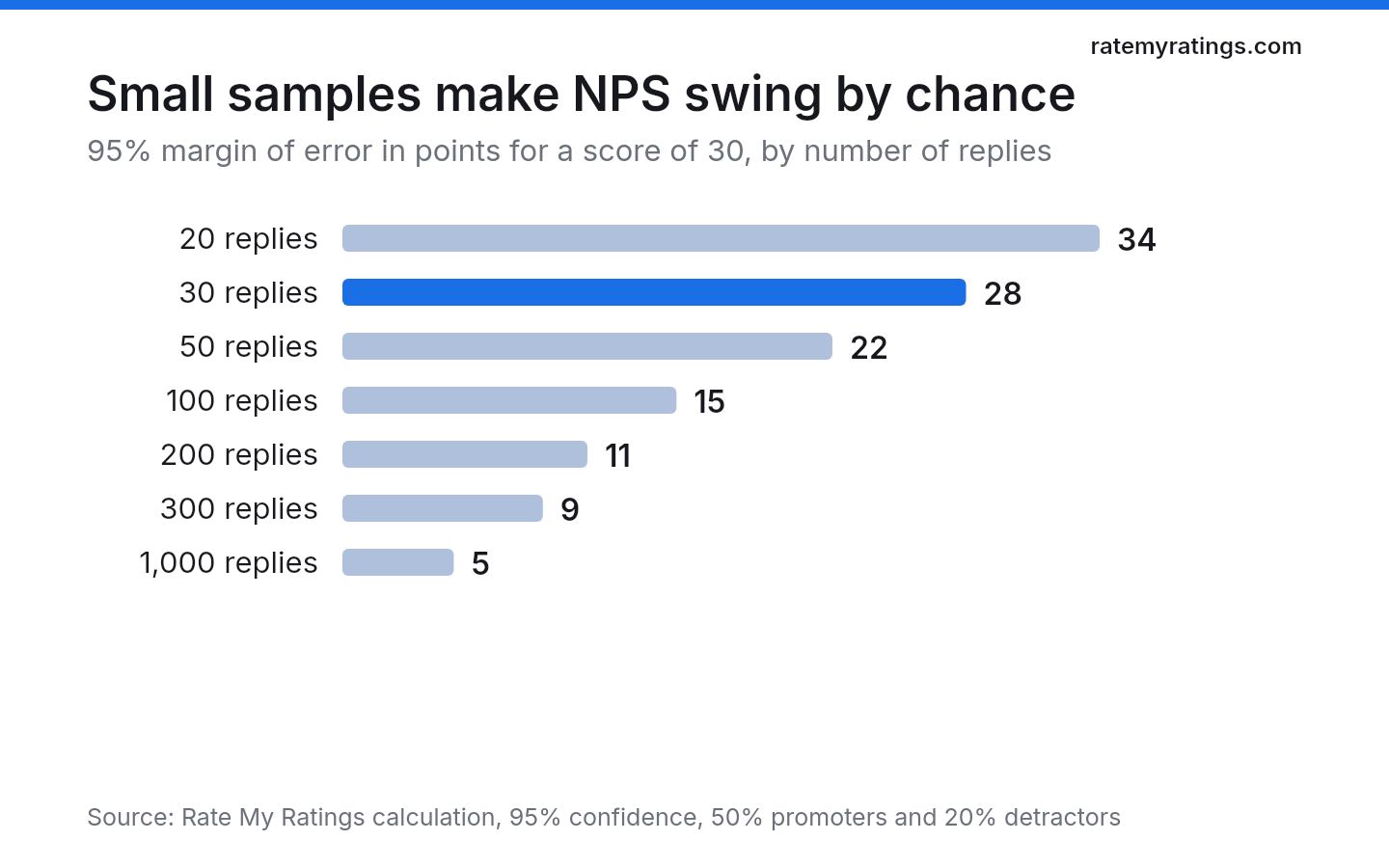
In plain terms, a score of 30 from 30 replies says the true figure is probably somewhere between 2 and 58. UK research firm TLF Research compares four ways of calculating this margin and finds they give very similar results once you have more than 100 responses. Below that, the more careful methods help, but none of them makes a small sample precise.
For the clinic, 80 replies gives a margin of about 16 points. If next quarter's score is 34, nothing has necessarily changed. Three habits keep you honest:
- Show the number of replies beside every score, so nobody reads 40 from 25 replies as if it came from 400.
- Use a rolling figure. Combine the last three or 12 months of replies rather than reporting each month on its own.
- Treat moves smaller than the margin as no change until they hold for several periods.
The "why" question matters more than the score
The score tells you whether things are drifting; only the reasons tell you what to do. Follow the 0 to 10 question with one open question, "What is the main reason for your score?", then sort the answers into themes and count them, as described in our guide to analysing open-ended survey responses.
Expect detractors to say the most. In the 524,000 recent Google reviews we have collected across 130 local markets in the UK and Australia, the median one-star review with text runs to 74 words and the median five-star review to 27. Four-star customers, the nearest thing reviews have to passives, write least of all. So ask passives directly: "What would have made it a 9 or 10?" They are the group most likely to drift to a competitor and least likely to tell you why.
With a small business's volumes you can read every detractor's comment yourself and ring the ones who left contact details. A call within a few days that says "we read this, and here is what we are changing" does more for that customer than any score.
Net Promoter Score is not your Google rating
It is tempting to convert one into the other. Do not: they measure different people in different ways.
- Who answers. Your Google rating averages the reviews of whoever chose to write one. Your NPS comes from a survey you send to a group you define, such as every customer last quarter.
- How answers count. A Google rating is an average, so a four and a five both lift it. NPS ignores 7s and 8s entirely and treats a 6 the same as a 0.
- How skewed they are. Public reviews lean heavily positive: 87% of the 524,000 recent reviews in our data are five-star and 5% are one-star.
A business rated 4.8 on Google can have an ordinary NPS, and that is not a contradiction. The two numbers answer different questions.
One rule links them. Never use NPS answers to decide who gets your Google review link. Google's prohibited and restricted content policy bans businesses from discouraging negative reviews or selectively asking for positive ones, and sending the link only to promoters is exactly that, a practice known as review gating. Ask everyone.
Does a high Net Promoter Score predict growth?
Less reliably than its early champions claimed. Reichheld's 2003 article argued that the recommend question tracked company growth better than other loyalty measures. A 2007 study in the Journal of Marketing by Timothy Keiningham and colleagues, using data on 21 firms and more than 15,500 interviews from the Norwegian Customer Satisfaction Barometer, failed to replicate that claimed superiority.
The method's own authors have also warned about misuse. In a 2021 Harvard Business Review article, Net Promoter 3.0, Reichheld and two Bain partners wrote that inexperienced practitioners had linked scores to bonuses for frontline staff, which pushed people to focus on the score rather than on customers. For a small business the lesson is simple: never tie anyone's pay to the score, never tell customers what a 10 means to you, and never hold back the survey from customers you expect to be unhappy.
Published averages by industry exist, mostly from survey software vendors, but they mix countries, business sizes and ways of collecting answers. Your own score last year, measured the same way, is a better benchmark than anyone else's.
When to use NPS, and when a simpler question works better
| Your situation | What to use |
|---|---|
| 100 or more replies a quarter, and most new customers come by recommendation | NPS as a quarterly or rolling trend, with the "why" question |
| A few dozen customers a month | Read every comment; ask "What is one thing we could do better?" |
| You want to judge one visit or job | A satisfaction (CSAT) question straight after it |
| You want to fix one process, such as booking | "How easy was it to book with us?" |
| You want to know why people choose a competitor | Market research, because your survey only reaches people who chose you |
The last row is the blind spot of every customer survey, explained in market research vs customer surveys. For other questions worth asking, see our list of customer survey questions and the questions that reveal what customers really want. Our guide to customer feedback platforms covers tools that send and score surveys for you.
Your survey only hears from your own customers. A Rate My Ratings market report adds the rest of the market: each competitor's Google rating, review count and share of positive reviews in your category and area, and the themes customers praise and complain about across it.
The short version
- Net Promoter Score is the share of customers scoring you 9 or 10 minus the share scoring 0 to 6, on a scale from -100 to +100.
- With 30 replies it can swing by about 28 points by chance. Show the number of replies beside it and track a rolling figure.
- The follow-up "why" question is where the value is: read every detractor's comment and ask passives what would make it a 10.
- Do not convert it to or from your Google rating, and never use it to choose who gets a review link.
- With only a few dozen customers a month, one open question often tells you more than the score.
Frequently asked questions
- How do you calculate Net Promoter Score?
Ask customers how likely they are to recommend you on a scale from 0 to 10. Work out the percentage who answered 9 or 10 (promoters) and the percentage who answered 0 to 6 (detractors), then subtract the second from the first. With 55% promoters and 15% detractors the score is 40. It is written as a number between -100 and +100, not a percentage.
- What is a good NPS score for a small business?
There is no reliable universal benchmark. Published averages come mostly from survey software vendors and mix industries, countries and ways of collecting answers. A score above zero means you have more promoters than detractors. The most useful comparison is your own score over time, measured the same way, with the number of replies shown beside it.
- How many responses do you need for a reliable NPS?
More than most small businesses get in a month. For a score of 30, the 95% margin of error is about 28 points with 30 replies, about 15 points with 100 and about 9 points with 300. If you get fewer than 100 replies a quarter, report a rolling 12-month score and treat small movements as noise.
- Can you convert a Google star rating into an NPS?
No. A Google rating is the average of reviews from whoever chose to leave one, and public reviews lean heavily positive: 87% of recent Google reviews in our data are five-star. NPS comes from a survey of customers you choose, ignores 7s and 8s, and treats a 6 the same as a 0. The two numbers measure different things.

Rate My RatingsNewsletter
What reviews say about local markets, in your inbox.
New articles and findings from the blog, as they're published.
Check your inbox.
If this address isn't subscribed yet, we've sent it a link to confirm. Nothing is sent until you click it.
That didn't go through. Check the email address and try again.
Hold on a moment, then subscribe again.