
What's the Difference Between Market Research and Customer Surveys?
A customer survey asks the people who already chose you. Market research looks at everyone you could serve, including the people who chose someone else. What each one is for, and how to use them together.

The difference in market research vs customer surveys comes down to who you are learning about. A customer survey asks the people who already buy from you how they feel about you. Market research studies the whole market you operate in: the people who could buy from you, the competitors they choose instead, and how big and healthy the demand is. A customer survey is one tool that market research can use, but it only ever sees the people who already said yes.
That matters because many of the most important decisions a business makes (where to open, what to charge, which service to add, why growth has stalled) depend on the people who are not your customers.
Market research vs customer surveys at a glance
| Customer survey | Market research | |
|---|---|---|
| Who it covers | Your existing customers | Your whole market: customers, non-customers and competitors |
| Main question | How are we doing for the people who chose us? | What does the market want, and where do we stand in it? |
| Typical methods | Online or in-person questionnaire after a purchase | Surveys of the public, interviews, competitor analysis, published statistics, review analysis, search data |
| Good for | Improving service, tracking satisfaction, spotting problems | Entering a market, pricing, positioning, new services, explaining lost share |
| Blind spot | Cannot see why people chose a competitor | Broader and slower, and usually less detailed about your own customers |
| Cost and time | Low; days | Low to high; days to months |
What a customer survey is for
A customer survey is a questionnaire sent to people who have used your business, usually soon after a visit or purchase. It is cheap, quick and direct, and it is the right tool for:
- measuring satisfaction over time (see our guide to customer satisfaction survey questions)
- finding out which parts of the experience frustrate people (see customer pain points questions)
- testing interest in a change among people who already know you
- learning how customers found you
Its limit is built in. Everyone it reaches already chose you. People who looked at your website and booked elsewhere, who visited once and never returned without saying why, or who never considered you at all are invisible to it. This is survivorship bias: a survey of current customers describes the people your business already suits.
For the questions themselves, our guide to customer survey questions covers what to ask and how to word it.
What market research is for
Market research looks outward. It asks how big the demand is, who the competitors are, what customers across the market value and complain about, and where there is room for a business like yours. It draws on two kinds of evidence.
Primary research
Information you collect yourself for your own question: surveys of the general public in your area (not just your customers), interviews, mystery shopping and observation. Done properly this is real work, which is why professional researchers follow codes such as the Market Research Society's Code of Conduct, including being transparent about how a sample was chosen before calling it representative.
Secondary research
Information that already exists: official statistics, industry reports, search data and public reviews. For a local business, some of the most useful sources are free:
- Business counts. The Office for National Statistics publishes counts of UK businesses by industry, size and location, and the Australian Bureau of Statistics publishes counts of Australian businesses with entries and exits by industry and region. Together with local population figures, these show how crowded your category is.
- Search demand. Google's Keyword Planner and Google Trends show what people search for and how interest changes over time. We explain how to use them in how to research market demand for your business idea.
- Public reviews. Every business in your area has a public record of what its customers liked and disliked. Read across the whole market, that is the closest thing a local business has to a survey of every customer in the category, including your competitors' customers.
Why the whole market changes the answer
Here is a simple example of why the two give different answers. Suppose your customer survey says people rate you 4.6 out of 5. On its own, that sounds excellent.
Market research adds the context. Across the Google ratings of 46,800 local businesses we track in 130 markets in the UK and Australia, the median rating is 4.8, and 74% of businesses are rated 4.5 or higher. In most categories, a 4.6 is middle of the pack.
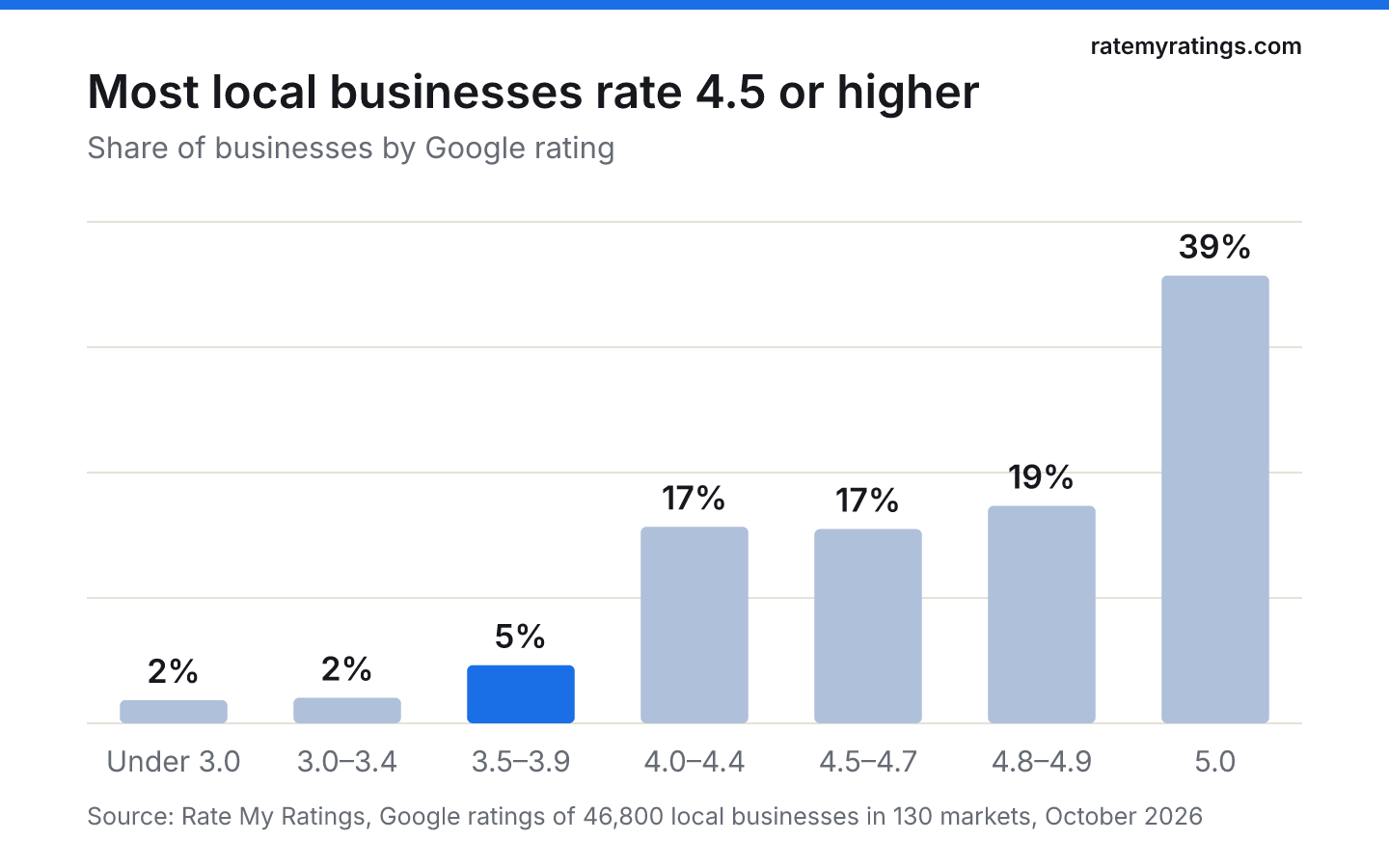
The survey told you customers are happy. The market view tells you that being happy is what customers expect, and that standing out takes more. Neither is wrong; they answer different questions.
Which one does your decision need?
| Decision | Use |
|---|---|
| Are customers happy with the service? | Customer survey |
| Which part of the visit annoys people most? | Customer survey, plus your own reviews |
| Should we open a second site in a nearby town? | Market research |
| Can we raise prices? | Both: market research for competitor prices and positioning, a survey for how your customers see your value |
| Why are enquiries down this year? | Market research first (demand, new competitors), then a survey |
| Should we add a new service? | Market research for demand, interviews and a survey for interest among your customers |
| Why do people choose the practice down the road? | Market research. Your customers cannot tell you. |
For questions about new products and services, combine the two. Our guide to researching customer needs before launching a product shows how.
Using reviews as market research
For local service businesses, the gap between a customer survey and full market research used to be large: you could survey your own customers cheaply, but understanding competitors' customers meant expensive fieldwork. Public reviews have narrowed it.
Read the reviews of every competitor in your area and you learn what customers across the market praise and complain about, which competitors are strong on what, and which complaints nobody is fixing. Our guide to competitor analysis using Google reviews shows how to do it by hand. It is also exactly what a Rate My Ratings report does: it reads every review of every business in a category and area, so a single practice or shop can see its market the way a chain's research team would. You can see how we do it on our methodology page.
How to use both together
- Start with the market. Read competitors' reviews, check search demand and look at how many similar businesses operate nearby. This tells you what questions are worth asking.
- Interview a handful of people, including some who are not your customers. Our guide to questions to ask customers covers how.
- Survey your customers on the specific issues the first two steps raised.
- Compare. Where your survey and the market view disagree, the market view usually explains why.
Three mistakes to avoid
Treating your customers as the market. "Our customers say they would not pay more" is a finding about the people your current price attracted. It says little about the customers who would choose a premium option if you offered one.
Mixing research with selling. A questionnaire that ends with a discount code or a sales call is marketing, and customers can tell. Answers given to a sales pitch are less candid than answers given to a genuine question. Keep the two apart.
Paying for research before reading the free evidence. Business counts, search trends and competitors' reviews cost nothing and often answer the question outright. Commission primary research for what they cannot tell you, not as the first step.
The short version
- In market research vs customer surveys, the difference is who you learn about: your existing customers, or the whole market including non-customers and competitors.
- Customer surveys are cheap and quick, and they are the right tool for improving the experience of people who already chose you.
- Market research is the right tool for decisions about growth, pricing, location and positioning, because those depend on people who are not yet your customers.
- A survey score means little without market context: across 46,800 local businesses the median Google rating is 4.8.
- Public reviews of every business in your area are the cheapest market research a local business has.
Frequently asked questions
- Is a customer survey a type of market research?
Yes, a customer survey is one method of primary research, but on its own it is narrow market research. It only covers people who already chose you, so it cannot explain why others chose a competitor or how big the wider demand is. Market research usually combines surveys with competitor analysis, published statistics and other sources.
- What is the main difference between market research and a customer survey?
Who it covers. A customer survey asks your existing customers about their experience with you. Market research studies the whole market: potential customers, competitors, demand and trends. Surveys help you improve what you already do; market research helps you decide where to compete and how.
- What is the cheapest way for a small business to do market research?
Start with free secondary sources: official business counts from the ONS or ABS, Google Trends and Keyword Planner for search demand, and the public reviews of every competitor in your area. Reviews in particular show what customers across your whole market value and complain about, without running any fieldwork.
- What is the difference between primary and secondary research?
Primary research is information you collect yourself for your own question, such as surveys, interviews or mystery shopping. Secondary research uses information that already exists, such as official statistics, industry reports, search data and public reviews. Most small businesses should start with secondary research and use primary research to fill the gaps.

Rate My RatingsNewsletter
What reviews say about local markets, in your inbox.
New articles and findings from the blog, as they're published.
Check your inbox.
If this address isn't subscribed yet, we've sent it a link to confirm. Nothing is sent until you click it.
That didn't go through. Check the email address and try again.
Hold on a moment, then subscribe again.